


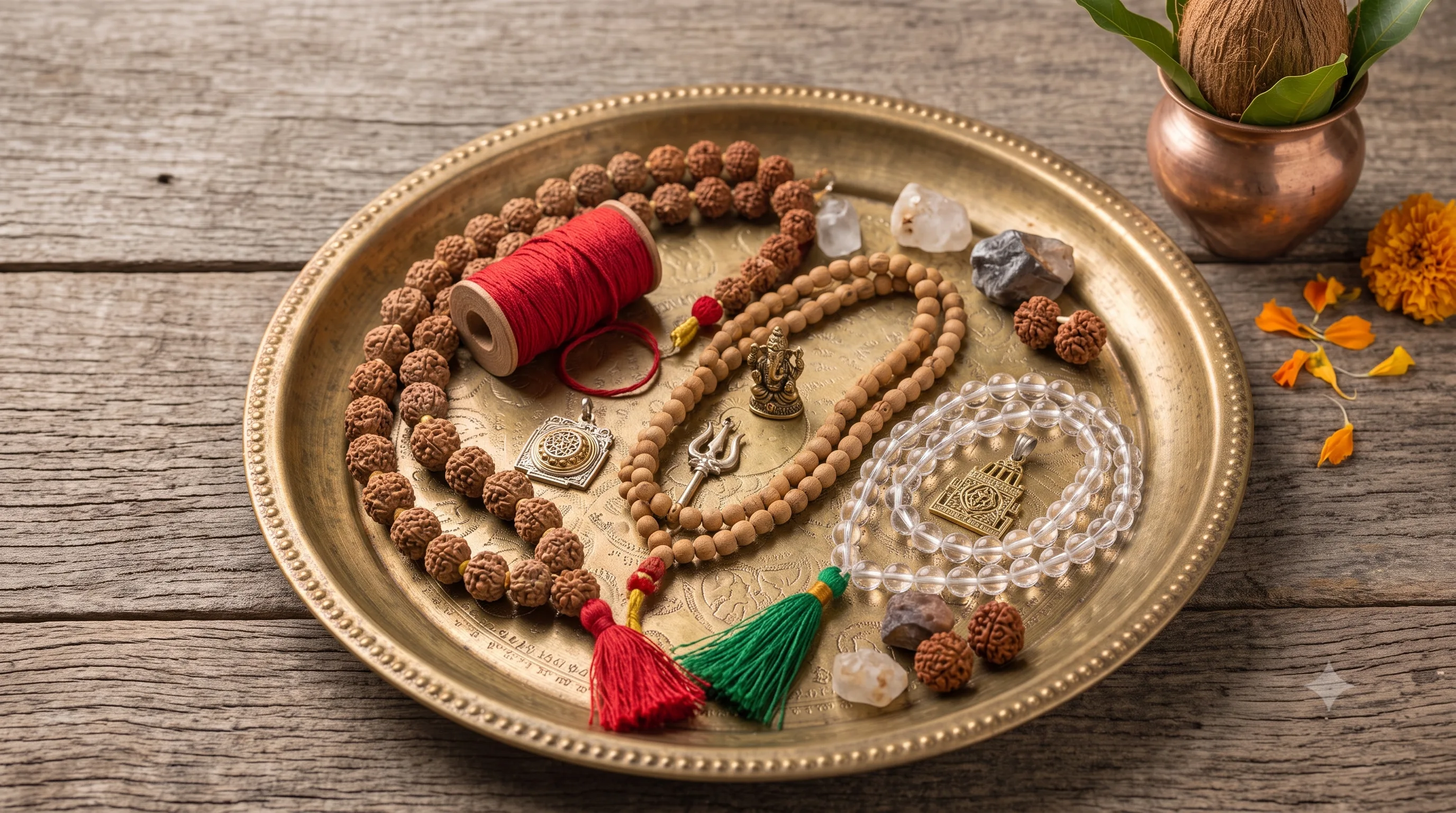
Some sacred items are worn close to the body for a lifetime of devotion, others reserved for the deity alone. This guide covers the twelve reusable items in Avyani's Master Samagri Catalogue — malas, ornaments, gem sets and yantras — and what to look for in each.
Almost everything else in the Samagri Catalogue is offered once and set aside. These twelve items are the exception: they are kept, worn, reused and often inherited, and a few of them are personal in a way no flower or powder is.
Where this guide says tradition or regional practice, the custom is real and widely followed but has no single scriptural locator; where it says practical guidance, it is Avyani's own advice on choosing and keeping these things.
Malas for Japa
The rudraksha mala (रुद्राक्ष माला) and the tulsi mala (तुलसी माला) are the two counting strings of Hindu practice, used for the recitation described in our Jaap and Paath guide — rudraksha above all in Shaiva practice, tulsi in Vaishnava.
Both traditionally carry 108 beads plus the sumeru or head bead, which is not crossed: on reaching it the mala is turned and counted back. Tradition holds a mala to be personal rather than shared, and many practitioners keep it in a cloth bag so it is neither displayed nor handled by others.
Practical guidance. Check the stringing rather than the beads — a mala fails at the knot. Tulsi wood darkens and takes a patina with use, which is a sign of age rather than a defect. Rudraksha should be kept dry and occasionally oiled; prolonged soaking splits the seed along its natural faces.
Mangalsutra and Red Bangles
The mangalsutra (मंगलसूत्र) is the marriage necklace tied during the vivah rites in our Marriage Rituals guide, and red bangles (लाल चूड़ियाँ) belong to the same set of observances.
Regional practice. Both are strongest in western, southern and northern traditions respectively, and the form varies a great deal — black beads on gold in Maharashtra, the thaali or mangalyam in Tamil and Telugu practice, the chooda of Punjabi weddings. The mangalsutra as an object is not attested in the earliest Vedic marriage rite; it is a later and regionally distinct development, which is why families differ so widely on its form and on when it is worn.
Gem Sets
Panchratna (पंचरत्न), the five gems, is placed in or beneath the kalash at sthapana — see our Kalash and Utensils guide. Navratna (नवरत्न), the nine gems, belongs to the Navagraha observances in our Navagraha and Dosha Nivaran guide, each stone associated with one graha.
Ritual sets of this kind normally use small chips rather than cut stones, and they are placed rather than worn. The gemstone-chip sets supplied as Puja Samagri are not certified astrological gemstones. This guide does not authenticate them, and it does not give personal gemstone recommendations — where a stone is being bought at real expense, ask for a laboratory identification report and take advice from someone qualified to give it.
Deity Ornaments and Guru Paduka
The shringar set (श्रृंगार सेट) is the deity's own ornament, used in the alankaram and kalyanotsavam sevas described in our Temple Seva and Temple Festivals and Special Sevas guides. Sets are sized to a particular murti, so measure before buying; a crown that does not sit is worse than none.
Guru paduka (गुरु पादुका), the sandals representing the teacher, are honoured in guru puja and on Guru Purnima. They stand for the guru's presence and are not worn.
Yantra, Coin and Naag-Nagin
A yantra (यंत्र) is a geometric diagram engraved on copper, silver or another metal, specific to a deity and installed and worshipped rather than displayed as decoration. Tradition holds that a yantra is consecrated before use and thereafter kept clean and undisturbed; a priest is the right person to advise on installation.
A silver or copper coin (चांदी/तांबे का सिक्का) is placed in the kalash and in Lakshmi worship — see our Lakshmi Rituals guide. The naag-nagin pair (नाग-नागिन जोड़ा), a small metal snake couple, belongs to Naga Panchami and to Naga dosha observances — a regional practice, strongest in parts of western and southern India, and connected to the remedies in our Navagraha and Dosha Nivaran guide, the household observances in our Health, Children and Education Rituals guide and the diversity described in Regional Rituals.
Keeping These Items
Practical guidance. Silver tarnishes and copper greens; both clean with tamarind or lemon and salt, rinsed and dried at once. Store metal items dry and wrapped in cloth rather than sealed in plastic, which traps moisture against the surface.
Keep malas out of the polish and the water altogether. And keep the personal items — mala, mangalsutra, paduka — separate from the general puja box, since they are the ones that go missing.
Jewellery and Sacred Items at a Glance
| Item | Hindi | What it is | Mandatory / Optional |
|---|---|---|---|
| Mangal |
मंगलसूत्र | Marriage necklace; form varies by region | Mandatory |
| Rudra |
रुद्राक्ष माला | 108 beads plus sumeru; Shaiva japa | Optional |
| Tulsi Mala | तुलसी माला | 108 beads plus sumeru; Vaishnava japa | Optional |
| Panch |
पंचरत्न | Five gems; placed at kalash sthapana | Optional |
| Navratna Set | नवरत्न | Nine gems; Nava |
Optional |
| Deity Orna |
श्रृंगार सेट | Shringar set; size to the murti | Optional |
| Guru Paduka | गुरु पादुका | Sandals honouring the teacher | Optional |
| Yantra | यंत्र | Engraved metal diagram; deity specific | Optional |
| Silver / Copper Coin | चांदी/तांबे का सिक्का | Placed in kalash; Lakshmi worship | Optional |
| Naag-Nagin Pair | नाग-नागिन जोड़ा | Metal snake pair; Naga Panchami | Optional |
| Red Bangles (Chudi) | लाल चूड़ियाँ | Worn in suhaag obser |
Optional |
See our Understanding Samagri guide for how these fit the wider offering, and Caring for Puja Samagri at Home for storage.
Sources
- Mala of 108 beads with a sumeru that is not crossed — standard japa practice across traditions.
- Mangalsutra forms — documented regional variation (Maharashtra, Tamil and Telugu thaali, Punjabi chooda); the object is a later and regionally distinct development rather than part of the earliest Vedic marriage rite.
- Panchratna and navratna — established ritual usage. The scope of this guide is the ritual chip set only: it is not a certified astrological gemstone, is not authenticated here, and no personal gemstone recommendation is given.
- Item names, Hindi names and mandatory flags — Avyani Master Samagri Catalogue v1.
Where a scriptural locator could not be verified, the statement is given as tradition or regional practice rather than scripture.