


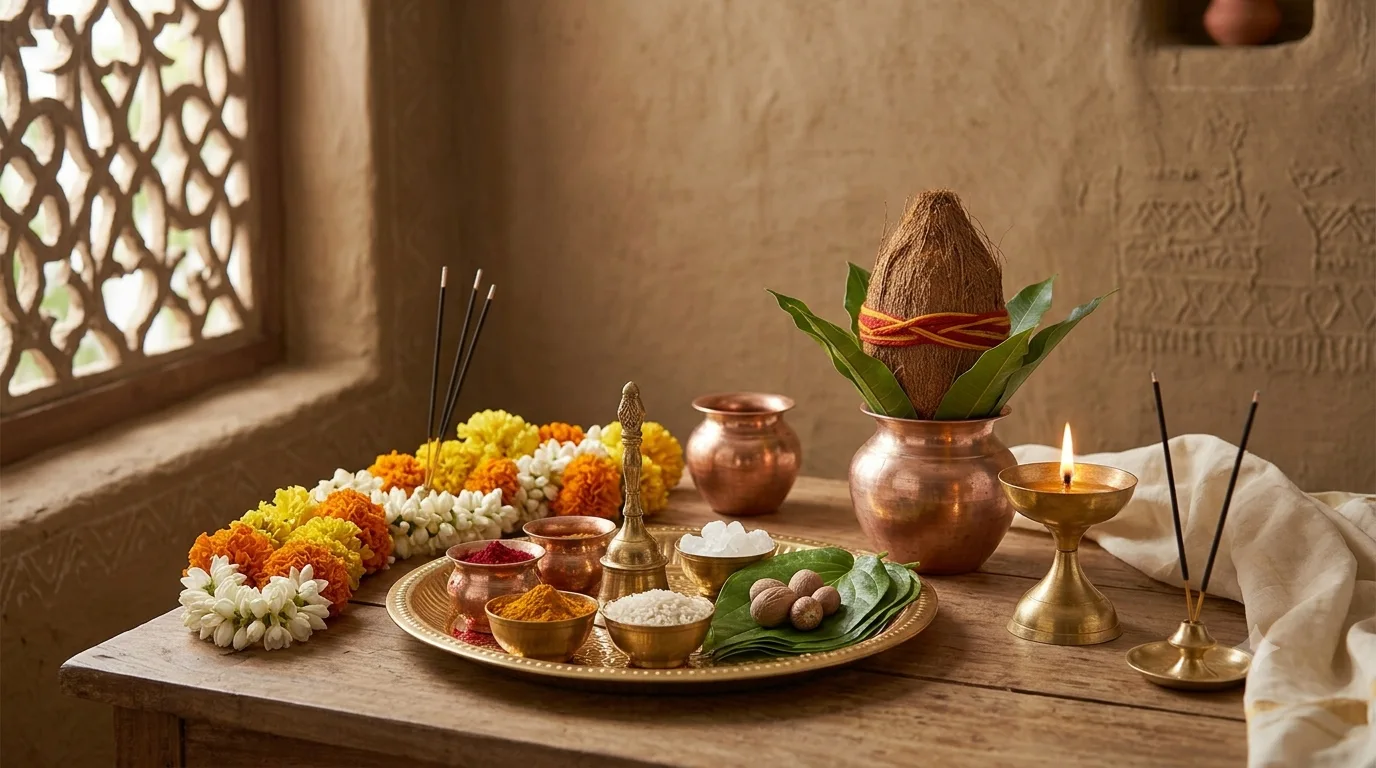
Some samagri is offered once and set aside; the vessels and tools of worship are meant to last, cared for and reused across a lifetime of ritual. This guide covers the thirteen vessels and tools in Avyani's Master Samagri Catalogue — what each is for, which metal suits it, and how to buy and keep them well.
Unlike flowers or food, the vessels of puja are not consumed. They are cleaned, put away and brought out again, often across generations, and a good one is bought once. Avyani's Master Samagri Catalogue records thirteen items in this category.
Where this guide says tradition, the practice is widely followed but has no single scriptural locator; where it says practical guidance, it is Avyani's own advice on choosing and keeping these things.
The Kalash
The kalash (कलश) is a pot filled with water, its mouth ringed with mango leaves and topped with a coconut, installed as a seat for the invoked deity. In this complete form it is the purna kumbha, the full vessel, and it is mandatory in most formal worship and central to the Ghatasthapana that opens Navratri — see our Devi Rituals guide.
Tradition. The pot is read as the earth, the water within it as the primordial ocean from which creation arose, the leaves as living growth and the coconut as the divine presence. The purna kumbha is one of the oldest motifs in Indian art and appears across Vedic and Puranic literature, though the specific chapter-and-verse references often quoted for it are difficult to verify, and Avyani does not repeat them as though they were settled.
Copper is the preferred metal, with brass and silver also used, and earthen pots in many regional and vrat observances. See our Flowers and Leaves guide for choosing the mango leaves, which should be mature and unblemished.
Two related pots serve narrower purposes. The kamandalu (कमंडल) is the ascetic's water pot, carried rather than installed. The karva (करवा) is a spouted earthen pot used in vrat observances, above all Karva Chauth.
Lamp, Bell and Thali
The deepak (दीपक), the lamp, and the aarti thali (आरती थाली) on which it is circled before the deity, appear in almost every rite in our Daily Worship guide. Brass is the usual metal for both. A lamp with a broad, shallow well and a defined lip holds oil without spilling and is far easier to clean than an ornate one.
The ghanti (घंटी) is rung to mark the openings and closings of worship. Bells are brass or bell metal; the tone is the only meaningful test, and it is worth ringing one before buying.
Seat, Fire Pit and Spoons
The chowki (चौकी/पीढ़ा) is a low wooden seat, used for the deity's image and in some traditions for the person performing the puja. Plain seasoned wood outlasts painted or veneered work, which lifts once it meets water.
For fire ritual, the havan kund (हवन कुंड) and the paired sruk and sruva ladles are dedicated tools, kept for havan and nothing else — see our Homam, Havan and Yajna guide and our Havan Samagri, Wood and Fuel guide. A kund needs a stable, heat-tolerant surface beneath it and clearance above; a metal kund on a wooden table wants a stone or metal tray under it, and never a cloth.
Shankh, Panchpatra and Soop
The shankh (शंख) is the conch, blown to mark auspicious moments and also filled with water for abhishekam. It is the shell of the marine snail Turbinella pyrum, collected by licensed divers in the Gulf of Mannar and Palk Bay. Because Indian marine curio trade is regulated and illegal collection is a real problem, buy a shankh from a seller who can say where it came from.
The panchpatra and its small spoon, the uddharani (पंचपात्र-उद्धरणी), hold and offer water throughout a puja — the most-handled vessels on the altar, and worth having in a metal you are happy to polish often.
The bhiksha patra (भिक्षा पात्र), the alms bowl, belongs specifically to the Upanayana samskara in our Sixteen Samskaras guide. The soop or daura (सूप/दउरा), a bamboo winnowing basket, carries offerings in several regional observances, most visibly Chhath.
Choosing the Metal
Practical guidance. Copper, brass, bronze and silver are the traditional metals, and most paddhati avoid iron and steel on the altar, and aluminium generally. Within that, the choice is mostly about what the vessel will hold.
Unlined copper and brass are excellent for plain water and poor for anything acidic. Curd, honey, lemon and sugarcane juice react with both, and prolonged contact produces copper salts that can cause gastric upset. So the panchpatra of water is fine in copper; panchamrit is better mixed and held in steel or glass and then offered from the copper vessel, as described in our Liquids and Panchamrit guide.
Care and Storage
Wash vessels soon after use rather than letting offerings dry on. Tamarind or lemon with a little salt is the traditional polish for copper and brass and works well; rinse thoroughly and dry completely afterwards, because water left standing is what causes the green bloom in the first place.
Store the set together, dry, wrapped in cloth rather than sealed in plastic. Keep the havan tools separate from the daily set, and keep the deity's vessels out of ordinary kitchen use. Fuller instructions are in our Caring for Puja Samagri at Home guide.
Vessels and Tools at a Glance
| Item | Hindi | Typical material and use | Mandatory / Optional |
|---|---|---|---|
| Kalash | कलश | Copper, brass or earthen; seat for the deity | Mandatory |
| Deepak | दीपक | Brass lamp for oil or ghee | Mandatory |
| Aarti Thali | आरती थाली | Brass or steel plate for the aarti | Mandatory |
| Chowki | चौकी/पीढ़ा | Low wooden seat for image or worshipper | Mandatory |
| Havan Kund | हवन कुंड | Metal or masonry fire pit; havan only | Mandatory |
| Sruk and Sruva | स्रुक-स्रुवा | Paired ladles for offering ghee into fire | Mandatory |
| Karva | करवा | Spouted earthen pot for vrat observance | Mandatory |
| Soop / Daura | सूप/दउरा | Bamboo winn |
Mandatory |
| Ghanti | घंटी | Brass or bell-metal bell | Optional |
| Shankh | शंख | Conch, Turbi |
Optional |
| Panch |
पंचपात्र-उद्धरणी | Copper water vessel and small spoon | Optional |
| Kaman |
कमंडल | Ascetic's water pot | Optional |
| Bhiksha Patra | भिक्षा पात्र | Alms bowl; Upanayana samskara | Optional |
Sources
- Purna kumbha symbolism — standard paddhati and iconographic usage; specific Puranic locators commonly quoted for it were not verified and are not asserted here.
- Turbinella pyrum — licensed collection in the Gulf of Mannar and Palk Bay; regulation of Indian marine curio trade and documented illegal collection.
- Copper and acidic foods — documented formation of copper salts on unlined copper and brass in contact with acidic contents.
- Item names, Hindi names and mandatory flags — Avyani Master Samagri Catalogue v1.
Where a scriptural locator could not be verified, the statement is given as tradition or practical guidance rather than scripture.