


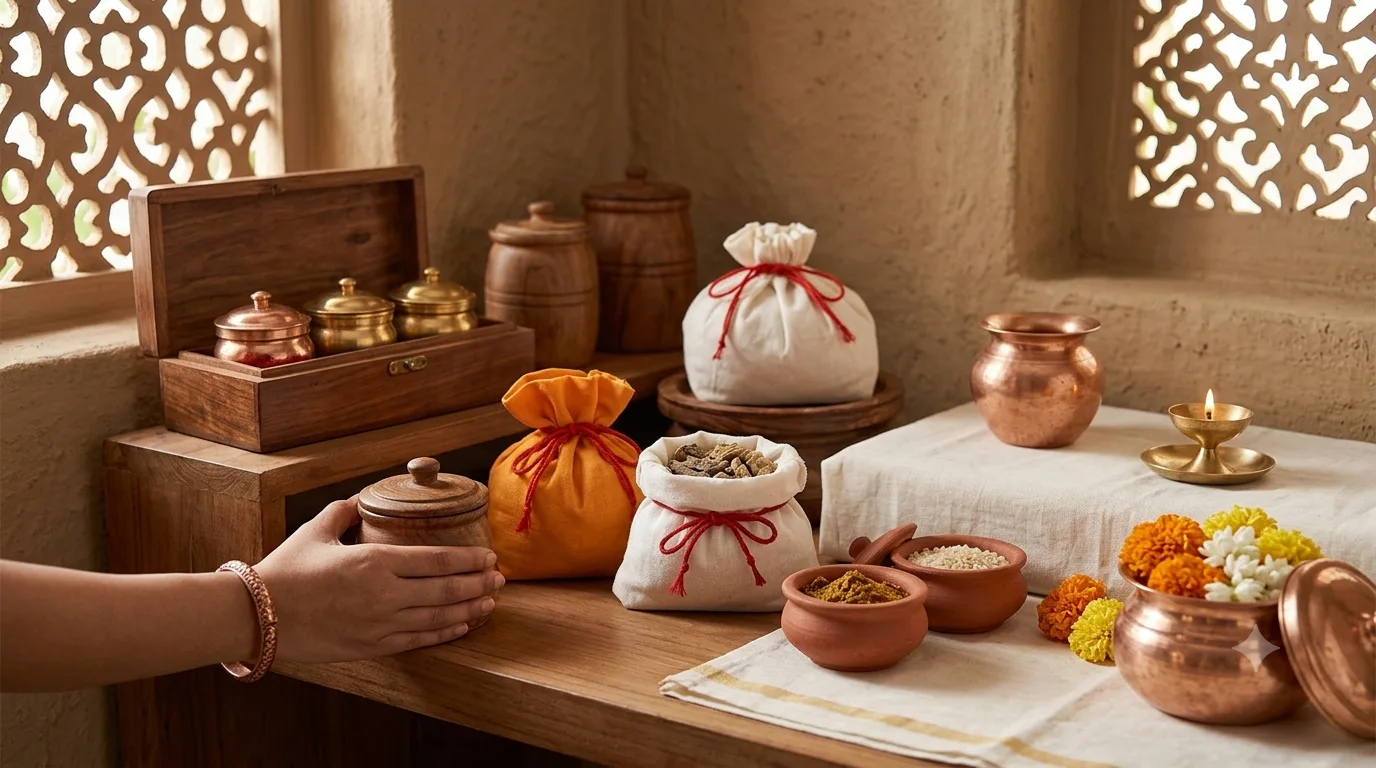
Simple guidance on storing, cleaning and respectfully retiring puja items, so a home altar stays sacred and organised. Care is itself a form of respect — and most of what it takes is knowing which of six kinds of thing you are holding.
Samagri divides into two groups by its nature: things kept and reused, and things offered once. Almost every care question answers itself once you know which group an item is in, and what it is made of.
Metal Vessels
The kalash, deepak, aarti thali, ghanti, panchpatra and shankh of our Kalash and Utensils guide are the permanent core of an altar, and they are the items that reward attention.
Wash them soon after use rather than letting offerings dry on. Tamarind or lemon with a little salt is the traditional polish for copper and brass and works as well as anything sold for the purpose; rinse thoroughly and dry completely, because standing water is what causes the green bloom in the first place. Store dry, wrapped in cloth rather than sealed in plastic, which traps moisture against the metal.
One caution worth repeating. Unlined copper and brass are excellent for plain water and poor for anything acidic. Curd, honey, lemon and sugarcane juice react with both, producing copper salts that can cause gastric upset. Mix and hold panchamrit in steel or glass and offer from the copper vessel — see our Liquids and Panchamrit guide.
Keep the havan kund and the sruk-sruva apart from the daily set, and let ash cool fully before moving it; embers stay live for hours.
Malas and Personal Items
Rudraksha and tulsi malas, described in our Jewellery and Sacred Items guide, are kept wrapped in cloth, away from sunlight and away from polish and water. Rudraksha should be kept dry and occasionally oiled; prolonged soaking splits the seed. Check the stringing rather than the beads, since a mala fails at the knot.
Tradition holds a mala to be personal rather than shared. Keep it, along with the mangalsutra and paduka, separate from the general puja box — these are the items that go missing.
Cloth and Thread
Rinse new cloth in cold water before it goes near a murti, since cheap red and yellow dyes bleed and a stain on stone or metal is difficult to lift. Wash puja cloth separately, fold it dry, and store it away from damp.
Prefer cotton and silk over synthetics. Cloth on an altar sits close to lamps and camphor, and synthetic fabric melts and burns fast — see our Cloth and Sacred Threads guide, which also covers the wrist-thread caution for infants.
Dry Goods
Powders, grains, resins, samidha and dung cakes all fail the same way, which is damp. Store powders in small airtight containers away from the stove and the window; grains airtight and away from heat, watching for the fine dust and small holes that mean weevil; resins and havan samagri airtight, since both lose their aromatics to open air within months.
Keep wood and dung cakes dry and off a concrete floor. Buy quantities matched to what you will use in a season rather than in bulk — see our Powders and Sacred Marks, Grains and Havan Samagri, Wood and Fuel guides.
Keep the ritual set separate from the kitchen tin, both so ritual akshat stays unbroken and so a jar of sindoor is never confused with a jar of turmeric.
Fresh Items and Food
Flowers, leaves, fruit and naivedya are not meant to be kept. Buy them fresh and buy them small; leaves in particular keep far better under a damp cloth in the shade than in a sealed plastic bag, which sweats and blackens them.
Anything that will be eaten afterwards is food from the moment it is bought. Cook naivedya fresh on the day, keep it covered, and distribute it soon after the rite rather than letting it stand — milk-based sweets, kheer and cooked rice are the items that spoil fastest in warm weather. See our Naivedya and Fruits guides.
Lamps, Camphor and Flame
Store camphor in a closed, clearly labelled container in a cool dry place, out of reach of children — it is poisonous if swallowed. Keep cotton wicks dry, since damp wicks sputter, and keep lamp oils capped and away from light.
Set every flame on a stable non-combustible surface, well clear of cloth, paper and aerosols, and never leave one unattended. Ventilate the room when burning incense or running a havan. Both points are covered in our Incense, Camphor, Oils and Ghee and Havan Samagri: What You Need for a Fire Ritual guides.
Retiring What Has Been Offered
Offered flowers and leaves — nirmalya — are set aside with respect rather than thrown out with the household rubbish. Strip out plastic thread, wire, staples and foil first: that binding, not the plant material, is what pollutes a river or spoils a compost heap. Then compost it or return it under a tree at home. Where local custom expects immersion, remove the binding and use a designated collection point if one exists. Fuller guidance is in our Flowers and Leaves guide.
Cloth offered to a deity is not returned to household use; most traditions give it away or set it aside. A mauli is worn until it wears through or is untied on a specific occasion rather than cut off casually. Havan ash is bhasma and treated as such. Broken or worn items — a cracked murti, a split mala — are traditionally returned to earth or water rather than binned, and again with any plastic or metal fitting removed first.
Keeping the Altar Itself
Practical guidance. A shallow drawer or a shelf with a few small boxes works better than one large tin, because the daily items should be reachable without unpacking the occasional ones. Keep three groupings: what you use every day, what comes out for festivals, and what is personal. Check the box before a festival rather than on the morning of it — the things that run out are always camphor, wicks and matches.
For what each item is and why it is offered, see our Understanding Samagri guide.
Sources
- Copper and acidic foods — documented formation of copper salts on unlined copper and brass in contact with acidic contents.
- Camphor toxicity, incense ventilation and flame safety — set out with citations in the guides linked above.
- Nirmalya disposal — temple floral waste is collected and composted at scale in India; the guidance to remove non-biodegradable binding first is Avyani's own.
- Cleaning, storage and altar-keeping advice is practical guidance from Avyani, not scriptural prescription.
Where a scriptural locator could not be verified, the statement is given as tradition or practical guidance rather than scripture. Nothing here is medical advice.