


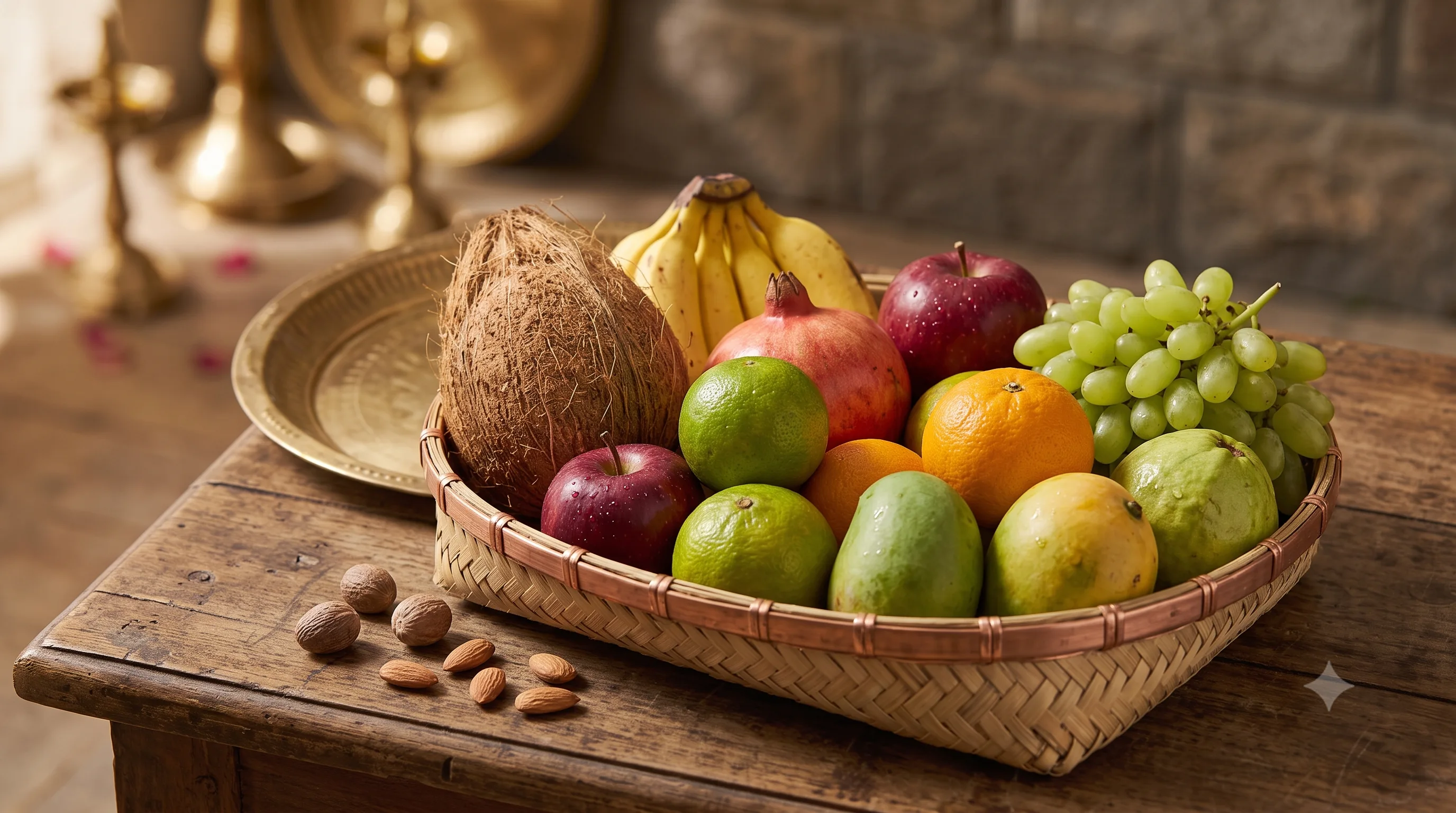
Fruit is one of the simplest and most universal offerings in Hindu worship — living, seasonal, and freely given back to the earth it grew from. This guide covers the seven fruit items in Avyani's Master Samagri Catalogue, and how to choose and handle each one well.
Fruit is the offering the tradition itself calls sufficient. The Bhagavad Gita puts it plainly: patram pushpam phalam toyam — a leaf, a flower, a fruit, water; whoever offers these to me with devotion, that I accept (9.26). Almost every other item on a samagri list is an elaboration of that line.
Avyani's Master Samagri Catalogue records seven fruit items. Where this guide says scripture, it names a text and verse you can check; where it says tradition, the practice is widely followed but has no single locator.
Coconut
The coconut (नारियल, Cocos nucifera) is the one fruit almost no puja omits. It sits on the kalash described in our Kalash and Utensils guide, and it is broken and offered at the start of countless undertakings.
Tradition. The devotional reading is that the rough husk is the ego and the white kernel within is the self offered up once the outer layer is stripped away. A second explanation circulates widely — that coconut-breaking replaced an older animal or human sacrifice — and Avyani does not repeat it as fact, because it rests on speculation rather than on any text.
Practical guidance. Choose a coconut that feels heavy for its size and sloshes audibly when shaken; no sound means the water has dried or leaked. Check the three eyes for softness, damp or mould, which is where spoilage shows first. A coconut that smells sour or fermented when opened should not be offered or eaten. Break it on a hard surface with hands clear of the strike, and keep children back.
Banana
The banana (केला, Musa spp.) is the other mandatory fruit, offered in nearly every rite in our How to Perform a Simple Home Puja guide. The plant fruits almost continuously and regenerates from its own base, which is why tradition reads it as a figure for abundance and continuity. Its leaves and stems serve as plates and pillars at weddings and festivals across the south and east.
Offer bananas ripe but firm, still on the hand where possible. A whole comb looks generous and keeps far better than loose fruit.
Bilva Fruit and Sugarcane
Bilva fruit (बिल्व फल), the fruit of the same tree that gives the bilva patra in our Flowers and Leaves guide, is a seasonal offering in Shiva worship — see our Shiva Rituals guide. The shell is hard and woody; a ripe one sounds hollow and smells faintly sweet at the stem.
Sugarcane (गन्ना), offered as a whole stalk, belongs to Chhath and to Pongal — a seasonal and regional offering rather than a general one, connected to the observances in our Surya Rituals guide. Choose firm, unsplit stalks with the leaf crown intact.
Dry Fruit and Seasonal Fruit
Dry dates (छुआरा) and the dry fruit mix (मेवा) are optional, offered and then shared as prasad alongside the sweets in our Naivedya guide. Buy them from a shop with turnover, keep them airtight, and discard any nut that is musty, discoloured or shrivelled rather than picking around it — mould on nuts is not something to eat past.
Seasonal fruits (मौसमी फल) is the catalogue's open entry, and it is meant to be. What is in season locally is the traditional answer, and it is usually the better one: fruit picked ripe nearby beats fruit shipped unripe from far away, on every count that matters to an offering.
Choosing and Offering Fruit
Practical guidance. Offer fruit whole and unblemished, washed and dried, arranged on a clean plate or a banana leaf. Odd numbers are customary in many households; five is the usual convention where a number is wanted.
Tradition asks that naivedya not be tasted before it is offered, so choose by look and smell rather than by sampling. Afterwards, distribute the fruit promptly rather than letting it stand through a long ceremony, and compost or return what is not eaten rather than binning it — the same principle as the nirmalya guidance in our Flowers and Leaves guide.
Fruits at a Glance
| Item | Hindi | What it is | Mandatory / Optional |
|---|---|---|---|
| Coconut | नारियल | Cocos nuci |
Mandatory |
| Banana | केला | Musa spp.; ripe but firm | Mandatory |
| Bilva Fruit | बिल्व फल | Bael fruit; Shiva worship | Optional · seasonal |
| Sugar |
गन्ना | Whole stalk; Chhath and Pongal | Optional · seasonal |
| Dry Dates (Chhuara) | छुआरा | Dried dates; store airtight | Optional |
| Dry Fruits Mix (Mewa) | मेवा | Mixed nuts and dried fruit | Optional |
| Seasonal Fruits | मौसमी फल | Whatever is in season locally | Optional |
See our Understanding Samagri guide for how these fit the wider offering.
Sources
- Bhagavad Gita 9.26, patram pushpam phalam toyam — Sanskrit text with translation.
- Coconut and banana symbolism — established devotional tradition; the claim that coconut-breaking replaced animal or human sacrifice is unsupported by any text and is not repeated here as fact.
- Storage of nuts and dried fruit — general food-safety practice on discarding mould-affected nuts rather than salvaging them.
- Item names, Hindi names and mandatory flags — Avyani Master Samagri Catalogue v1.
Where a scriptural locator could not be verified, the statement is given as tradition or regional practice rather than scripture. Nothing here is medical advice.