


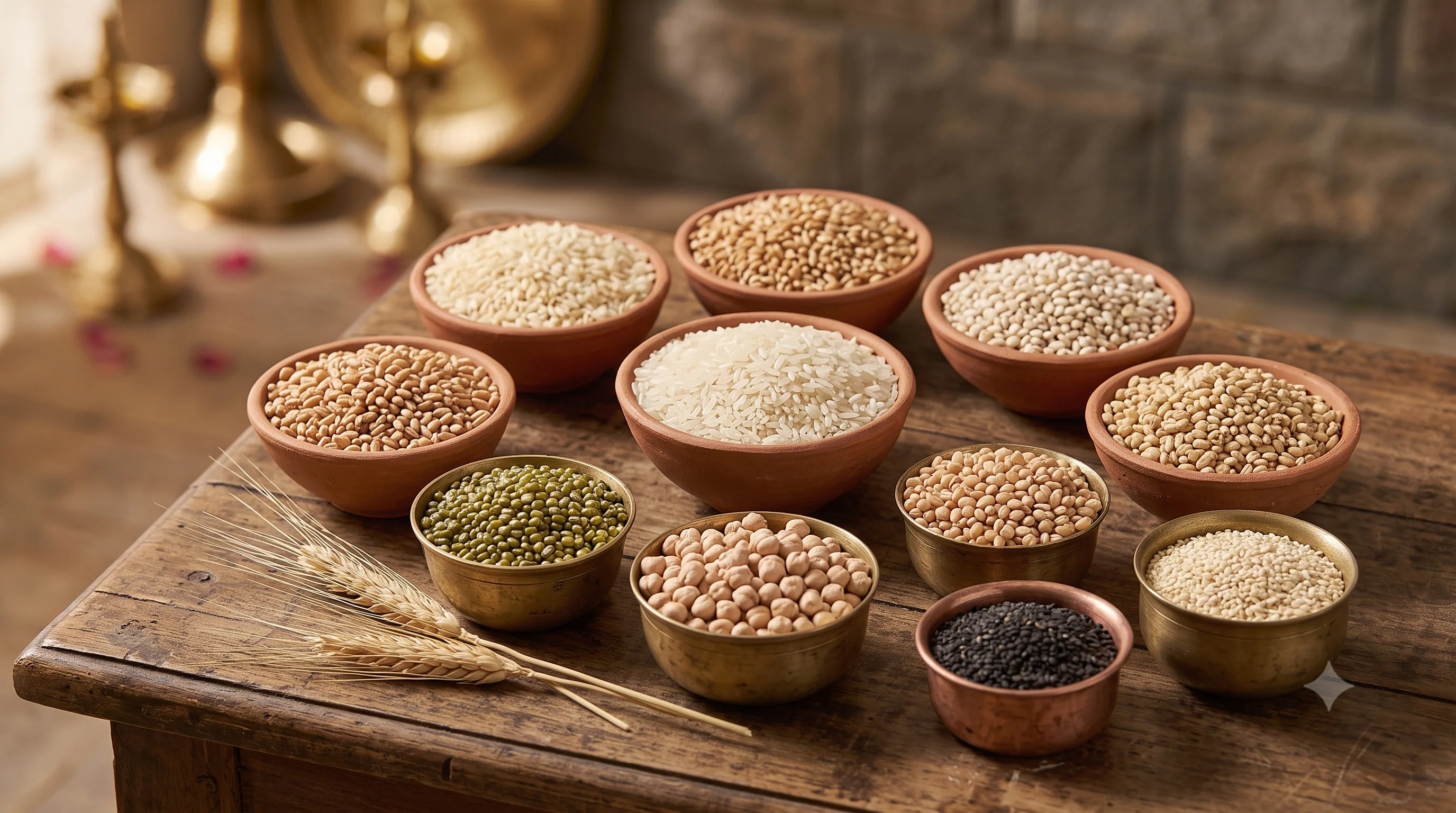
Grain is among the oldest offerings in Hindu worship, older even than the fire it is sometimes given to. This guide covers the seven grain items in Avyani's Master Samagri Catalogue — akshat scattered by hand, navdhanya sown to sprout, and the til and barley of the ancestral rites.
Grain anchors both the household puja and the Vedic fire. It is scattered by hand as akshat, sown to sprout at Ghatasthapana, poured as ahuti into the homa, and shaped into the pinda of the ancestral rites. Avyani's Master Samagri Catalogue records seven grain items.
Where this guide says scripture, it names a text and verse you can check; where it says tradition, the practice is widely followed but has no single locator, and regional lists differ.
Akshat — the Unbroken Grain
Akshat (अक्षत चावल) is whole rice, and the name carries the requirement: a-kshata means unbroken. Grains that have split or cracked are set aside, because what is offered is meant to be whole rather than merely plentiful. It is used in almost every rite in our Daily Worship guide, scattered at each name in an archana and pressed onto the forehead with kumkum.
Tradition. Most households tint akshat with a little turmeric or kumkum and a few drops of water. Some traditions also hold that akshat is not offered in particular forms of Vishnu worship; the rule is real in the households that keep it, varies by sampradaya, and is not something Avyani states as a general law.
Practical guidance. Buy plain unpolished or lightly polished rice rather than parboiled, and pick through it once. It is worth keeping a small jar of ritual akshat separate from the kitchen rice, since the kitchen tin inevitably fills with broken grain.
Navdhanya — the Nine Grains
Navdhanya (नवधान्य) is a mix of nine grains and pulses, used in Navagraha worship and sown in earth at Ghatasthapana to sprout across the nine nights — see our Navagraha and Dosha Nivaran guide.
Tradition. Each grain is associated with one of the nine grahas — wheat with the Sun, rice with the Moon, black sesame with Shani, horse gram with Ketu, and so on. The full correspondence varies between regions and between practitioners, so a packet from one part of India may not match a list from another. Both are legitimate; ask the priest conducting the rite which set they want.
Where the grains are to be sown, freshness decides everything. Old stock will not germinate, and a tray that fails to sprout is usually the seed rather than the sowing.
Barley, Sesame and the Pinda
Barley (जौ) is among the oldest ritual grains in the tradition and a standard ahuti in the fire rites of our Homam, Havan and Yajna guide.
Black sesame (काला तिल) belongs above all to the ancestral rites. It is offered with water in tarpana and used throughout Shraddha, alongside the kush grass described in our Flowers and Leaves guide — see our Shraddha and Pitru Karma guide. Til also goes into the havan fire, and into the winter offerings of Makar Sankranti.
Yava atta (जौ का आटा), barley flour, is used for pinda in the traditions that shape the ancestral offering from flour rather than from cooked rice. Which is used depends on family and region, and on the particular rite.
Wheat and Moong
Wheat (गेहूं) and whole moong (साबुत मूंग) are the catalogue's general-purpose grains, offered in household observances, given in daan, and used in the sprouting and food offerings of several festivals. Both are catalogued as optional and both are ordinary kitchen staples — buy them as food.
Buying and Keeping Ritual Grain
Practical guidance. Grain keeps for months and then, quite suddenly, does not. Buy in quantities you will use within a season, store airtight and away from heat, and look for the signs of weevil — fine dust, webbing, small holes, movement when the jar is tilted. A few bay leaves or dried neem in the container is the traditional deterrent and works well enough.
Where grain is bought for sprouting, buy it fresh and separately from grain bought for offering; the two have different requirements and only one of them has a deadline.
Grains at a Glance
| Item | Hindi | What it is | Mandatory / Optional |
|---|---|---|---|
| Rice (Akshat) | अक्षत चावल | Whole unbroken rice; often turmeric- |
Mandatory |
| Nav |
नवधान्य | Nine grains for the nine grahas | Mandatory |
| Barley (Jau) | जौ | Classic havan grain | Mandatory |
| Black Sesame (Til) | काला तिल | Tarpana, shraddha and havan | Mandatory |
| Yava Atta | जौ का आटा | Barley flour, for pinda | Optional |
| Wheat | गेहूं | General offering and daan | Optional |
| Moong Dal (Whole) | साबुत मूंग | Whole green gram | Optional |
See our Understanding Samagri guide for how these fit the wider offering, and our Havan Samagri, Wood and Fuel guide for what else goes into the fire.
Sources
- The meaning of akshata as "unbroken", and the preference for whole grain — standard paddhati usage.
- Navdhanya and the nine grahas — established tradition with documented regional variation in the grain-to-graha correspondence; no single list is asserted here as authoritative.
- Til in tarpana and shraddha — established grihya and paddhati practice; no single verse locator is asserted.
- Item names, Hindi names and mandatory flags — Avyani Master Samagri Catalogue v1.
Where a scriptural locator could not be verified, the statement is given as tradition or regional practice rather than scripture.