


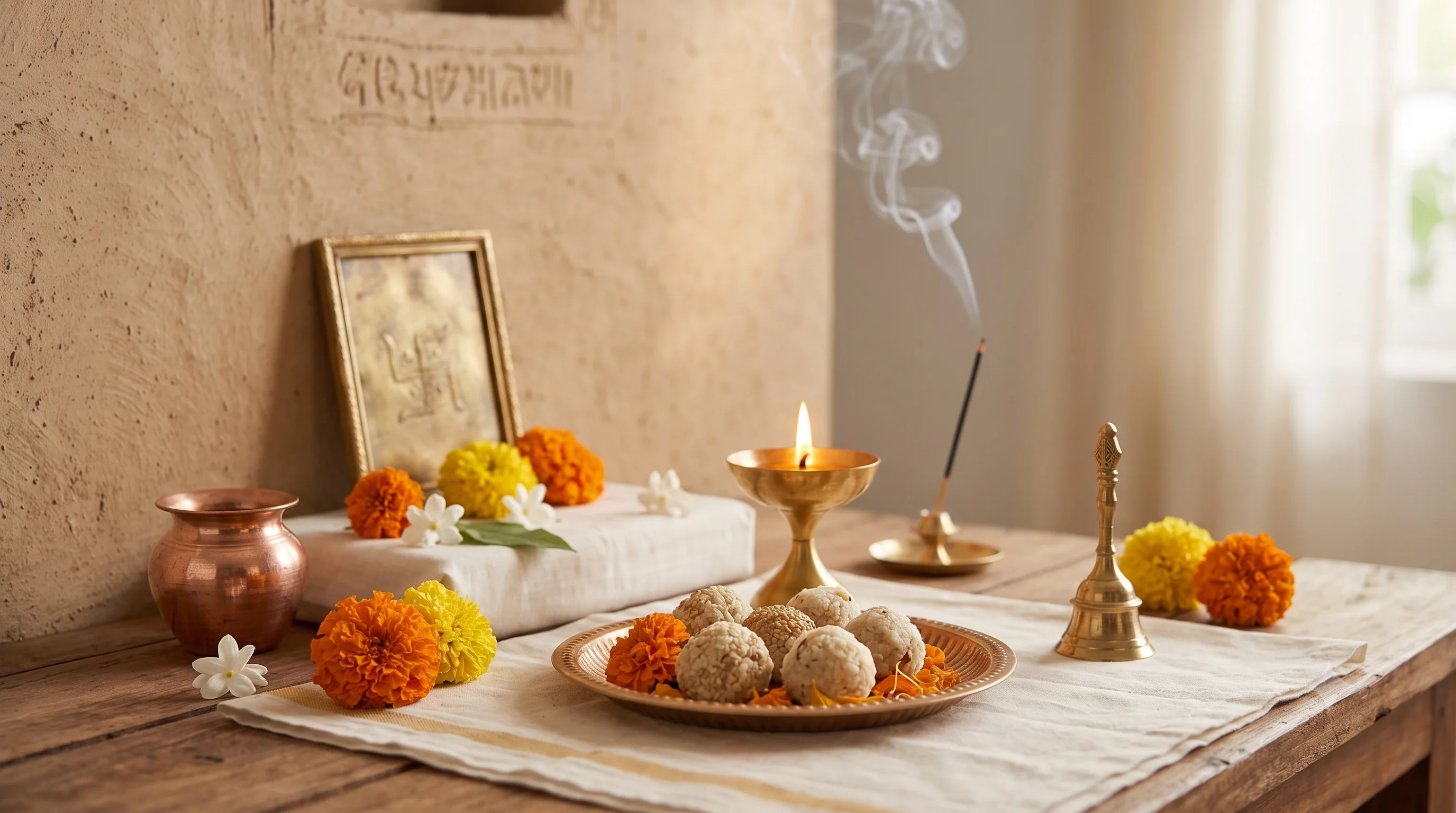
Shraddha and the wider family of Pitru Karma honour those who have died and keep a family's bond with them. These are among the most sensitive rites a household will observe, and this guide sets them out plainly, with the care they deserve.
Shraddha (श्राद्ध) takes its name from shraddha, faith or trust — a rite performed in good faith towards those who can no longer be thanked directly. It follows Antyeshti, the last of the samskaras in our Sixteen Samskaras guide, and continues at intervals for the rest of a family's life.
Avyani's Master Puja & Ritual Catalogue records five Shraddha rituals and six further Pitru Karma rites. This guide describes what they are. Anyone arranging one after a recent death should speak to their family priest, who will know the observances of your tradition and the days they fall on.
The Idea Behind the Rite
Tradition. The pitru are the ancestors, held in the tradition to be sustained by what descendants offer and to remain part of the household in a real if unseen sense. The three generations immediately preceding are named in most paddhati; beyond them the ancestors are addressed collectively.
The three constants are water, sesame and rice. Tarpana offers water libations, with black sesame, through the pitru tirtha — poured across the base of the thumb rather than the fingertips. The pinda is the rice or barley-flour ball described in our Naivedya guide, and kusha grass and the pavitri ring are covered in our Flowers and Leaves and Cloth and Sacred Threads guides.
In the Period After a Death
Asthi Visarjan is the collection and immersion of the cremated remains, most often at Haridwar, Prayagraj, Varanasi, Rameswaram or another sacred water. Ekodishta Shraddha is performed for the one who has recently died, and Sapindikarana is the rite that formally joins them to the collective ancestors — conventionally at the close of the first year, though many traditions bring it forward.
Narayan Bali is performed where a death was untimely or unnatural, before the ordinary shraddha can proceed. Nag Bali is frequently paired with it, and both are most associated with Trimbakeshwar.
Ongoing Remembrance
Annual Shraddha falls on the lunar tithi of the death, not the calendar date, and is the observance most families keep indefinitely. Mahalaya Shraddha is the collective rite performed during Pitru Paksha, the fortnight before Navratri, when the ancestors are honoured together; the last day, Sarvapitri Amavasya, serves for any ancestor whose tithi is unknown — which is a quiet kindness in a tradition that otherwise counts days carefully.
Tarpana can be kept daily or periodically, needs no priest, and is the simplest way to maintain the observance between the formal rites.
At Gaya, and for the Unresolved
Gaya Shraddha is performed at Gaya in Bihar, where the tradition holds that the rite completes the ancestral obligation in a way it cannot elsewhere. It runs from a single day to seventeen depending on the vidhi followed. Pind Daan is its central act and is also performed at Prayagraj, Varanasi and other places.
Tripindi Shraddha is undertaken where ancestral rites are believed to have been left undone across generations. Tradition connects these observances with what is sometimes called pitru dosha; our Navagraha and Dosha Nivaran guide sets out how Avyani treats that framing — described as the tradition understands it, and not asserted as the cause of anything in a particular family's life.
A Note for Families
Practical guidance. Grief and ritual obligation do not always sit easily together, and families are often anxious about having done something wrongly or too late.
Two things are worth saying. Traditions differ substantially on timing, on who may perform the rite, and on what to do when circumstances — distance, illness, an absent son, a family with only daughters — make the prescribed form impossible; most paddhati contain provisions for exactly these cases. And a rite performed late, or simply, or by someone other than the expected person, is within the tradition's own capacity to accommodate. Ask your priest rather than assuming the worst.
Shraddha and Pitru Karma at a Glance
Durations are typical planning ranges. "Traditionally for" records the intention the tradition assigns — not an outcome Avyani predicts or guarantees.
| Rite | Tradi |
Typical duration | Priest advised |
|---|---|---|---|
| Tarpana | Water and til for the pitru | 15–30 mins | No |
| Asthi Visarjan | Immersion of the remains | 1–2 hours | Yes |
| Ekodishta Shraddha | For one recently died | 1–2 hours | Yes |
| Sapindi | Joining the ancestors | 1–2 hours | Yes |
| Annual Shraddha | Yearly remem | 1–2 hours | Yes |
| Mahalaya Shraddha | All ancestors; Pitru Paksha | 1–2 hours | Yes |
| Pind Daan | Offering of the pinda | 1 day | Yes |
| Gaya Shraddha | The rite at Gaya | 3–17 days | Yes |
| Tripindi Shraddha | Rites long left undone | 1 day | Yes |
| Narayan Bali | After an untimely death | 1 day | Yes |
| Nag Bali Puja | Paired with Narayan Bali | 1–2 days | Yes |
The Garuda Purana, read in the days after a death, is described in our Jaap and Paath guide. For the samagri these rites use — kush, til, yava atta, white cloth — see the Samagri Catalogue.
Sources
- Shraddha from shraddha, faith — the standard derivation given in the tradition's own literature.
- Tarpana with water and black sesame through the pitru tirtha; three named generations and collective ancestors beyond — established paddhati practice, with regional variation.
- Pitru Paksha as the fortnight before Navratri, with Sarvapitri Amavasya for ancestors whose tithi is unknown — established observance.
- Gaya, Prayagraj, Varanasi and Trimbakeshwar as the principal sites for pind daan and for Narayan Bali — documented regional practice.
- Ritual names, durations and priest-advised flags — Avyani Master Puja & Ritual Catalogue. Durations are planning ranges, not prescriptions.
Where a scriptural locator could not be verified, the statement is given as tradition or regional practice rather than scripture. Stated purposes are the intentions the tradition assigns, not outcomes Avyani predicts.