


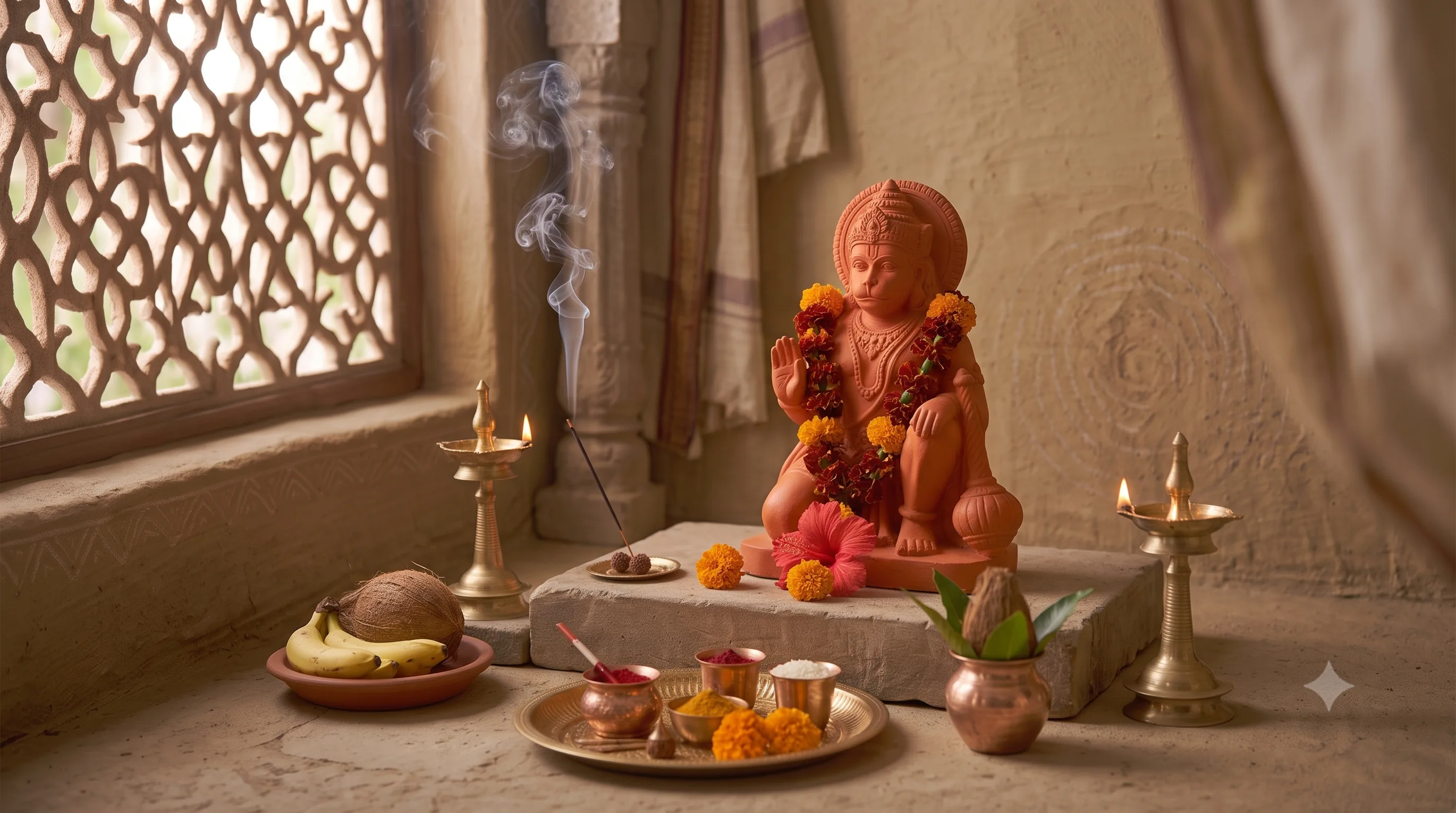
Ten Hanuman rituals, from the daily recitation of the Chalisa to the annual celebration of Hanuman Jayanti. This guide sets out where the texts come from, why Tuesday and Saturday, and what the sindoor offering actually involves.
Hanuman (हनुमान) — devoted servant of Rama, and the embodiment of strength, courage and selfless service — is among the most widely worshipped deities in India. Avyani's Master Puja & Ritual Catalogue records ten distinct Hanuman rituals.
This is an overview, not a manual. Where it says scripture, it names a text you can check; where it says tradition or regional practice, the custom is real and widely followed but has no single locator.
The Texts Behind the Worship
Two texts carry most Hanuman devotion, and they belong to different worlds.
The first is the Ramayana itself. The Sundarakanda, its fifth book, is Hanuman's own — the leap to Lanka, the search for Sita, the burning of the city. Its recitation as Sundarkand Path is described in our Jaap and Paath guide.
The second is the Hanuman Chalisa, and it is worth being precise about it. Tulsidas composed it in the sixteenth century, in Awadhi rather than Sanskrit, in forty chaupais — chalis is forty. That choice of language was deliberate: it put the hymn within reach of people who had no Sanskrit. It is devotional poetry of enormous reach and influence, and calling it that is more accurate than calling it scripture.
The Bajrang Baan is likewise a later devotional composition in the vernacular, recited for protection in difficulty.
Everyday Devotion
A simple Hanuman Puja, offered with a diya and sindoor, is common on Tuesdays and Saturdays across India — Tuesday as Hanuman's own day, Saturday by association with the tradition that he eased Shani's affliction. It often opens with a short salutation:
ॐ हनुमते नमः
Om Hanumate Namah is among the simplest ways Hanuman is invoked before longer recitation. Hanuman Chalisa Path takes ten minutes and needs no priest, which is a large part of why it is among the most recited texts in India. Hanuman Ashtottara Archana offers his hundred and eight names.
The Sindoor Offering
Sindoor Puja to Hanuman is a distinct ritual: vermilion mixed with oil, usually chameli, and applied to the murti. Tradition connects it to the story of Sita applying sindoor for Rama's long life, and Hanuman covering himself in it entirely.
Practical guidance. Sindoor is the one item in this worship that repays care in buying. Much of what is sold is not the traditional turmeric-and-lime preparation, and published testing has found lead in a substantial share of samples. Our Powders and Sacred Marks guide sets out the evidence and what to look for on a label.
Forms, Fire and Shrines
Panchmukhi Hanuman Puja addresses the five-faced form — Hanuman with the faces of Narasimha, Garuda, Varaha and Hayagriva alongside his own — and belongs to the more esoteric end of the tradition. Hanuman Homam is the fire form, described in our Havan Samagri: What You Need for a Fire Ritual guide.
Regional practice. Salasar Balaji Puja belongs to the Shekhawati shrine in Rajasthan, where Hanuman is worshipped in a bearded form and the offering is traditionally of churma and coconut. Hanuman Jayanti is observed on different days in different regions — Chaitra Purnima across much of the north, and in the Tamil and Telugu calendars at other points entirely.
Hanuman Rituals at a Glance
Durations are typical planning ranges. "Traditionally for" records the intention the tradition assigns — not an outcome Avyani predicts or guarantees.
| Ritual | Tradi |
Typical duration | Priest advised |
|---|---|---|---|
| Hanuman Puja | Strength, courage, shelter | 30–45 mins | No |
| Hanuman Chalisa Path | Shelter, strength, devotion | 10–15 mins | No |
| Bajrang Baan Path | Shelter in difficulty | 10–15 mins | No |
| Sindoor Puja to Hanuman | Shelter; see the note above | 15–20 mins | No |
| Hanuman Protection Puja | Troubles cleared; shelter | 30–45 mins | No |
| Hanuman Ashtot | Full devotion and merit | 45–60 mins | No |
| Hanuman Jayanti Puja | Birth festival of Hanuman | 2 hours | Yes |
| Hanuman Homam | Strength; blocks cleared | 1.5–2 hours | Yes |
| Panch | Shelter on all sides | 1 hour | Yes |
| Salasar Balaji Puja | A wish; yatra merit | 1 hour | Yes |
For the samagri these rituals use, see the Samagri Catalogue.
Sources
- Sundarakanda — the fifth book of Valmiki's Ramayana, given over to Hanuman's journey to Lanka.
- Hanuman Chalisa — composed by Tulsidas in the sixteenth century in Awadhi, in forty chaupais; devotional poetry rather than Sanskrit scripture, and described as such.
- Tuesday and Saturday observance, and the sindoor story — established tradition; no single locator is asserted.
- Lead in sindoor — American Journal of Public Health 2017;107(10):1630, cited in full in our Powders and Sacred Marks guide.
- Ritual names, durations and priest-advised flags — Avyani Master Puja & Ritual Catalogue. Durations are planning ranges, not prescriptions.
Where a scriptural locator could not be verified, the statement is given as tradition or regional practice rather than scripture. Stated purposes are the intentions the tradition assigns, not outcomes Avyani predicts.