


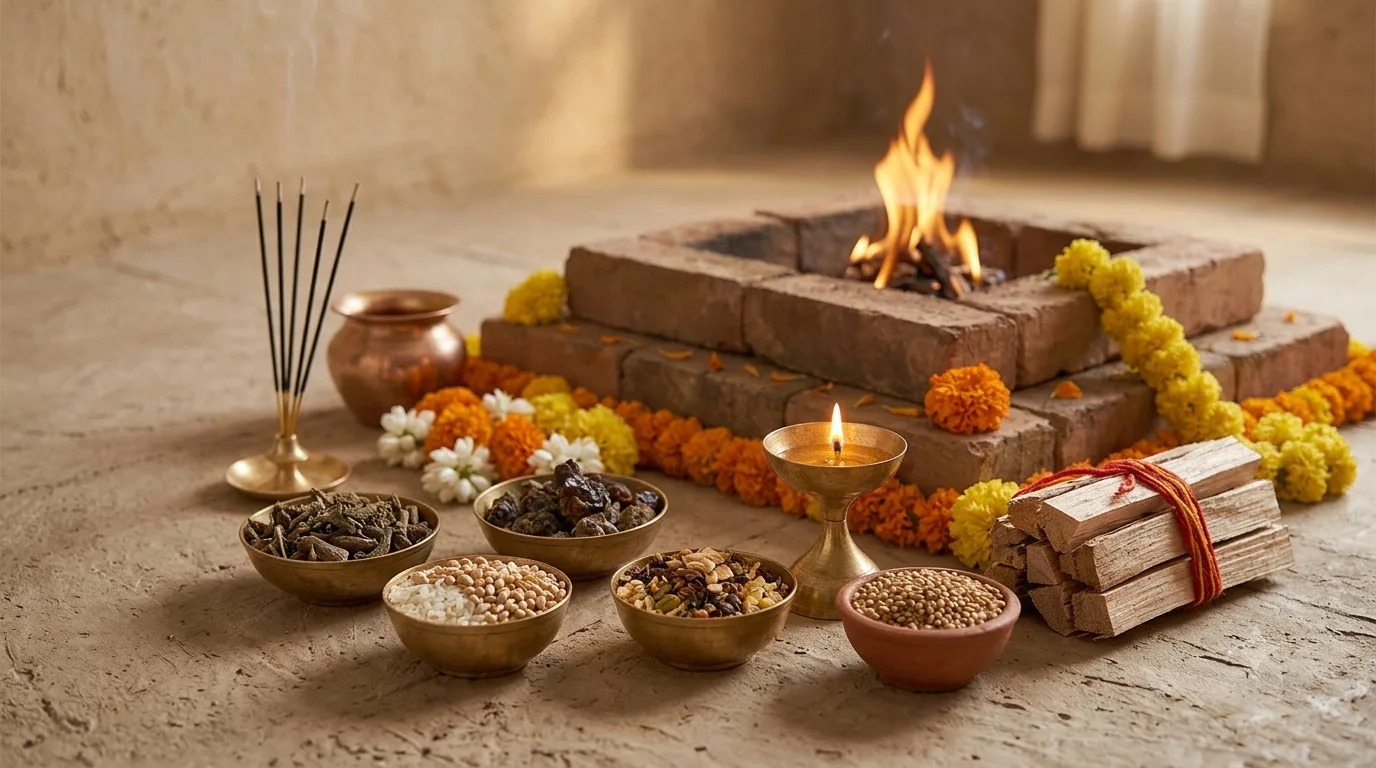
A practical guide to the fire pit, tools, fuel and offerings used in a home or temple havan — how to assemble what a fire ritual needs, how much of each to plan for, and how to burn a fire safely indoors.
A havan or homam — the offering of substances into a consecrated fire — sits at the centre of many rites in our Homam, Havan and Yajna guide, from a short Ganapati homam to the long Rudra sequence.
This guide is about assembling and running one. For the materials themselves — which wood, which resin, what is in the samagri mix — see our Havan Samagri, Wood and Fuel guide.
The Kund and the Tools
The havan kund holds the fire: a built pit, or more usually at home a portable copper or brass vessel, square or stepped. Offerings go in with the sruk and sruva, the paired long-handled ladles kept for havan and nothing else. Both are described in our Kalash and Utensils guide.
Alongside the kund you will want a metal or stone tray beneath it, a separate plate for the samagri mix, a small vessel of ghee with its own spoon, and water within reach. Most households also keep a lid or a metal sheet large enough to cover the kund, which is the simplest way to put a fire out.
What to Have Ready
Practical guidance. A short home havan of thirty to forty minutes usually needs less than people expect. As a planning guide rather than a rule:
- One bundle of samidha, with a handful of thin kindling sticks for lighting.
- A packet of havan samagri mix, and cow ghee — a small quantity, since it is offered by the spoon.
- Four or five cow dung cakes if the fire is to burn for longer than half an hour.
- Camphor to light the fire, and a matchbox — see our Incense, Camphor, Oils and Ghee guide.
- Akshat, til and barley from our Grains guide, and jaggery, where the rite calls for them.
The priest conducting the rite should be asked for quantities in advance. A long homa can consume several bundles of wood, and running out mid-sequence is the one shortage that cannot be improvised around.
Laying and Lighting the Fire
Build the fire before the rite begins rather than during it. Cow dung cakes go at the base, broken small; the samidha is laid over them with air gaps rather than packed tight, since a fire that cannot breathe smokes.
Camphor lights it cleanly. Ghee poured on at the start helps it take. Once established, the fire is fed sparingly — a stick or a spoonful at a time, in step with the mantras — rather than banked up, because the rite is measured by the offering and not by the blaze.
Burning a Fire Safely Indoors
A havan is an open solid-fuel fire. Ventilate the room and never leave it unattended.
- Burning wood and dung produces fine particulate matter and carbon monoxide. WHO guidance on household fuel combustion is clear that solid-fuel burning indoors needs ventilation; a havan is short and occasional rather than daily, but the same physics applies.
- Open windows and a door. Do not perform a havan in a sealed, air-conditioned or windowless room, and stop if anyone develops a headache, dizziness or nausea.
- Set the kund on a stone or metal tray, on a stable non-combustible surface, with clearance above and nothing overhead. Check for a smoke detector directly above before you begin.
- Keep cloth, paper, curtains, aerosols and loose clothing well clear. Tie back dupattas, sleeves and hair — see the fabric note in our Cloth and Sacred Threads guide.
- Keep children and pets at a distance, and keep water and a covering sheet within reach throughout.
- Let the ash cool fully before moving it. Embers stay live in ash for hours.
Where a large or long homa is planned, an open courtyard or a temple's own kund is the right place for it, not a flat.
Afterwards
The cooled ash is bhasma, and it is treated with respect rather than swept out with the household waste — see the note on sacred ash in our Powders and Sacred Marks guide. Many households keep a little and return the rest to earth or water.
Clean the kund and the ladles once they are cold, dry them fully, and store the havan set apart from the daily puja vessels. Guidance on cleaning and storing metal is in our Caring for Puja Samagri at Home guide.
Sources
- Solid-fuel combustion indoors — WHO Guidelines for Indoor Air Quality: Household Fuel Combustion, on particulate matter and carbon monoxide from burning wood and dung, and the importance of ventilation. The guidance addresses daily household cooking and heating; its application to a short, occasional havan is Avyani's own, and is offered as ventilation advice rather than as a finding about ritual.
- Havan kund, sruk and sruva as dedicated tools, and the laying and feeding of the fire — established paddhati practice.
- Quantities given are Avyani planning guides for assembling a home havan, not scriptural prescriptions; the officiating priest decides what a given rite requires.
- Item names and mandatory flags — Avyani Master Samagri Catalogue v1.
Where a scriptural locator could not be verified, the statement is given as tradition or practical guidance rather than scripture. Nothing here is medical advice.