


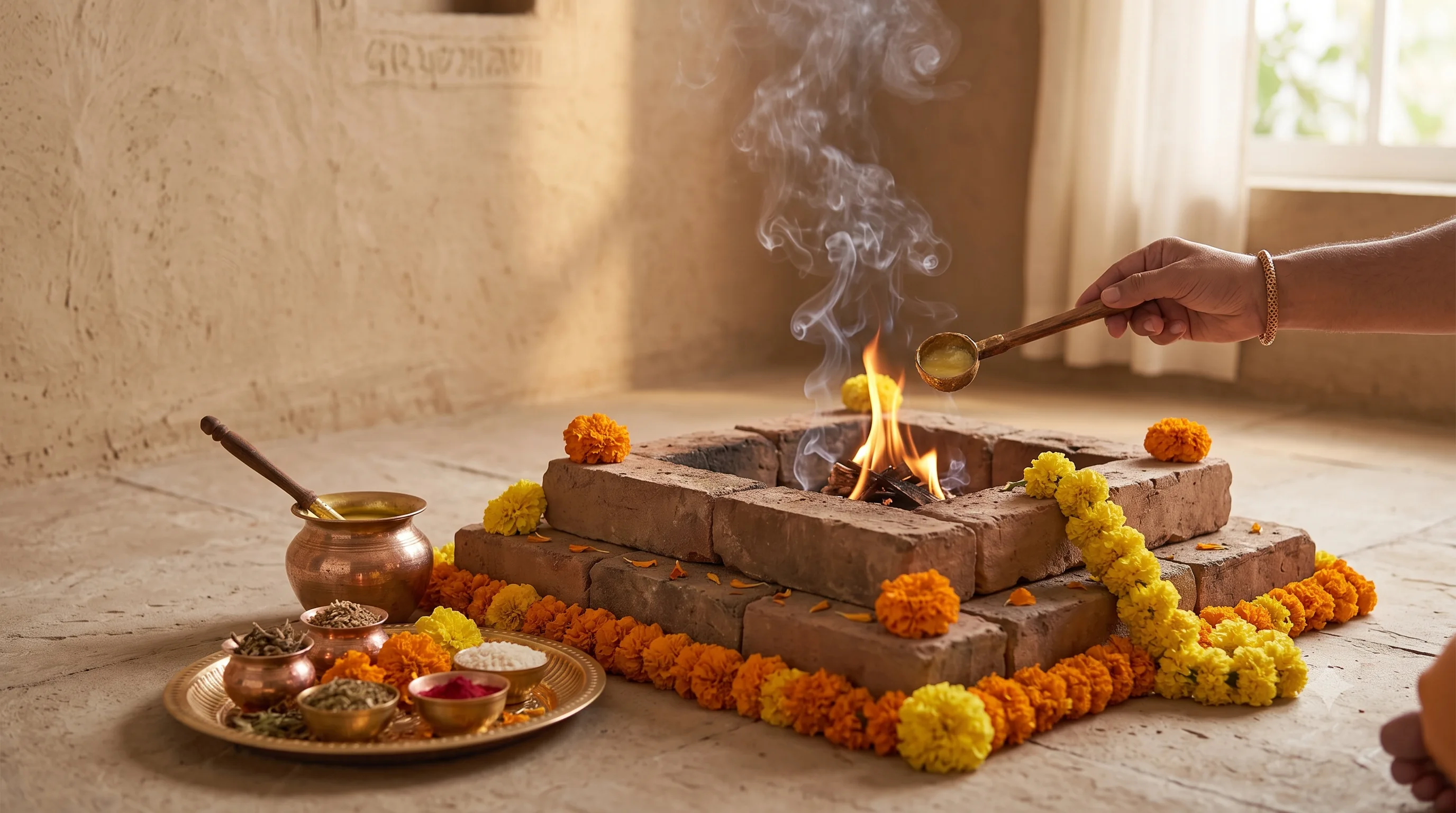
Thirty-five fire rituals across three traditions — the Agama homam of southern temple practice, the Grihya havan of the household, and the shrauta yajna. This guide explains what separates them, and distinguishes the yajnas that belong to living practice from those recorded for historical reference.
Fire ritual runs in three streams, and Avyani's Master Puja & Ritual Catalogue keeps them apart for good reason. Homam (होमम्) is the Agama-tradition fire ritual of southern temple practice. Havan (हवन) is the Grihya-tradition domestic rite of the household. Yajna (यज्ञ) is the shrauta sacrifice — large, public, and in several cases no longer performed at all. Thirty-five rituals in total.
Where this guide says scripture, it names a text you can check; where it says tradition, regional practice or history, it says which. The materials these use are covered in our Havan Samagri, Wood and Fuel guide, and running one safely in our Havan Samagri: What You Need for a Fire Ritual guide.
What Separates the Three
The difference is not scale but lineage. Havan descends from the Grihya Sutras, the domestic ritual manuals: one fire, a householder, and rites tied to the life of a family. Homam follows the Agama texts that govern temple worship, is deity-specific, and is normally conducted by temple priests. Yajna in the strict sense belongs to the shrauta tradition, with three fires and multiple officiants, and is a public rather than a household act.
In everyday use the words are interchanged freely, and there is no harm in that. In a catalogue it is worth keeping straight.
Homam — the Agama Tradition
Homams are named for the deity invoked. Gayatri, Vishnu, Durga and Saraswati Homam are the general forms. Ayushya Homam and Ganapati Ayushya Homam are traditionally performed for long life, often for a child on a birth star.
Navagraha Shanti Homam and Nakshatra Shanti Homam belong with the observances in our Navagraha and Dosha Nivaran guide, and that guide's scope note applies to them. Mrityunjaya Maha Homam and Ekadasha Rudra Homam are the extended Shaiva forms described in our Shiva Rituals guide.
Trishati and Shodasha Homam are structured by count; Beeja Akshara Homam works from seed syllables and belongs to initiatory practice; Sarpa Homam and Kubera Homam address the serpent deities and the lord of treasure.
Havan — the Household Tradition
The havans in this catalogue attach to occasions rather than deities, and most accompany a samskara from our Sixteen Samskaras guide: Mundan Havan at the first tonsure, Yagyopavit Havan at the sacred thread, Vivah Havan at the wedding described in our Marriage Rituals guide.
Griha Shanti Havan is performed at a new house, Punyahavachanam is the short purification that precedes a larger ceremony, and Navratri, Satyanarayan, Rudra, Durga, Vishnu and Navagraha Havan are the household counterparts of the temple homams above. Shanti Havan is the general form.
Yajna — and What Is Actually Performed
This is where a catalogue has to be careful, because the shrauta yajnas are not a menu.
Putrakameshti and Vishnu Yajna are still performed, the first in the household form described in our Health, Children and Education Rituals guide. Vishwashanti Maha Yajna is a modern community form, organised for public welfare and widely held.
Soma Yajna and Agnichayana survive as living shrauta practice, but barely, and among very few lineages. Agnichayana — the twelve-day building of the fire altar — was performed by Nambudiri priests at Panjal in Kerala in April 1975 and documented in detail by the scholar Frits Staal; it has been held a small number of times since. It is not something a family arranges.
The royal yajnas are recorded here for reference. Rajasuya, Vajapeya and Ashvamedha are ancient royal sacrificial rites, associated with kingship and sovereignty and known chiefly from the shrauta literature and from historical accounts. The Ashvamedha included the sacrifice of a horse. Later performances are rare in the historical record; the rite of Maharaja Jai Singh II of Jaipur in 1741 is the instance most commonly cited.
Avyani records them because the catalogue documents the tradition's own literature. They are presented for historical and reference understanding, are not part of ordinary contemporary practice, and are not something this guide offers as available to arrange.
Fire Rituals at a Glance
Durations are typical planning ranges. "Traditionally for" records the intention the tradition assigns — not an outcome Avyani predicts or guarantees.
| Ritual | Tradi |
Typical duration | Priest advised |
|---|---|---|---|
| Gayatri Homam | Light; inner purity | 1.5–2 hours | Yes |
| Vishnu Homam | Shelter, plenty, dharma | 2 hours | Yes |
| Durga Homam | Shelter; victory | 2–3 hours | Yes |
| Saraswati Homam | Learning and the arts | 2 hours | Yes |
| Ayushya Homam | Long life; often for a child | 2–3 hours | Yes |
| Ganapati Ayushya Homam | Long life; blocks cleared | 2 hours | Yes |
| Kubera Homam | Wealth; business | 1.5–2 hours | Yes |
| Nava | Graha shanti; see that guide | 3–4 hours | Yes |
| Nak | Birth-star shanti | 2 hours | Yes |
| Mrityun | Healing and long life | 4–6 hours | Yes |
| Eka | Eleven-fold Rudra offering | 4–5 hours | Yes |
| Sarpa Homam | The serpent deities | 2–3 hours | Yes |
| Trishati Homam | Devi worship by count | 2–3 hours | Yes |
| Shodasha Homam | Structured sixteen-fold form | 1.5–2 hours | Yes |
| Beeja Akshara Homam | Seed-syllable practice | 1.5–2 hours | Yes |
| Griha Shanti Havan | A new or troubled house | 2–3 hours | Yes |
| Shanti Havan | General peace | 1.5–2 hours | Yes |
| Punyaha | Purity before a ceremony | 30–45 mins | Yes |
| Nava | Graha shanti; household form | 2–3 hours | Yes |
| Rudra Havan | Peace; Shaiva household form | 1.5–2 hours | Yes |
| Durga Havan | Shelter and courage | 2 hours | Yes |
| Vishnu Havan | Plenty, shelter, dharma | 1.5–2 hours | Yes |
| Satya | Vows kept; purity | 1–1.5 hours | Yes |
| Navratri Havan | Closing the nine nights | 1.5–2 hours | Yes |
| Mundan Havan | With the first tonsure | 1.5–2 hours | Yes |
| Yagyo | With the sacred thread | 2–3 hours | Yes |
| Vivah Havan | With the marriage rite | 1–2 hours | Yes |
| Putraka | Tradi | 1–3 days | Yes |
| Vishnu Yajna | Community welfare | 1–3 days | Yes |
| Vishwa | Public peace; modern form | 1–3 days | Yes |
| Soma Yajna | Shrauta rite; very rare | Multi-day | Yes |
| Agni | Shrauta rite; very rare | 12 days | Yes |
| Vajapeya Yajna | Ancient royal rite; reference | Multi-day | Yes |
| Rajasuya Yajna | Ancient royal rite; reference | Multi-day | Yes |
| Ashva | Ancient rite; see the note | Multi-day | Yes |
Sources
- Homam, havan and yajna as Agama, Grihya and shrauta traditions respectively — the standard distinction; the words are used interchangeably in ordinary speech.
- Agnichayana performed by Nambudiri priests at Panjal, Kerala, in April 1975 and documented by Frits Staal in Agni: The Vedic Ritual of the Fire Altar and the film Altar of Fire.
- Ashvamedha as an ancient royal sacrificial rite including horse sacrifice, known from the shrauta literature and historical accounts; later performances are rare in the record, with the 1741 rite of Maharaja Jai Singh II of Jaipur most commonly cited. Recorded for historical reference only.
- Ritual names, durations and priest-advised flags — Avyani Master Puja & Ritual Catalogue. Durations are planning ranges, not prescriptions.
Where a scriptural locator could not be verified, the statement is given as tradition, regional practice or history rather than scripture. Stated purposes are the intentions the tradition assigns, not outcomes Avyani predicts.