


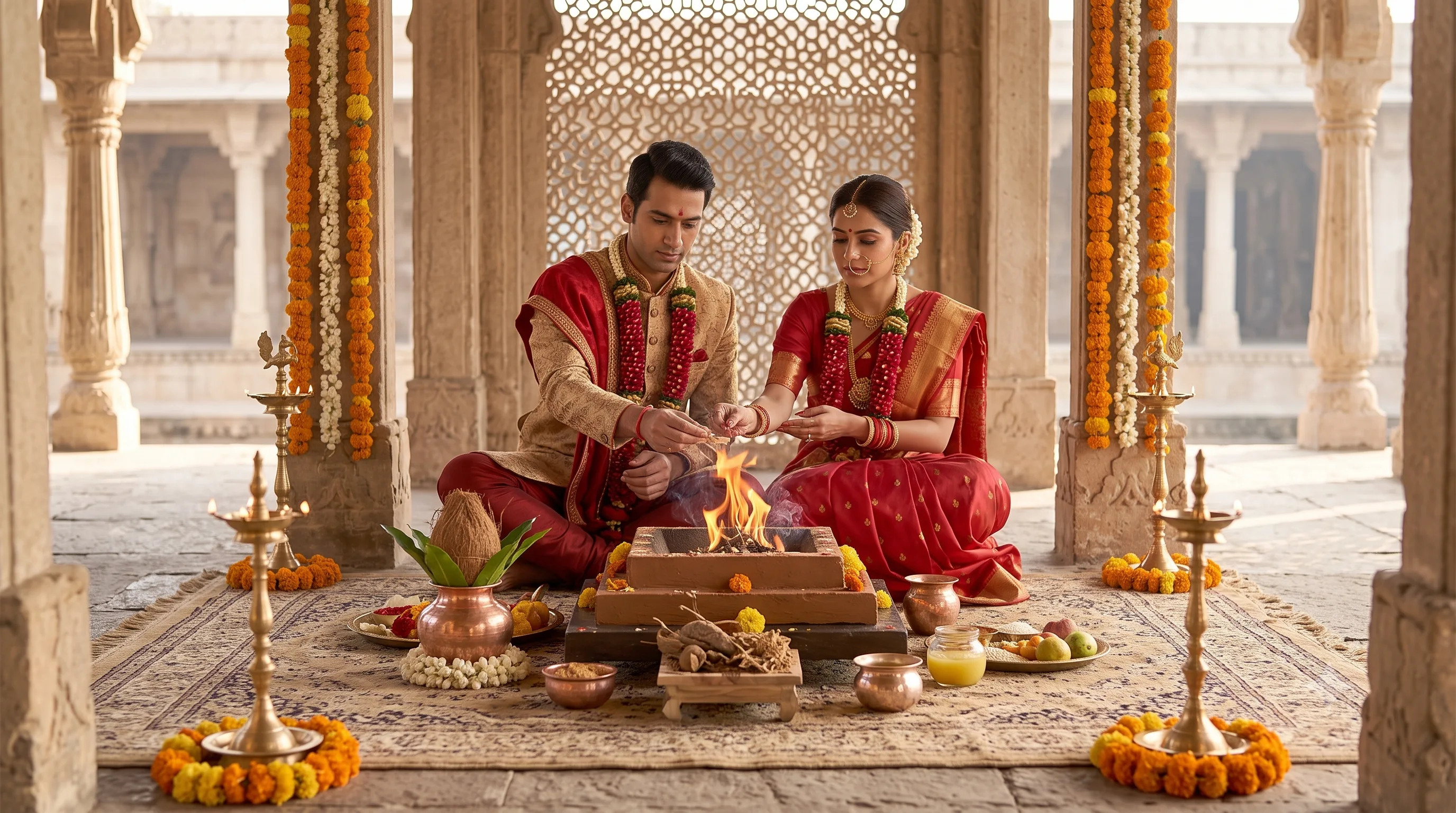
Hindu marriage — Vivaha Sanskar — unfolds across several ceremonies rather than a single event. This guide covers the twelve rituals in Avyani's catalogue, from the betrothal to the rites of early married life, and sets out what the law actually says about the seven steps.
Vivaha Sanskar (विवाह संस्कार) is the fourteenth of the sixteen samskaras described in our Sixteen Samskaras guide, and in most traditions it unfolds across several distinct ceremonies. Avyani's Master Puja & Ritual Catalogue records twelve rituals spanning betrothal, the days before, the wedding itself and early married life.
Where this guide says scripture, it names a text you can check; where it says tradition or regional practice, the custom is real and widely followed but has no single locator. Weddings vary more by region and community than almost anything else in this catalogue.
Betrothal
The sequence usually opens with an Engagement Puja or Ring Ceremony, formalising the agreement between families — known in Telugu and Tamil traditions as Nishchitartham (निश्चितार्थम्), where the formal declaration and often the fixing of the muhurta take place.
The Days Before
Haldi (हल्दी) applies turmeric paste to bride and groom, and Mehendi (मेहंदी) is the ceremonial application of henna. Both are family occasions rather than priestly ones.
Practical guidance. Buy plain henna. Cones sold as "black henna", or promising a jet-black stain within minutes, commonly contain PPD, a hair-dye chemical that is not permitted on skin and that causes blistering and chemical burns — the evidence is set out in our Miscellaneous guide. Natural henna stains orange and deepens to brown or maroon over a day or two; it is never black.
Mangala Snanam, the ceremonial bath, is performed shortly before the main ceremony in many traditions.
The Wedding
Two moments carry particular weight. Kanyadaan (कन्यादान) is the formal giving of the bride by her father or guardian. Saptapadi (सप्तपदी) is the seven steps taken together before Agni — and in the traditions whose rites include it, the point at which the marriage is complete.
Scripture and law. The rite is described in the Grihya Sutras, and the Ashvalayana Grihya Sutra also gives the stone-stepping that accompanies it — "Tread on this stone; like a stone be firm" (1.7.7), covered in our Miscellaneous guide.
Indian law takes its lead from the customary rite rather than prescribing one. The Hindu Marriage Act, 1955 provides at section 7 that a Hindu marriage may be solemnised in accordance with the customary rites and ceremonies of either party, and that where those rites include saptapadi, the marriage becomes complete and binding when the seventh step is taken. Many Hindu marriages are validly solemnised under customs that do not include saptapadi at all.
Regional practice. The rest varies widely. In Tamil and Telugu weddings the thaali or mangalyam is tied and the bride steps on the ammi; in the north the pheras are taken around the fire and sindoor is applied; Bengali weddings have the shubho drishti and mala badal; Maharashtrian weddings the antarpat. None of these is a deviation. The saptapadi and the fire are the common thread.
After the Wedding
Three rituals in this category belong to early married life. Godh Bharai is the household form of the Simantonnayana samskara, a blessing for mother and unborn child in later pregnancy. Garbha Raksha Puja and Santan Gopal Puja are performed during pregnancy and by couples hoping for children.
On the pregnancy and progeny rituals. These are recorded as the tradition's own observances, undertaken for wellbeing and blessing. They are not medical care, and Avyani does not suggest they affect any medical outcome. Antenatal care belongs with a doctor or midwife, and families commonly arrange both without any conflict.
Marriage Rituals at a Glance
Durations are typical planning ranges. "Traditionally for" records the intention the tradition assigns — not an outcome Avyani predicts or guarantees.
| Ritual | Tradi |
Typical duration | Priest advised |
|---|---|---|---|
| Engagement Puja | Formalising the agreement | 1 hour | No |
| Ring Ceremony Puja | Exchange of rings | 30–45 mins | No |
| Nishchi | Formal betrothal | 1 hour | Yes |
| Haldi Ceremony | Turmeric; blessing | 1–2 hours | No |
| Mehendi Ceremony | Henna; see the note above | 2–3 hours | No |
| Mangala Snanam | Bath before the wedding | 1 hour | Yes |
| Vivah Sanskar | The marriage itself | 3–4 hours | Yes |
| Kanyadaan | Giving of the bride | 20–30 mins | Yes |
| Saptapadi | The seven steps before Agni | 15–20 mins | Yes |
| Godh Bharai Puja | Mother and unborn child | 1–2 hours | No |
| Garbha Raksha Puja | Blessing during pregnancy | 1 hour | Yes |
| Santan Gopal Puja | Tradi | 45–60 mins | No |
For the samagri a wedding uses — haldi, mehendi, the ashmarohan stone, the mangalsutra, cloth and thread — see the Samagri Catalogue.
Sources
- Ashvalayana Grihya Sutra 1.7.7 on treading the stone; the saptapadi and the fire are described in the Grihya Sutras generally.
- Hindu Marriage Act, 1955, section 7: a Hindu marriage may be solemnised according to the customary rites of either party, and where those rites include saptapadi it becomes complete and binding on the seventh step. The Act does not require saptapadi of every Hindu marriage. Stated for information; this is not legal advice.
- Regional wedding forms — thaali and ammi in the south, pheras and sindoor in the north, shubho drishti in Bengal, antarpat in Maharashtra; documented regional practice.
- "Black henna" and PPD — US Food and Drug Administration guidance, cited in full in our Miscellaneous guide.
- Ritual names, durations and priest-advised flags — Avyani Master Puja & Ritual Catalogue. Durations are planning ranges, not prescriptions.
Where a scriptural locator could not be verified, the statement is given as tradition or regional practice rather than scripture. Stated purposes are the intentions the tradition assigns, not outcomes Avyani predicts. Nothing here is medical or legal advice.