


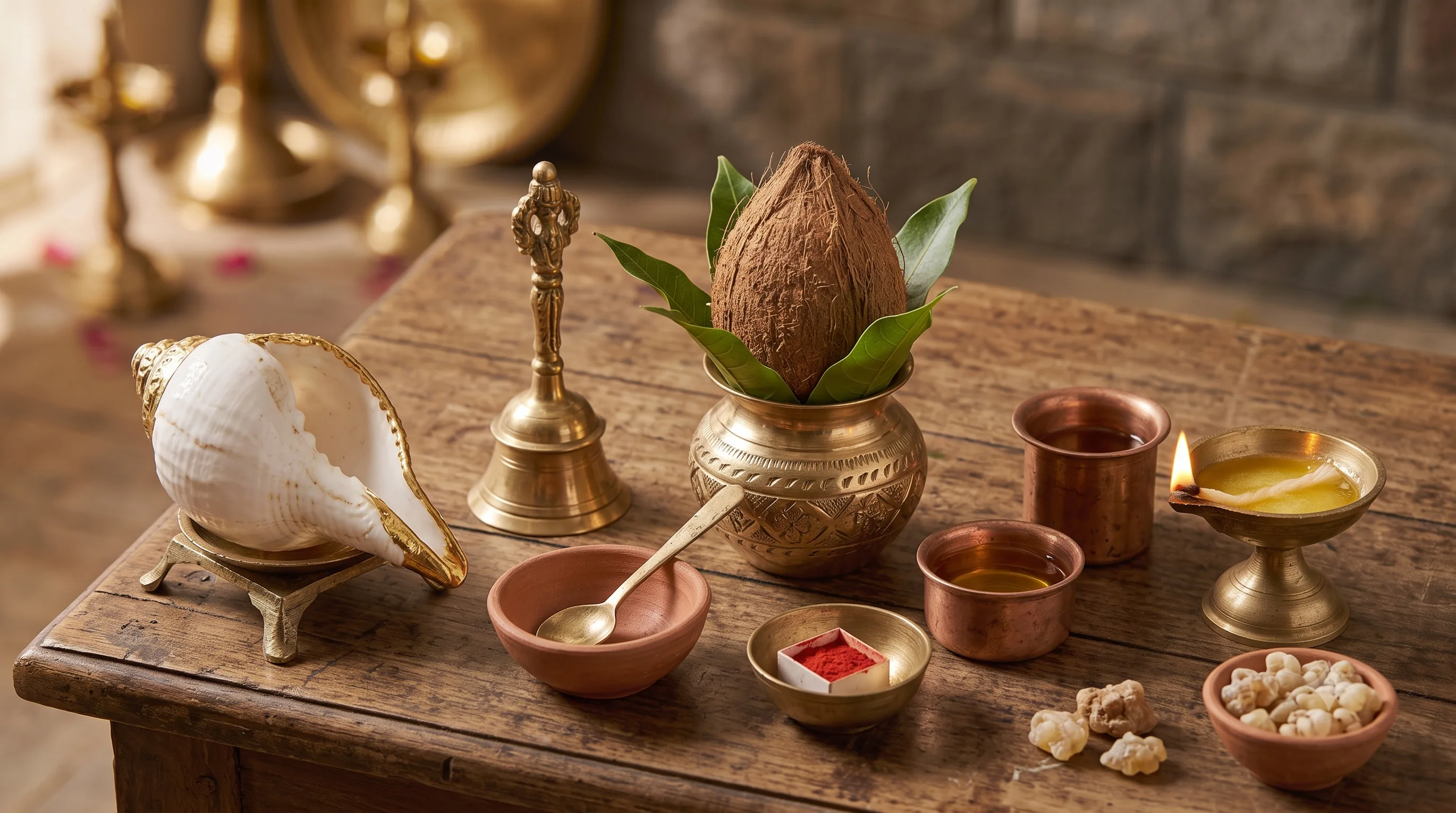
Not every samagri item fits neatly into a category — some belong to a single samskara, a single pilgrimage or a single festival, yet each still has its own quiet purpose. This guide covers the twelve such items in Avyani's Master Samagri Catalogue.
This is the catalogue's catch-all, and its twelve items have nothing in common except that each belongs to one occasion rather than to the general run of worship. Several of them are also the items where a buying decision carries real consequences, which is why this guide is more practical than most.
Where this guide says scripture, it names a text and verse you can check; where it says tradition or regional practice, the custom is real and widely followed but has no single locator.
The Ashmarohan Stone
The ashmarohan stone (अश्मारोहण शिला) is the flat stone the bride steps on during the wedding, in the rite described in our Marriage Rituals guide.
Scripture. It is among the oldest surviving elements of the Hindu wedding. The Ashvalayana Grihya Sutra gives both the act and its words: each time the groom has led her round, he makes her tread on the stone with "Tread on this stone; like a stone be firm" (1.7.7). The verse asks for steadiness, and that is the whole meaning of the object.
Regional practice. In Tamil and Telugu weddings the stone is the household ammi, the granite grinding stone, and the moment is given more prominence than it usually receives in the north.
Danda and Asan
The danda (दंड), a wooden staff, is given to the boy at Upanayana — see our Sixteen Samskaras guide. Traditional texts specify the wood by the student's varna and the staff's height by his stature; palash, bilva and udumbara all appear in different lists.
The seat is catalogued as mrigachhala or kush asan (मृगछाला/कुश आसन) — deer skin or a kusha grass mat.
Deer skin is protected animal material, and Indian wildlife law governs it. Under the Wildlife (Protection) Act, 1972, possessing, transferring, selling or transporting material from protected species may require valid provenance, a declaration, an ownership certificate, or written permission from the Chief Wildlife Warden, depending on the species and the circumstances.
Do not acquire or use deer skin without verified lawful documentation. Where a family holds an inherited piece, the position turns on that documentation and on how the law applies to the particular piece — a question for a qualified legal adviser and the state wildlife authority. Avyani gives no legal assurance either way.
Avyani recommends the kusha grass asan, which is traditional, lawful and in ordinary use. The catalogue's combined label "Mrigachhala/Kush Asan" is flagged for separate data review.
The Clay Ganesh Idol
A clay Ganesh idol (मिट्टी गणेश मूर्ति) is installed and later immersed in the Chaturthi sequence described in our Ganapati Rituals guide. The catalogue specifies clay, and there is now a regulatory reason as well as a traditional one.
The Central Pollution Control Board's Revised Guidelines for Idol Immersion, issued in May 2020, ban idols made of plaster of Paris, do not permit single-use plastic or thermocol, and prohibit toxic non-biodegradable dyes and paints — naming mercury, cadmium, arsenic, lead and chromium among the heavy metals to avoid. Natural clay and mud, with natural colours and biodegradable decoration, is what the guidelines encourage.
Practical guidance. Unfired clay is heavier and more fragile than PoP and does not hold fine detail as sharply — that is the trade, and it is the right one. Handle it from the base, keep it dry until visarjan, and where a home immersion is intended, a large vessel of water dissolves a small clay murti cleanly.
Mehendi
Mehendi (मेहंदी) is henna, the paste of dried Lawsonia inermis leaves, applied before weddings and festivals. Natural henna stains orange at first and deepens over a day or two to brown or maroon. It does not stain black.
Avoid "black henna". Natural henna is never black.
- Cones sold as black henna, or promising an instant jet-black stain, commonly contain para-phenylenediamine (PPD), a hair-dye chemical that is not permitted in products applied directly to the skin.
- The US Food and Drug Administration warns about these products, and published testing has found PPD at concentrations far above what is allowed even in hair dye.
- Reactions include intense itching, redness, blistering, chemical burns, and in some cases permanent scarring or lifelong sensitisation from a single application. Children are frequently the ones affected.
- Buy plain henna, check for a stated ingredient list, and be wary of any cone that stains black within minutes. If a reaction develops, seek medical advice.
This is not medical advice; a doctor is the right person to advise on any skin reaction.
Chalni, Toran and Rangoli
The chalni (छलनी), a sieve, is held up to view the moon and then the husband at Karva Chauth — a north Indian observance. A toran (तोरण) is the doorway hanging, strung fresh from mango leaves and marigold or kept as a worked cloth or beaded piece; the fresh version is described in our Flowers and Leaves guide.
Rangoli colours (रंगोली रंग) are used across the festivals in our Festival Rituals guide. Composition varies widely, and rangoli ends up on hands, on floors where people walk barefoot and eventually swept outdoors. Rice flour, dry turmeric, and dried flower petals are the traditional materials and remain the better choice; where packaged colours are bought, prefer ones that state what is in them.
Pilgrimage Items
The irumudi kettu (इरुमुडी कट्टू) is the two-compartment cloth bundle carried on the head to Sabarimala — offerings in the front, the pilgrim's own provisions behind. It is filled and tied in a prescribed ceremony, and a pilgrim does not ascend the eighteen steps without it.
The kanwar (कांवड़) is the decorated bamboo pole from which pots of Ganga water are slung across the shoulders on the Kanwar Yatra in Shravan. Both belong to the living diversity described in our Regional Rituals guide, and both are prepared under the guidance of those who lead the yatra rather than assembled from a shop list.
Dakshina and Go Grass
Dakshina (दक्षिणा) is the offering made to the officiating priest, traditionally with a coin and a betel nut. It completes the rite rather than paying for it, and by long convention the amount is not haggled over.
Go grass (गौ चारा) is the fodder offered in Go Puja and in go-grasa seva, the practice of setting aside the first portion of a meal for a cow. Offer fresh green fodder, and never bread, spiced food or anything in a plastic bag — plastic swallowed by free-roaming cattle is a well-documented cause of death.
Miscellaneous Items at a Glance
| Item | Hindi | What it is | Mandatory / Optional |
|---|---|---|---|
| Ashma |
अश्मारोहण शिला | Stone stepped on at the wedding | Mandatory |
| Chalni (Sieve) | छलनी | Held to view the moon at Karva Chauth | Mandatory |
| Clay Ganesh Idol | मिट्टी गणेश मूर्ति | Natural clay; no PoP, plastic or thermo |
Mandatory |
| Coins / Dakshina | दक्षिणा | Offering to the officiating priest | Optional |
| Cow Fodder | गौ चारा | Fresh green fodder for go-grasa seva | Optional |
| Danda | दंड | Wooden staff; Upana |
Optional |
| Kush Asan | कुश आसन | Kusha grass mat; see the legal note above | Optional |
| Mehendi | मेहंदी | Henna paste; never buy black henna | Optional |
| Irumudi Kettu | इरुमुडी कट्टू | Two-part bundle; Sabari |
Optional |
| Kanwar | कांवड़ | Bamboo carrying pole; Kanwar Yatra | Optional |
| Rangoli Colours | रंगोली रंग | Prefer rice flour, turmeric, petals | Optional |
| Toran | तोरण | Doorway hanging, fresh or worked | Optional |
See our Understanding Samagri guide for how these fit the wider catalogue.
Sources
- Ashvalayana Grihya Sutra 1.7.7, on treading the stone — Oldenberg translation.
- Wildlife (Protection) Act, 1972 — requirements that may apply to possessing, transferring, selling or transporting protected animal material, including provenance, declarations, ownership certificates and written permission of the Chief Wildlife Warden. Summarised here for awareness only; this is not legal advice.
- Central Pollution Control Board, Revised Guidelines for Idol Immersion, May 2020 — ban on plaster of Paris, single-use plastic and thermocol, and on toxic non-biodegradable dyes and paints.
- "Black henna" and PPD — US Food and Drug Administration, Temporary Tattoos, Henna/Mehndi, and "Black Henna" fact sheet, and published testing of PPD concentrations in such products.
- Item names, Hindi names and mandatory flags — Avyani Master Samagri Catalogue v1. The catalogue's combined label "Mrigachhala/Kush Asan" is flagged for separate data review; this guide recommends the kusha asan.
Where a scriptural locator could not be verified, the statement is given as tradition or regional practice rather than scripture. Nothing here is legal or medical advice.