


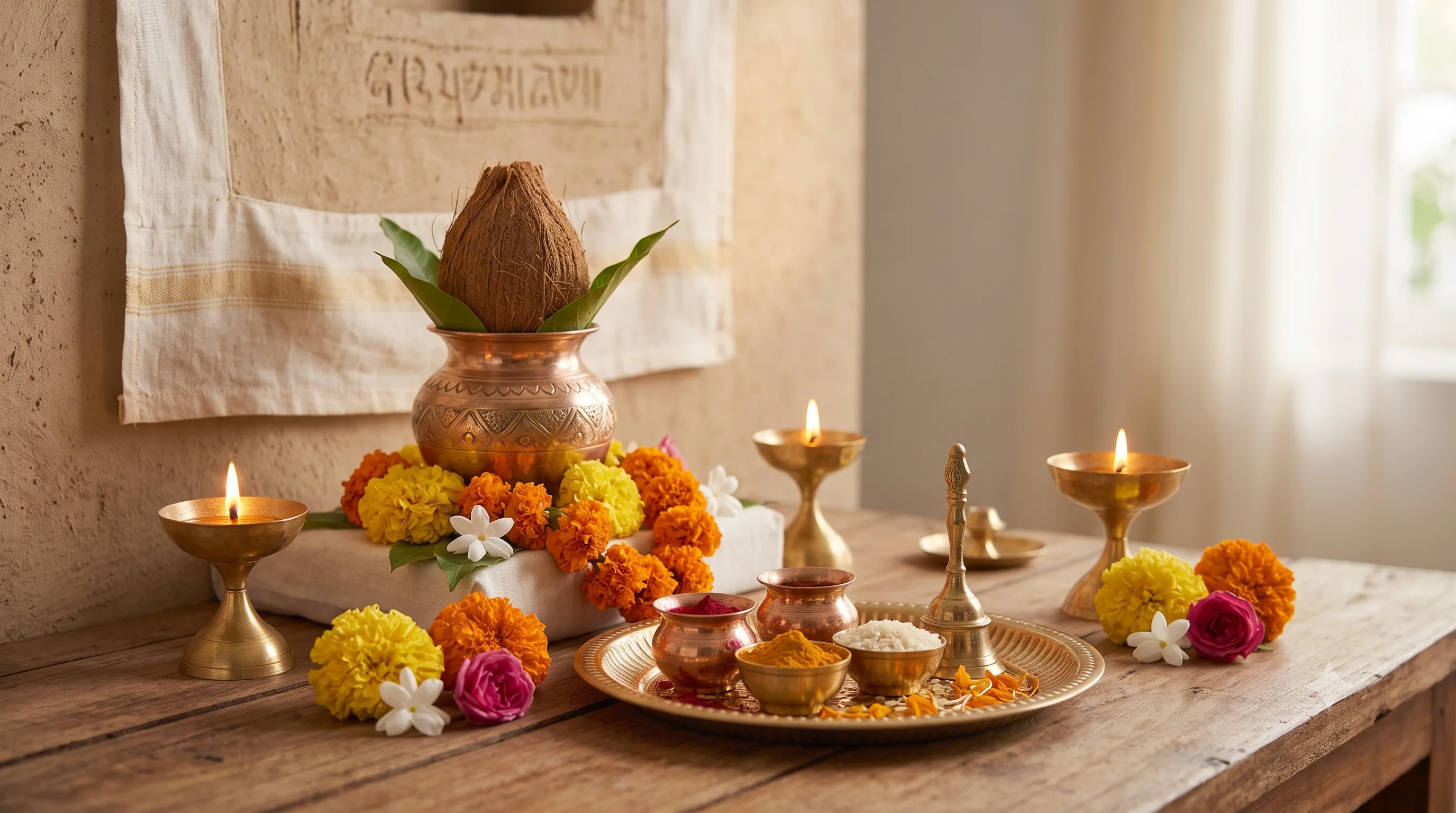
Thirty-five festival observances across the year — the specific worship performed on each major festival day, spanning the pan-Indian calendar and the regional observances that sit alongside it.
Our Hindu Festivals Through the Year guide sets out the calendar. This one covers the worship performed on the day: thirty-five festival rituals recorded in Avyani's Master Puja & Ritual Catalogue.
Where this guide says tradition or regional practice, the custom is real and widely followed but has no single locator. Festival practice is where regional variation is widest, and dates differ between calendars even for the same festival.
How the Calendar Works
Almost every festival here follows the lunar calendar, which is why the Gregorian dates move each year. Two conventions matter, and they are the reason a festival can fall on different days in different states.
Tradition. The purnimanta reckoning ends the month at the full moon; the amanta ends it at the new moon. North India largely follows the first and the south and west the second, so the same festival can carry different month names. Only a few observances — Makar Sankranti among them, described in our Surya Rituals guide — are fixed to the solar calendar and fall on nearly the same date each year.
Spring
Holika Dahan is the bonfire on the night before Holi, commemorating Prahlad's deliverance; Holi Puja follows the next day. Basant Panchami honours Saraswati at the turn of the season, and Chaitra Navratri is the spring counterpart of the autumn nine nights, closing at Ram Navami.
Regional practice. The regional new years cluster here and are genuinely distinct festivals rather than local names for one: Gudi Padwa in Maharashtra, Ugadi in the Deccan, Vishu in Kerala with its kani arrangement viewed on waking, Poila Boishakh in Bengal with the opening of new account books, Baisakhi in Punjab and Bihu in Assam.
Monsoon and Early Autumn
Guru Purnima honours teachers, Nag Panchami the serpent deities, and Raksha Bandhan the sibling bond — the rakhi itself is covered in our Cloth and Sacred Threads guide. Onam and Thiruvonam mark Kerala's harvest and the homecoming of Mahabali.
Pitru Paksha, the sixteen-day ancestral fortnight, closes at Mahalaya Amavasya — which is also the day the Goddess is invoked in Bengal, so the ancestral fortnight ends exactly where Navratri begins. Our Shraddha and Pitru Karma guide covers the rites.
Navratri to Diwali
Sharadiya Navratri is the autumn nine nights, with Durga Puja Sandhi Puja at its heart — the forty-eight minutes spanning the junction of Ashtami and Navami, one of the most precisely timed observances in the tradition. Dussehra closes it.
Then the Diwali sequence: Naraka Chaturdashi, Deepavali Puja described in our Lakshmi Rituals guide, Govardhan Puja, and Bhai Dooj. Tulsi Vivah follows, marrying the tulsi plant to Vishnu and ending Chaturmas — after which weddings resume.
Kartik Purnima and Karthika Deepam close the season with lamps, the latter with the great fire lit on Arunachala at Tiruvannamalai.
Southern and Eastern Observances
Skanda Shashti is the six-day Murugan observance of Tamil Nadu, and Thaipusam its great vow-fulfilment festival, kept in Tamil Nadu and across the Tamil diaspora. Ayyappa Mandala Puja is the forty-one-day vrat preceding the Sabarimala pilgrimage, closing at Makara Vilakku — see our Temple Festivals and Special Sevas guide.
At Puri, Snana Yatra bathes the deities before the Rath Yatra and Bahuda Yatra brings them home. Ganga Dussehra honours the river's descent, and Rongker is a Karbi community observance of Assam.
Festival Rituals at a Glance
Durations are typical planning ranges. "Traditionally for" records the intention the tradition assigns — not an outcome Avyani predicts or guarantees. Dates follow the lunar calendar and differ between regions.
| Festival | Tradi |
Typical duration | Priest advised |
|---|---|---|---|
| Holika Dahan | The bonfire; evil burned | 1–2 hours | No |
| Holi Puja | Colour, love, spring | 1–2 hours | No |
| Basant Panchami Puja | Saraswati; spring | 30–45 mins | No |
| Chaitra Navratri Puja | The spring nine nights | 9 days | Yes |
| Gudi Padwa Puja | New year; Maharashtra | 30–45 mins | No |
| Ugadi Puja | New year; the Deccan | 30–45 mins | No |
| Vishu Puja | New year; Kerala | 30–45 mins | No |
| Poila Boishakh Puja | New year; Bengal | 30–45 mins | No |
| Baisakhi Puja | Harvest; Punjab | 1 day | No |
| Bihu Puja | Harvest and new year; Assam | Multi-day | No |
| Ganga Dussehra Puja | The river's descent | 1 hour | No |
| Guru Purnima Puja | Thanks to one's teachers | 1 hour | No |
| Nag Panchami Puja | The serpent deities | 30–45 mins | No |
| Raksha Bandhan Puja | The sibling bond | 30–45 mins | No |
| Onam Puja | Harvest; Mahabali's return | 1 day | No |
| Onam Thiruvonam Puja | The chief day of Onam | 1 day | No |
| Pitru Paksha Rituals | The ancestral fortnight | 16 days | Yes |
| Mahalaya Amavasya Puja | Closing Pitru Paksha | 1–2 hours | Yes |
| Sharadiya Navratri Puja | The autumn nine nights | 9 days | Yes |
| Durga Puja Sandhi Puja | The junction of Ashtami and Navami | 48 mins | Yes |
| Dussehra Puja | Good over evil | 2–3 hours | Yes |
| Naraka Chatur | Opening the Diwali days | 30–45 mins | No |
| Deepavali Puja | Lamps; Lakshmi; homecoming | 1–2 hours | Yes |
| Govardhan Puja | Thanks to hill and herd | 1–2 hours | No |
| Bhai Dooj Puja | The sibling bond | 30–45 mins | No |
| Tulsi Vivah Puja | Tulsi wed; Chaturmas ends | 1–1.5 hours | Yes |
| Kartik Purnima Puja | Lamps on the full moon | 1 hour | No |
| Karthika Deepam Puja | The lamp on Arunachala | 1 day | No |
| Skanda Shashti Puja | Six days for Murugan | 6 days | Yes |
| Thaipusam Rituals | Vows fulfilled; penance | 1 day | Yes |
| Ayyappa Mandala Puja | The vrat before Sabari | 41–48 days | No |
| Makara Vilakku Rituals | Closing the Sabari | 1 day | Yes |
| Ratha Yatra Snana Yatra | Bathing before the Rath Yatra | 1 day | Yes |
| Puri Bahuda Yatra | The return procession | 1 day | Yes |
| Rongker Puja | Karbi community welfare | 1 day | Yes |
For the samagri a festival uses, see the Samagri Catalogue, and our Regional Rituals guide for the observances that belong to one region alone.
Sources
- Purnimanta and amanta month reckonings, and the resulting regional differences in festival dating — standard calendrical practice.
- Sandhi Puja at the forty-eight-minute junction of Ashtami and Navami — established Durga Puja practice.
- Tulsi Vivah as the close of Chaturmas, after which weddings resume — established tradition.
- Regional new years as distinct festivals rather than local names for one — documented regional practice.
- Festival names, durations and priest-advised flags — Avyani Master Puja & Ritual Catalogue. Durations are planning ranges, not prescriptions; dates follow the lunar calendar.
Where a scriptural locator could not be verified, the statement is given as tradition or regional practice rather than scripture. Stated purposes are the intentions the tradition assigns, not outcomes Avyani predicts.