


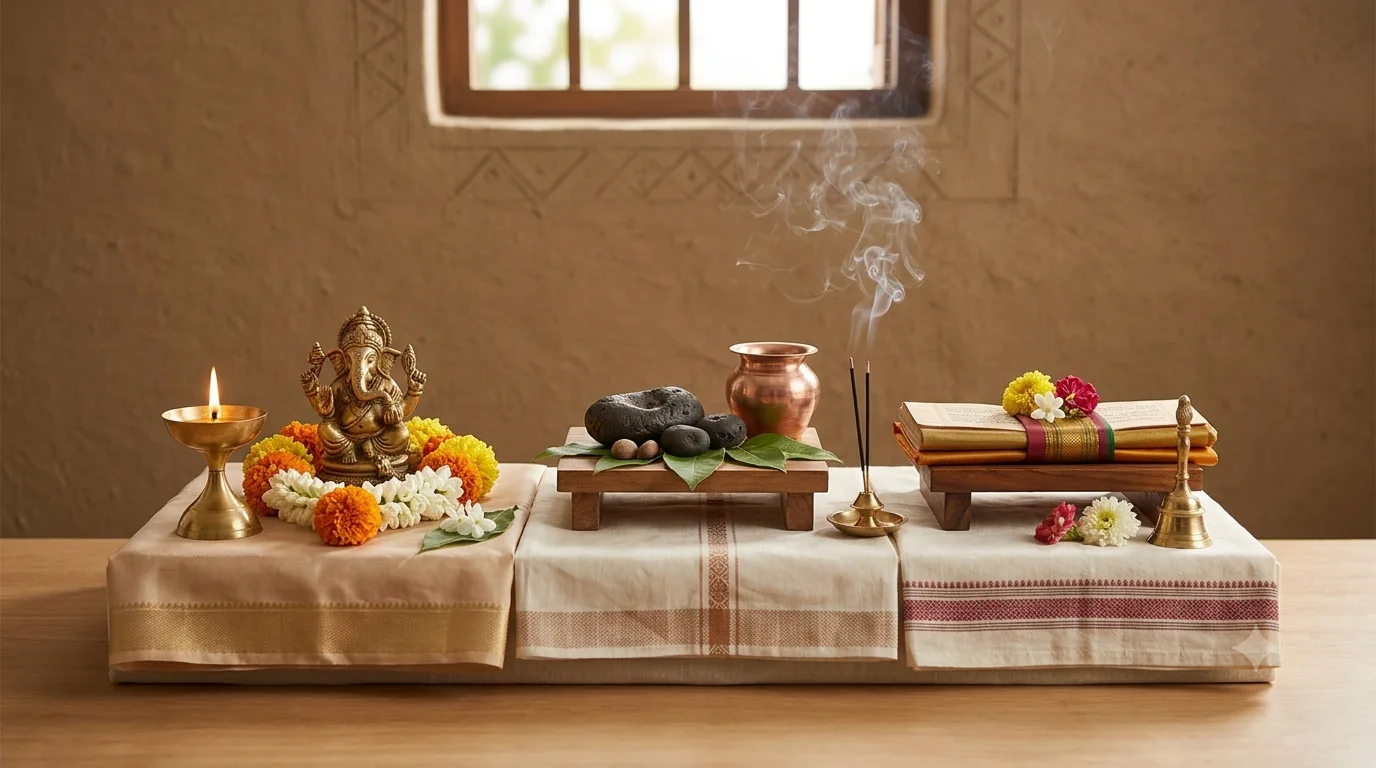
A sampradaya is a living lineage of teaching and practice. This final category records seven observances distinctive to particular Vaishnava, Shaiva and Advaita lineages — and explains why a catalogue can list them but not supply them.
A sampradaya (सम्प्रदाय) is a lineage — a line of teaching handed down, with its own philosophy, its own liturgy and its own authority. Avyani's Master Puja & Ritual Catalogue records seven observances distinctive to particular lineages, and this is the right note on which to close the Puja Catalogue: not with a summary, but with a reminder that the tradition is many traditions.
Everything in this category belongs to the lineage that holds it. Avyani describes; the sampradaya decides.
The Vaishnava Lineages
Panchang Sthapana and the Udupi Krishna Paryaya Utsav belong to the Madhva sampradaya, which follows the Dvaita philosophy of Madhvacharya. The Paryaya is the biennial transfer of custodianship of the Udupi Krishna temple between the eight Ashta Mathas — each math taking the worship in turn, in a rotation running since the thirteenth century.
Nimbarka Sampradaya Yugal Seva is the daily worship of Radha and Krishna as an inseparable pair, which is the distinctive theological emphasis of the Nimbarka line. Ramanandi Sampradaya Puja belongs to the largest Vaishnava monastic order in northern India, whose tradition of initiation across social boundaries is one of its defining features.
ISKCON Sankirtan Yajna is the congregational chanting of the Gaudiya tradition — the one entry here that is open to anyone who arrives, and needs no priest at all. Our Vishnu Rituals guide covers the wider Vaishnava sevas.
The Advaita and Smarta Peethams
Sringeri Sharada Peetham Rituals and the Kanchi Kamakshi and Kamakoti Peetham Rituals are the observances of two of the principal seats of the Advaita tradition, with their own daily worship, their own festival calendars and their own presiding acharyas. Sringeri's worship of Sharada connects to the Devi traditions in our Devi Rituals guide, and Kanchi's to both Devi and the Smarta Panchayatana described in our Daily Worship guide.
Why This Category Is Different
Every other category in the Puja Catalogue lists things that can be arranged. This one largely does not, and it is worth saying why.
These observances are performed by the lineage, at its own seat, on its own calendar. A householder can attend, can be present for darshan, can in some cases sponsor a seva through the institution — but cannot commission the Paryaya or arrange a Peetham's daily worship, because those are not services. They are the life of an institution.
Where a family belongs to a sampradaya, its acharya or its appointed priest is the authority on what is observed and how. Where a family does not, these remain worth knowing about, because they are a large part of how the tradition has actually been transmitted.
Tradition. Avyani records these seven because a catalogue that stopped at the pan-Indian deities would misrepresent the tradition it documents. Seven is a sample; the sampradayas number many more, and several of the largest have not been recorded here at all.
Sampradaya Rituals at a Glance
Durations are typical planning ranges. "Traditionally for" records the intention the tradition assigns — not an outcome Avyani predicts or guarantees. Access and participation are matters for the lineage concerned.
| Observance | Tradi |
Typical duration | Priest advised |
|---|---|---|---|
| Panchang Sthapana (Madhva) | The Madhva ritual calendar | Ongoing | Yes |
| Udupi Krishna Paryaya Utsav | Transfer of temple charge | Multi-day | Yes |
| Nimbarka Yugal Seva | Radha and Krishna as a pair | Daily cycle | Yes |
| Ramanandi Sampra | Rama-bhakti; Ramanandi | 1 hour | Yes |
| ISKCON Sankirtan Yajna | Chanting together | 1–3 hours | No |
| Sringeri Sharada Peetham Rituals | The Sringeri seat's worship | Ongoing | Yes |
| Kanchi Kamakoti Peetham Rituals | The Kanchi seat's worship | Ongoing | Yes |
For the full Puja Catalogue, browse the Puja Catalogue; for the materials these rituals use, the Samagri Catalogue.
Sources
- The Udupi Paryaya as a biennial rotation of custodianship among the Ashta Mathas, in a tradition running from the thirteenth century — documented institutional practice.
- Nimbarka's Yugal emphasis on Radha and Krishna as an inseparable pair; the Ramanandi order's initiation across social boundaries — established features of those lineages.
- Sringeri and Kanchi as principal Advaita seats with their own daily worship and calendars — institutional practice; each institution is the authority on its own observance.
- Observance names, durations and priest-advised flags — Avyani Master Puja & Ritual Catalogue. Durations are planning ranges, not prescriptions.
Everything here is the practice of a particular lineage and is described as such. Where a sampradaya holds its own tradition, that lineage is the authority on how it is described and who may participate. Stated purposes are the intentions the tradition assigns, not outcomes Avyani predicts.