


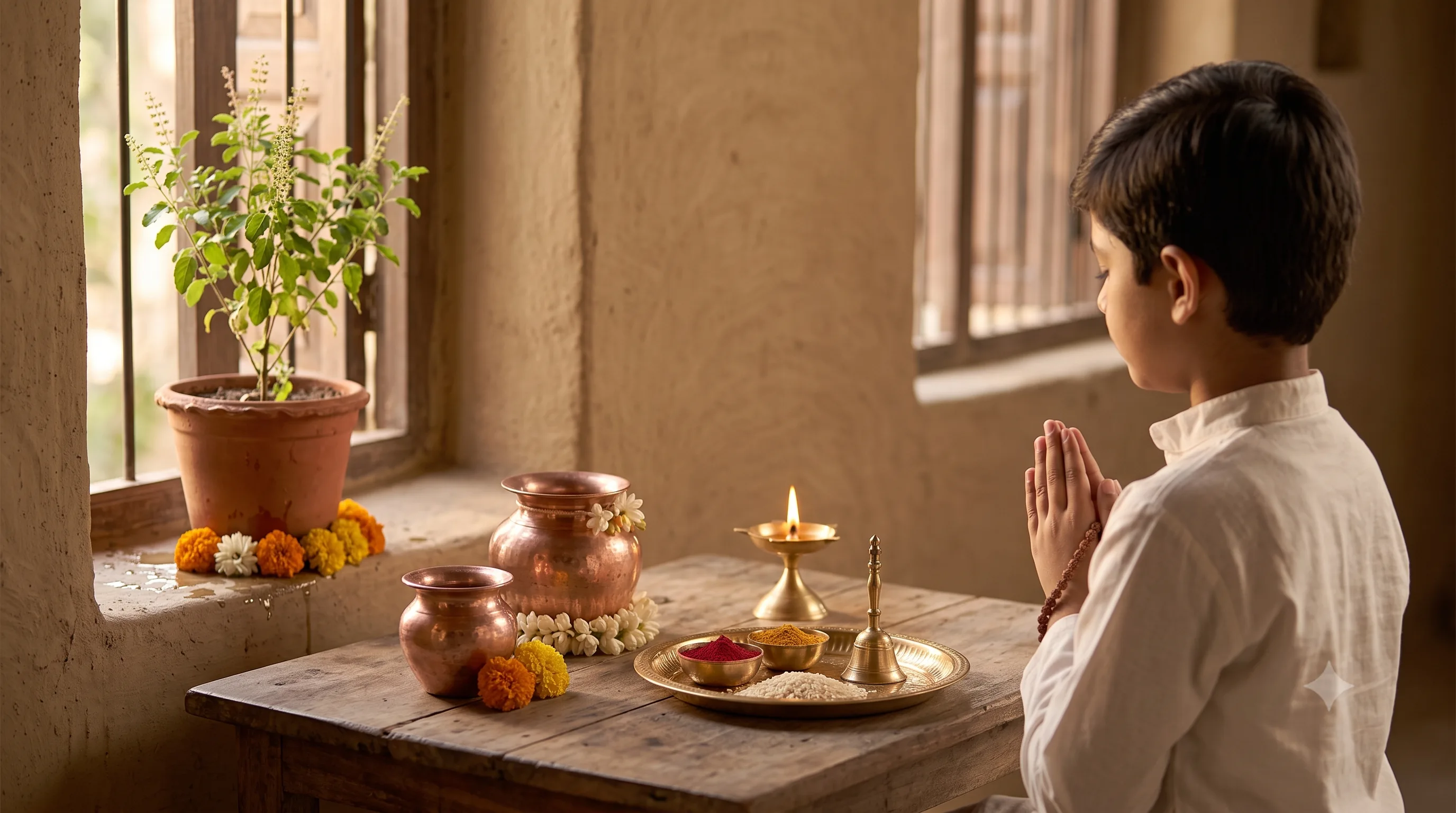
Fifteen daily observances — from Nitya Puja at the home shrine to Sandhya Vandanam and Agnihotra. This guide sets out how the upachara sequences differ, what belongs to the Grihya tradition, and which of these still need a priest.
Nitya karma (नित्य कर्म), daily religious duty, is the foundation the rest of the Puja Catalogue rests on. Avyani's Master Puja & Ritual Catalogue records fifteen such observances, most of them short, most of them needing no priest.
This is an overview, not a manual. Where it says scripture, it names a text you can check; where it says tradition or regional practice, the custom is real and widely followed but has no single locator, and households differ a great deal.
The Home Shrine
Nitya Puja, daily worship of the family's chosen deity, is the most widespread ritual practice in Hinduism and the least standardised. What it involves depends on how many upacharas are offered.
- Panchopachara — five: fragrance, flower, incense, lamp, food.
- Dashopachara — ten, adding the reception of a guest: a seat, water, and so on.
- Shodashopachara — sixteen, the full formal sequence, ending with leave-taking.
The logic is set out in our Understanding Samagri guide, and the methods themselves in Abhishekam and Worship Methods. The exact composition of the sixteen varies between paddhati; no single list is the authoritative one.
Ishta Devata Puja is the same worship named for its object — the deity a person holds personally. Kuldevta Puja addresses the family's lineage deity, and is the one entry here that genuinely differs house to house: which deity, on which days, with which offerings, is family knowledge rather than public knowledge, and a priest of that lineage is the person to ask.
The Vedic Layer
Sandhya Vandanam is the twilight worship performed at the junctions of the day — dawn and dusk, and at noon in the fuller three-time form. It is a Grihya Sutra observance, older than almost anything else in this catalogue, and it is built around the Gayatri.
Scripture. That verse is Rigveda 3.62.10, attributed to Vishvamitra and addressed to Savitr. Gayatri Upasana is its sustained recitation, covered in our Jaap and Paath guide.
Agnihotra is the daily fire offering, made at sunrise and sunset, and is the smallest surviving form of the shrauta tradition — a household rite that descends directly from the Vedic sacrifice. It is the one item here that most often calls for someone trained; see our Havan Samagri: What You Need for a Fire Ritual guide for handling an open flame indoors.
Lamp, Tulsi, Cow and Sun
Four short observances make up much of an ordinary morning. Deepa Puja is the lighting of the lamp, and takes minutes — our Incense, Camphor, Oils and Ghee guide covers oils and wicks. Tulsi Puja waters and circumambulates the plant, most often in Vaishnava households; the plucking conventions vary by region and are noted in our Flowers and Leaves guide.
Go Puja honours the cow, and in many households takes the practical form of go-grasa — the first portion of the meal set aside, described in our Miscellaneous guide. Surya Arghya and Surya Namaskar Puja are covered in our Surya Rituals guide, which also explains why the familiar twelve-posture sequence is a twentieth-century development rather than an ancient one.
Panchayatana Puja
Panchayatana Puja worships five deities together — Shiva, Vishnu, Devi, Surya and Ganesha — arranged with the household's chosen one at the centre and the other four around it.
Tradition. The arrangement is associated with Adi Shankaracharya and with the reconciling of the major sampradayas in a single household practice. The attribution is traditional rather than documented, and Avyani records it as such; the practice itself is well attested and still kept.
Keeping a Daily Practice
Practical guidance. Almost everything in this category is short. Nitya puja in its five-offering form takes a quarter of an hour, deepa puja and arghya take minutes, and the point of nitya karma is that it is done daily rather than done elaborately.
A shrine that is easy to reach gets used. Our Caring for Puja Samagri at Home guide covers keeping the daily set separate from the occasional one, which is most of what makes a practice sustainable.
Daily Worship at a Glance
Durations are typical planning ranges. "Traditionally for" records the intention the tradition assigns — not an outcome Avyani predicts or guarantees.
| Ritual | Tradi |
Typical duration | Priest advised |
|---|---|---|---|
| Nitya Puja | Daily devotion in the home | 15–30 mins | No |
| Pancho | Simple daily worship | 15–20 mins | No |
| Dasho | Fuller daily worship | 30 mins | No |
| Shodasho | The full formal sequence | 45–60 mins | Yes |
| Ishta Devata Puja | One's own chosen deity | 15–30 mins | No |
| Deepa Puja | Lighting the lamp | 10 mins | No |
| Tulsi Puja | Purity; Vishnu's grace | 10 mins | No |
| Surya Arghya | Health and vigour | 5–10 mins | No |
| Surya Namaskar Puja | Salutation to the sun | 15–20 mins | No |
| Go Puja | Reverence for the cow | 15–20 mins | No |
| Sandhya Vandanam | Twilight worship; purity | 15–20 mins | No |
| Gayatri Upasana | Steady recitation; light | 20–30 mins | No |
| Agnihotra | Daily fire offering | 20–30 mins | Yes |
| Pancha | Five deities together | 30–45 mins | Yes |
| Kuldevta Puja | The family lineage deity | 1–2 hours | Yes |
Our How to Perform a Simple Home Puja guide walks through a first daily puja step by step.
Sources
- Gayatri — Rigveda 3.62.10, attributed to Vishvamitra and addressed to Savitr.
- Sandhya Vandanam and Agnihotra as Grihya and shrauta observances — established Vedic domestic ritual; no single verse locator is asserted.
- Panchopachara, Dashopachara and Shodashopachara — standard sequences; the composition of the sixteen varies between paddhati.
- Panchayatana Puja — traditionally associated with Adi Shankaracharya; the attribution is traditional and is described as such.
- Ritual names, durations and priest-advised flags — Avyani Master Puja & Ritual Catalogue. Durations are planning ranges, not prescriptions.
Where a scriptural locator could not be verified, the statement is given as tradition or regional practice rather than scripture. Stated purposes are the intentions the tradition assigns, not outcomes Avyani predicts.