


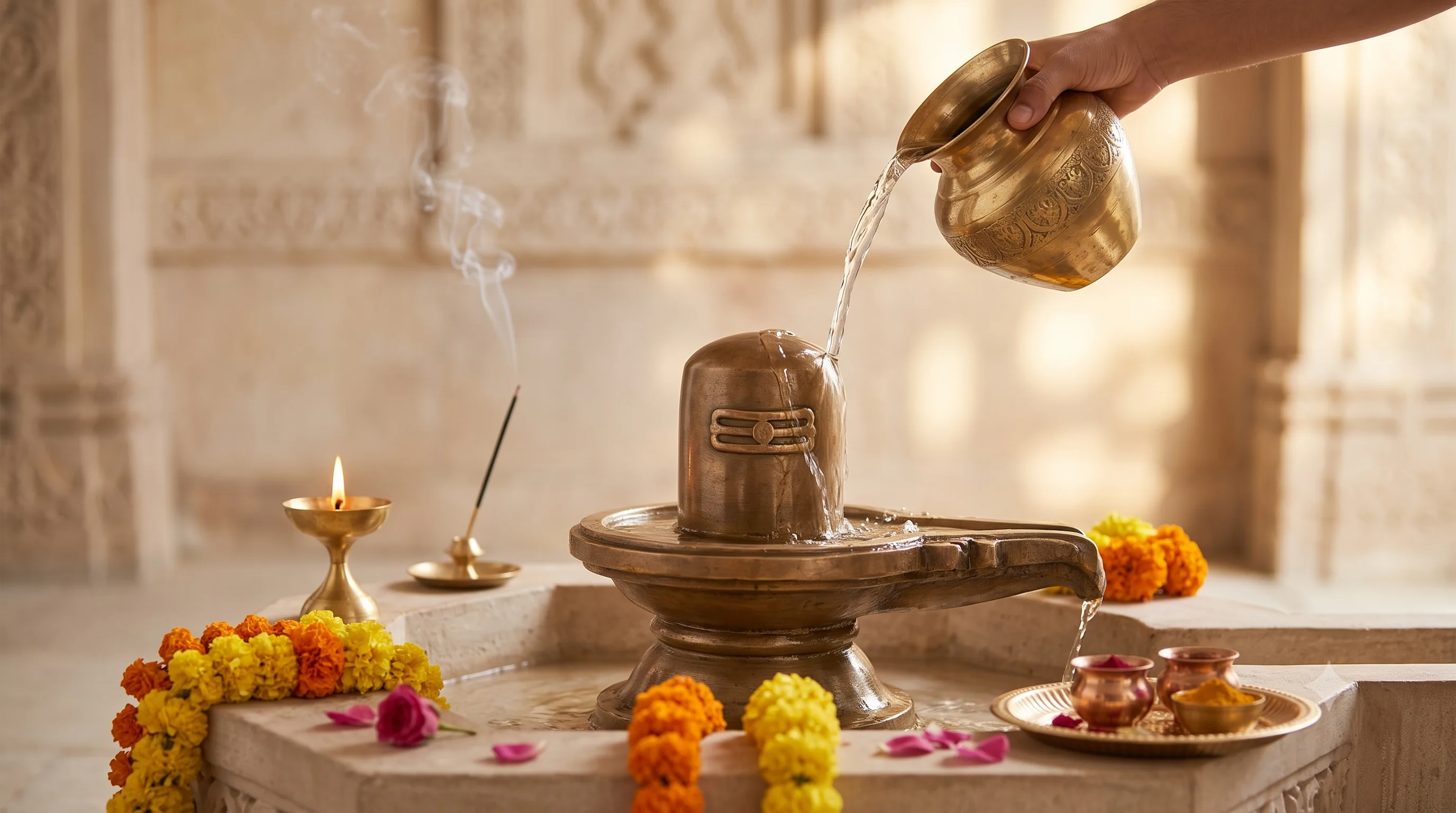
Abhishekam is the ritual bathing of a murti or linga; the upachara methods define how a deity is served in the first place. Together these fourteen entries are the underlying grammar behind most of the deity-specific rituals elsewhere in this catalogue.
Two things sit in this category, and they work at different levels. Abhishekam (अभिषेकम्) is a ritual act: bathing the murti or linga with a sacred substance. The upachara methods are not rituals at all but sequences — the ordered service that any puja follows. Avyani's Master Puja & Ritual Catalogue records nine of the first and five of the second.
Where this guide says tradition, the practice is widely followed but has no single locator, and Agama and Grihya traditions differ in emphasis throughout.
The Methods
A method answers the question of how many services are offered, and in what order. The tradition treats the deity as an honoured guest, and the sequences differ in how fully that hospitality is extended.
- Panchopachara — five services: fragrance, flower, incense, lamp, food.
- Shodashopachara — sixteen, adding the guest's reception: a seat, water for the feet, water to sip, the bath, cloth, ornament, and finally leave-taking.
- Panchayatana — the Smarta arrangement of five deities around a chosen centre, described in our Daily Worship guide.
- Abhisheka Vidhi and Homa Vidhi — the standard procedures for the bathing and for the fire offering.
The exact composition of the sixteen varies between paddhati, and no single list is the authoritative one. Our Understanding Samagri guide sets out how the upachara framework organises the whole Samagri Catalogue.
What Each Substance Carries
Jala Abhishekam, with plain or sanctified water, is the simplest and most universal form and needs no priest at all. Ksheera uses milk, Madhu honey, and Coconut Water Abhishekam the water of a tender coconut — all three widely offered and easy to obtain.
Panchamrita Abhishekam uses the five-nectar mixture, and Panchagavya Abhishekam the five cow products, which are a different preparation entirely; both are set out in our Liquids and Panchamrit guide. Kumkumarchana offers vermilion to Devi forms and is a distinctly Shakta variant — see the note on sindoor and kumkum quality in our Powders and Sacred Marks guide.
Abhishekam with Recitation
Abhishekam is frequently combined with a name-litany, and that combination gives the two largest entries here. Ashtottara Abhishekam pours through the hundred and eight names; Sahasranama Abhishekam through the thousand, which is why it runs to two or three hours.
The best-known example of the form is Rudrabhishek, where the Sri Rudram is recited throughout — described in our Shiva Rituals guide, along with why the longer Rudra forms need teams of reciters.
Doing It Well at Home
Practical guidance. A home abhishekam needs less than people expect: a vessel that pours cleanly, a tray beneath the murti, and something to catch what runs off.
- Metal and stone murtis take abhishekam; painted, plaster and paper images do not, and neither do most framed pictures.
- Milk, curd and honey react with unlined copper and brass. Mix and hold them in steel or glass and pour from the copper vessel — the reasoning is in our Kalash and Utensils guide.
- What runs off is not waste. It is collected as charanamrit and shared, so keep the tray and the collecting vessel clean from the start.
- Distribute it soon afterwards rather than letting it stand, particularly in warm weather.
- Dry the murti gently afterwards. Standing moisture is what marks stone and tarnishes metal.
Abhishekam and Methods at a Glance
Durations are typical planning ranges. "Traditionally for" records the intention the tradition assigns — not an outcome Avyani predicts or guarantees.
| Ritual or method | Tradi |
Typical duration | Priest advised |
|---|---|---|---|
| Jala Abhi | Purity and devotion | 15–20 mins | No |
| Ksheera Abhi | Milk; purity, cooling | 20–30 mins | Yes |
| Madhu Abhi | Honey; sweetness | 20–30 mins | Yes |
| Coconut Water Abhi | Cooling; purity | 20–30 mins | Yes |
| Pancha | The five nectars | 30–45 mins | Yes |
| Pancha | The five cow products | 30–45 mins | Yes |
| Kumkum | Vermilion; Devi forms | 30–45 mins | Yes |
| Ashtot | Bathing through 108 names | 1–1.5 hours | Yes |
| Sahasra | Bathing through 1000 names | 2–3 hours | Yes |
| Pancho | Five-service daily worship | Method | No |
| Shodasho | Sixteen-service formal worship | Method | No |
| Pancha | Smarta five-deity worship | Method | No |
| Abhisheka Vidhi | Standard bathing procedure | Method | No |
| Homa Vidhi | Standard fire procedure | Method | Yes |
Our How to Perform a Simple Home Puja guide walks through a first puja, and our Havan Samagri: What You Need for a Fire Ritual guide covers the homa side.
Sources
- Panchopachara and shodashopachara as standard upachara sequences; the composition of the sixteen varies between paddhati and no single list is asserted.
- Panchamrita and panchagavya as distinct preparations — set out in full in our Liquids and Panchamrit guide.
- Copper and brass with acidic contents — documented formation of copper salts; the sourcing note is Avyani's own practical guidance.
- Ritual names, durations and priest-advised flags — Avyani Master Puja & Ritual Catalogue. Durations are planning ranges, not prescriptions.
Where a scriptural locator could not be verified, the statement is given as tradition rather than scripture. Stated purposes are the intentions the tradition assigns, not outcomes Avyani predicts.