


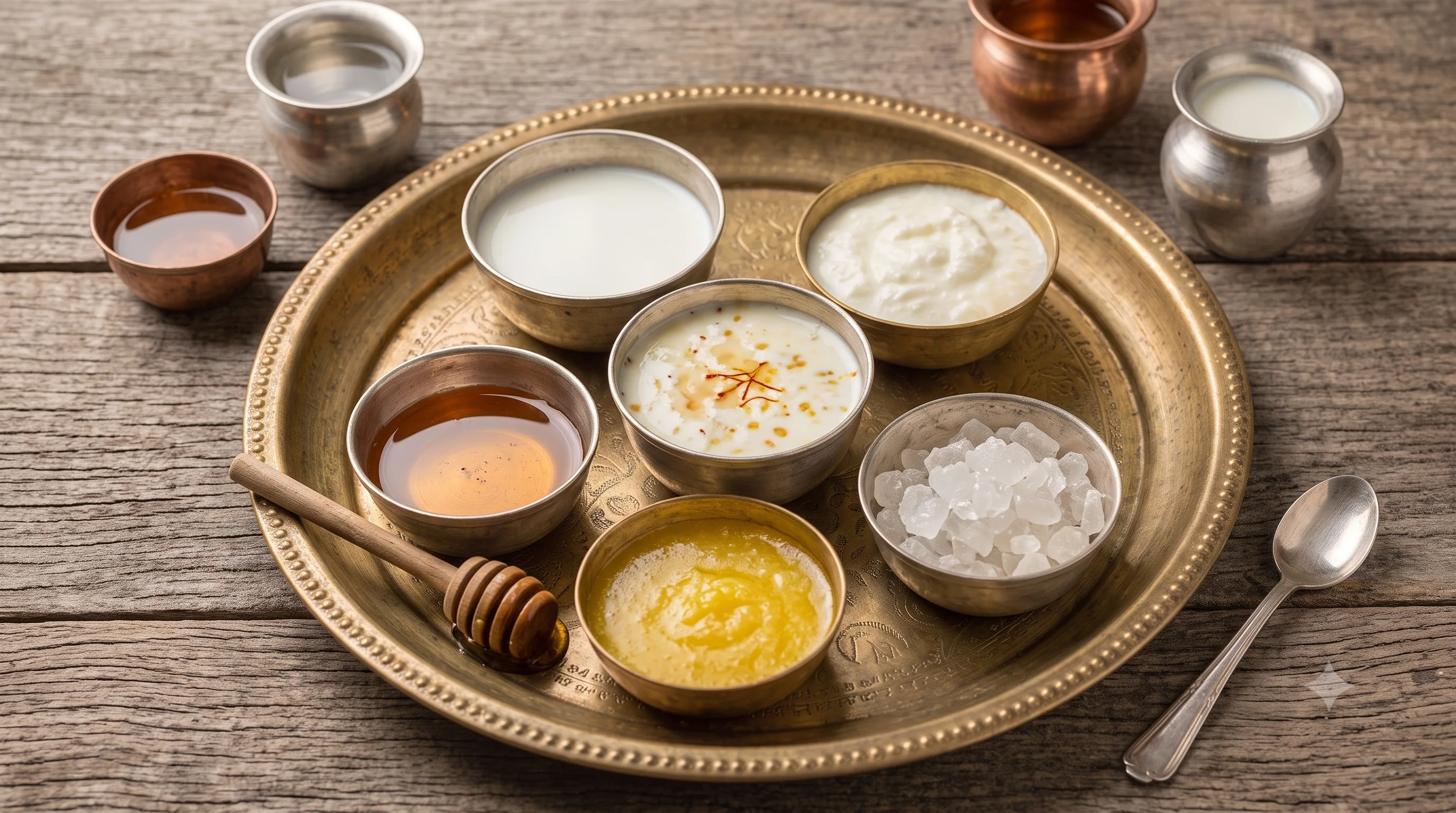
Liquids run through nearly every puja — from the water that sanctifies the space to the sweet Panchamrit shared afterwards as prasad. This guide covers the twelve liquid items in Avyani's Master Samagri Catalogue, what goes into each, and the handling that matters when an offering is later eaten.
Liquids form the basis of abhishekam, the ritual bathing of a deity described in our Abhishekam and Worship Methods guide. They also make up most of what is afterwards shared as prasad — which is why this is the one samagri category where food handling genuinely matters.
Avyani's Master Samagri Catalogue records twelve liquid items. Where this guide says scripture, it names a text you can check; where it says tradition, the practice is widely followed but has no single locator.
Panchamrit — the Five Nectars
Panchamrit (पंचामृत) is panch and amrit, five nectars: milk, curd, ghee, honey and sugar or jaggery. Each of the five is also a catalogue item in its own right. It is poured over the murti during abhishekam and then commonly distributed to those present as prasad, and the tradition reads the mixture as a single complete gift rather than five separate ones.
Proportions are not fixed. Household and temple paddhati differ, some traditions use jaggery where others use sugar, and a few add tulsi leaves or dry fruit. None of these is a departure from the rule, because there is no single scriptural recipe to depart from.
Panchagavya — a Different Mixture Entirely
Panchagavya (पंचगव्य) shares part of its name and three of its ingredients with panchamrit, and the two are frequently confused. They are different preparations with different purposes. Panchagavya's five are the products of the cow: milk, curd and ghee, together with cow urine and cow dung.
It is a traditional purification mixture, used in prayashchitta observances, in certain consecrations and in Panchagavya Abhishekam. Some traditions do prescribe taking a small, measured quantity within those rites, prepared according to the prescribed procedure and under a priest's direction — a narrow, context-bound usage that is not the same thing as prasad.
What panchagavya is never is a substitute for panchamrit, and it should not be served casually to a gathering as though it were. Avyani makes no medicinal or therapeutic claim for it.
Water, Plain and Sacred
Shuddh jal (शुद्ध जल), plain clean water, is used continuously through every puja for washing, offering and achamana, and is the most-used item on any samagri list.
Ganga jal (गंगाजल) is Ganges water, kept sealed and used in small quantity to sanctify a space, an object or another offering. Its standing in the tradition is unquestioned and very old. What Avyani will not tell you is that a sealed bottle bought in a shop is chemically or microbiologically anything in particular — that is a claim about a product, not about the river, and it needs evidence a label does not provide. Treat gangajal as a ritual sanctifier, not as drinking water.
Milk, Curd, Honey and Sugar
Raw milk (कच्चा दूध) is specified for abhishekam in most paddhati, and unboiled milk is what tradition asks for at the moment of offering. It is also a food that spoils quickly and, unpasteurised, can carry pathogens.
When an offering is going to be eaten, treat it as food.
- Buy milk, curd and honey fresh, from a source you would buy food from, and keep them cold until the puja.
- Panchamrit and charanamrit should be distributed soon after the rite, not left standing at room temperature through a long ceremony — particularly in warm weather.
- Honey is not given to infants under one year, because of the risk of infant botulism. This is standard paediatric advice and applies to prasad as much as to anything else.
- Anyone who is pregnant, elderly, very young or immunocompromised may prefer pasteurised milk for anything they will consume.
Honey (शहद) deserves a word on its own. A 2020 investigation by the Centre for Science and Environment found that a large majority of branded Indian honey samples failed nuclear magnetic resonance testing for added sugar syrup, even where they passed the standard domestic tests. Avyani names no brands, but the finding is a reason to buy honey from a traceable source rather than on price.
Curd (दही) and sugar (शक्कर) are the least complicated items here. Set curd fresh where you can; many households keep a little of the previous day's culture for exactly this.
Abhishekam Variants and Optional Additions
Chandan jal (चंदन जल), sandalwood water, is made by grinding sandalwood on a stone with water — see the note on chandan quality in our Powders and Sacred Marks guide. Sugarcane juice (इक्षु रस) is seasonal, used in abhishekam and connected to the harvest observances in our Surya Rituals guide; it ferments fast and should be pressed the same day.
Rose water (गुलाब जल) and tender coconut water (नारियल पानी) are optional. Coconut water is also offered on its own as a form of abhishekam, and is best opened at the moment it is needed.
A Note on Vessels
Copper and brass are the traditional metals for the panchpatra and the abhishekam vessel, described in our Kalash and Utensils guide, and they are entirely appropriate for plain water.
Acidic contents are a different matter. Curd, honey, lemon and sugarcane juice all react with unlined copper and brass, and prolonged contact produces copper salts that can cause gastric upset. Mix and hold panchamrit and charanamrit in steel, glass or a lined vessel, use the copper panchpatra for the offering itself, and wash metal vessels promptly rather than leaving them standing.
Liquids at a Glance
| Item | Hindi | What it is | Mandatory / Optional |
|---|---|---|---|
| Pancha |
पंचामृत | Milk, curd, ghee, honey and sugar | Mandatory |
| Raw Milk | कच्चा दूध | Unboiled milk for abhi |
Mandatory |
| Curd (Dahi) | दही | Set curd | Mandatory |
| Honey (Shahad) | शहद | Honey; buy from a traceable source | Mandatory |
| Sugar | शक्कर | Sugar or jaggery, by tradition | Mandatory |
| Ganga Jal | गंगाजल | Ganges water, sealed, used in small quantity | Mandatory |
| Water (Shuddh Jal) | शुद्ध जल | Plain clean water | Mandatory |
| Pancha |
पंचगव्य | Five cow products; purificatory rites only | Optional |
| Chandan Jal | चंदन जल | Sandal |
Optional |
| Sugar |
इक्षु रस | Fresh pressed; seasonal | Optional |
| Rose Water | गुलाब जल | Distilled rose water | Optional |
| Tender Coconut Water | नारियल पानी | Opened fresh at the time of use | Optional |
See our Understanding Samagri guide for how these fit the wider offering.
Sources
- Panchamrit and panchagavya compositions — standard paddhati usage and Ayurvedic literature; proportions vary and no single scriptural recipe is asserted here.
- Honey adulteration — Centre for Science and Environment, food fraud investigation, 2020, including NMR testing of branded samples.
- Infant botulism and honey — standard paediatric guidance that honey is not given below one year of age.
- Copper and acidic foods — documented formation of copper salts on unlined copper and brass in contact with acidic contents.
- Item names, Hindi names and mandatory flags — Avyani Master Samagri Catalogue v1.
Where a scriptural locator could not be verified, the statement is given as tradition rather than scripture. Nothing here is medical advice.