


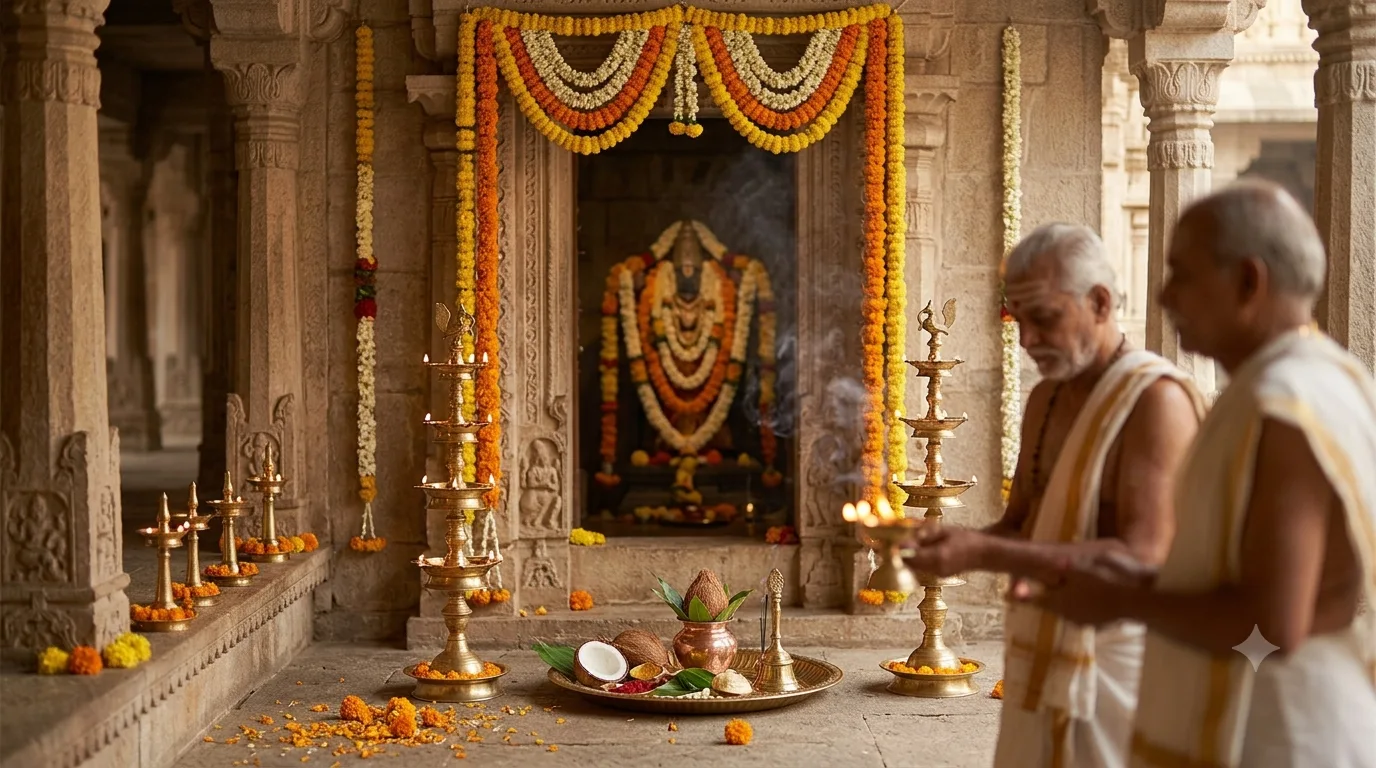
Fourteen annual temple festivals and ten elaborate sponsored sevas — the grand tier above the daily cycle. This guide covers what a Brahmotsavam is, which pilgrimage seasons open when, and what the larger sponsored sevas involve.
Above the daily cycle described in our Temple Seva guide sits a further tier: the annual festivals that take a temple out into its streets, and the elaborate sevas offered on special occasions. Avyani's Master Puja & Ritual Catalogue records fourteen festivals and ten special sevas.
Almost everything here is regional practice in the strict sense — tied to one temple, one town, one season. That is the point of the category rather than a limitation of it.
Brahmotsavam
Brahmotsavam is the standard grand-festival format of southern temples: nine days, with the utsava murti taken out each morning and evening on a different vahana, and a chariot procession near the close. The Tirumala Brahmotsavam is the best known, but the form is general and most large Agama temples hold one.
Float Festival — teppotsavam — sets the deity on a raft on the temple tank, and Rathotsavam is the chariot day within or alongside the festival.
Divine Marriages
Several festivals commemorate a marriage. Chithirai at Madurai celebrates Meenakshi's coronation and her wedding to Sundareswarar, and draws one of the largest crowds in Tamil Nadu. Panguni Uthiram marks several divine weddings on the same day — Shiva and Parvati, Murugan and Deivanai, and in Vaishnava temples Rama and Sita. Both connect to our Devi Rituals guide.
Nitya Kalyanam Seva is the daily sponsored form of the same idea, performed at Vaishnava temples throughout the year.
Regional Festivals
Navratri Golu is the southern tradition of arranging dolls in tiers through the nine nights — a home observance as much as a temple one, described alongside the rest of Navratri in our Festival Rituals guide. Dussehra at Mysuru is the royal-temple form, with the Chamundeshwari procession.
Puri Chandan Yatra runs twenty-one days in summer, when the deities are cooled with sandalwood paste and taken to water. Guruvayur Ekadashi is Kerala's great Vaishnava festival. Somnath Aarti Utsav is the evening aarti at the Jyotirlinga described in our Shiva Rituals guide.
Nabakalebara at Puri is the rarest observance in this catalogue: the ceremonial renewal of the Jagannath deities' wooden forms, held only when the lunar calendar repeats a particular pattern — roughly every twelve to nineteen years.
Pilgrimage Seasons
Three entries are the opening of a season rather than a festival. Kedarnath Yatra Opening Rituals mark the unsealing of the temple after winter, when the deity returns from Ukhimath; the wider Char Dham Yatra follows the same seasonal pattern across the four Himalayan shrines.
Sabarimala Pilgrimage Season Rituals run about two months, and the pilgrimage involves a preparatory vrat of some weeks and the irumudi bundle described in our Miscellaneous guide. Kanwar Yatra carries Ganga water on foot through Shravan.
Practical guidance. Season openings and closings follow the calendar and the weather, and dates are announced by the temple or the state authority rather than fixed in advance. Confirm with the temple before travelling, and note that several of these pilgrimages are physically demanding at altitude or over distance.
The Larger Sponsored Sevas
The special sevas are the elaborate end of what a devotee can arrange. Sahasranama Pushpanjali offers flowers through a thousand names; Sahasra Deepa Seva lights a thousand lamps; Sahasra Kalasha Abhishekam bathes the deity from a thousand pots. Each is the amplified form of an ordinary daily seva.
Anna Kalasam and Go Grasa Seva sponsor food — for the deity and the assembled devotees in the first case, for temple cattle in the second, described in our Miscellaneous guide. Vastra Samarpana offers garments, and Kalasa Puja consecrated water.
Palli Vetta is the ceremonial hunt of Kerala temple festivals, in which the deity symbolically subdues evil — a night observance and a good example of how local a temple calendar can be.
Temple Festivals and Special Sevas at a Glance
Durations are typical planning ranges. "Traditionally for" records the intention the tradition assigns — not an outcome Avyani predicts or guarantees. Dates and availability are matters for the individual temple.
| Festival or seva | Tradi |
Typical duration | Priest advised |
|---|---|---|---|
| Brahmot | The annual grand festival | 9 days | Yes |
| Float Festival | The deity on the tank | 1 day | Yes |
| Chithirai Festival | Meen | Multi-day | Yes |
| Panguni Uthiram | The divine marriages | 1–2 days | Yes |
| Navratri Golu | Nine nights of Golu | 9 days | No |
| Dussehra Mysuru Rituals | The royal Dussehra | 10 days | Yes |
| Puri Chandan Yatra | Cooling the deities | 21 days | Yes |
| Guru | The Kerala Vaishnava festival | Multi-day | Yes |
| Somnath Temple Aarti Utsav | Evening aarti and darshan | 30–45 mins | Yes |
| Puri Jagannath Nabakale | Renewal of the wooden forms | Multi-day | Yes |
| Kedarnath Yatra Opening Rituals | Opening the season | 1 day | Yes |
| Char Dham Yatra Rituals | The four Himalayan shrines | Multi-day | Yes |
| Sabari | The pilgrimage season | 2 months | Yes |
| Kanwar Yatra | Ganga water carried on foot | Multi-day | No |
| Sahasra | Flowers through 1000 names | 1–1.5 hours | Yes |
| Sahasra Deepa Seva | A thousand lamps lit | 1–2 hours | Yes |
| Sahasra Kalasha Abhi | Bathing from 1000 pots | Full day | Yes |
| Nitya Kalyanam Seva | The daily wedding rite | 45–60 mins | Yes |
| Anna Kalasam Seva | Food for deity and devotees | 1–2 hours | Yes |
| Vastra Samar | Garments for the deity | 30–45 mins | Yes |
| Kalasa Puja Seva | Consecrated water offering | 1 hour | Yes |
| Go Puja Seva (Temple) | Cow worship at the temple | 30–45 mins | No |
| Go Grasa Seva | Feeding temple cattle | 30 mins | No |
| Palli Vetta Seva | The ceremonial hunt | Full night | Yes |
Sources
- Brahmotsavam as the standard nine-day southern temple festival with daily vahana processions — established Agama practice.
- Chithirai at Madurai and Panguni Uthiram as divine-marriage festivals; Nabakalebara at Puri held at intervals of roughly twelve to nineteen years — documented regional practice.
- Kedarnath and Char Dham season openings following the Himalayan calendar; Sabarimala's roughly two-month season with a preparatory vrat — established practice; dates are announced by the temple or state authority.
- Festival names, durations and priest-advised flags — Avyani Master Puja & Ritual Catalogue. Durations are planning ranges and differ from temple to temple.
Where a scriptural locator could not be verified, the statement is given as tradition or regional practice rather than scripture. Stated purposes are the intentions the tradition assigns, not outcomes Avyani predicts. Dates, booking and access are matters for the individual temple.