


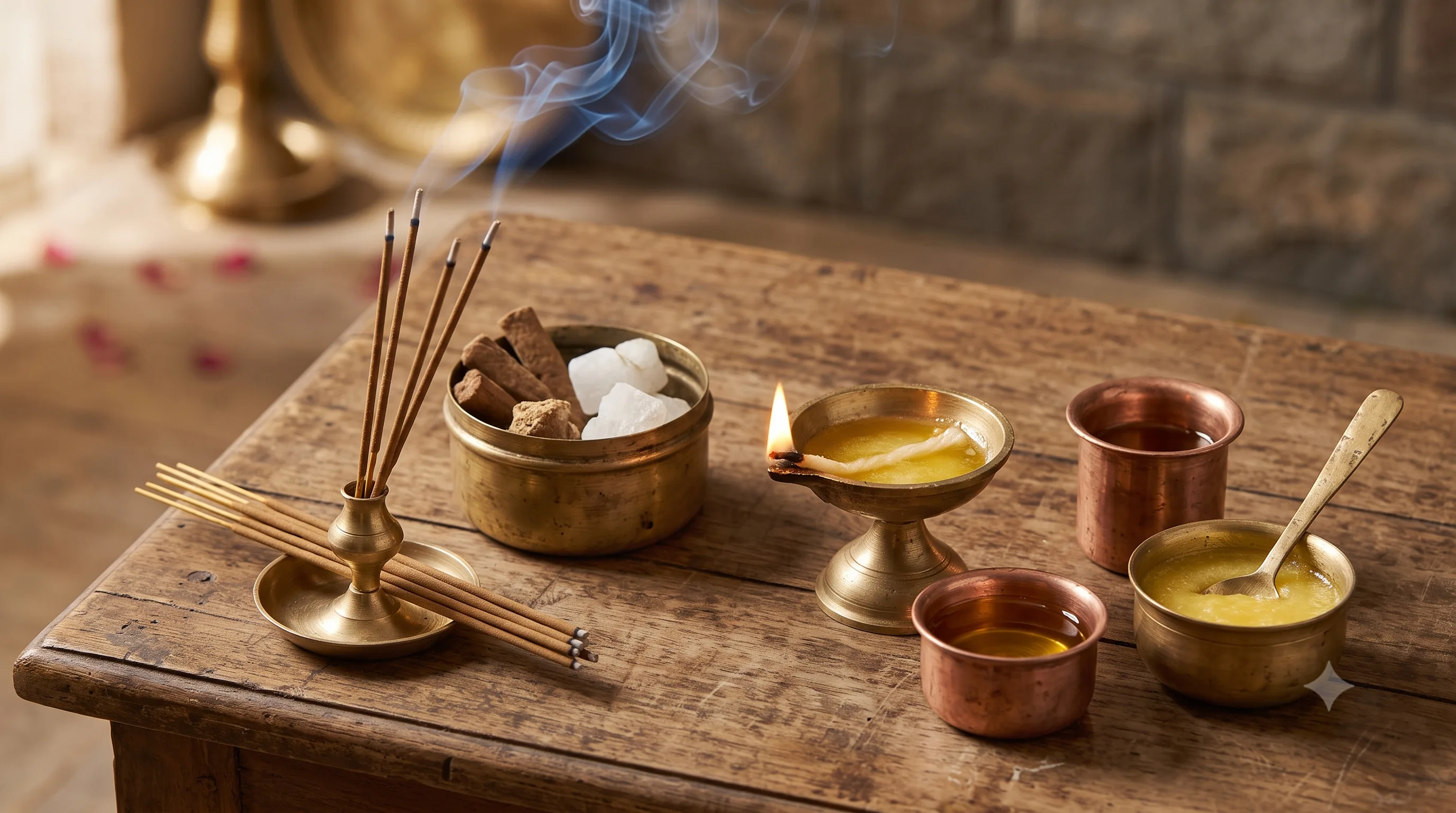
Fragrance and flame are among the most immediate parts of any puja — the curl of incense smoke, the flicker of the aarti lamp, the offering of ghee. This guide covers the ten incense, camphor, oil and ghee items in Avyani's Master Samagri Catalogue, and how to use them safely in a small room.
Light and fragrance are constants of worship: dhupa and dipa are two of the five offerings of the Panchopachara method in our Daily Worship guide. Avyani's Master Samagri Catalogue records ten items across incense, camphor, oils and ghee.
Two of them — camphor and cow ghee — have full research guides of their own, linked below. This page covers the category, what distinguishes each item, and the one practical matter that applies to all of them: these are things you set on fire indoors.
Incense and Dhoop
Agarbatti (अगरबत्ती), the incense stick, is a bamboo splint coated with a paste of charcoal, wood powder, a binder and perfume. Dhoop (धूप) is the same idea without the stick — an extruded cone or stick of the aromatic material itself, so it burns denser and heavier.
Neither is a fixed formula. Traditional dhupa used resins, woods and herbs; a large part of the modern market uses synthetic aromatic compounds, which is not in itself a fault but is worth knowing when a packet claims a botanical name it does not contain. A supplier who lists ingredients is telling you more than one who lists moods.
Incense smoke is smoke. Ventilate the room.
- Burning incense is a combustion source, and measured studies find fine particulate levels indoors that rise sharply with the number of sticks burnt and fall sharply with ventilation.
- Open a window or door while burning, and burn one or two sticks rather than a handful.
- Take particular care where there is an infant, an elderly person, or anyone with asthma or another respiratory condition in the house.
- Set incense in a holder that catches the ash, clear of curtains, paper and cloth, and never leave it burning unattended or overnight.
None of this asks anyone to stop offering dhupa. It asks for a window.
Camphor and the Aarti Flame
Camphor (कपूर), cotton wicks (रुई की बत्ती) and a matchbox (माचिस) together make the aarti flame offered before the deity. Camphor's place in that role rests partly on a quality anyone can observe: it burns away completely, leaving almost nothing behind, which the devotional tradition reads as a figure for the self offered without remainder.
Camphor also carries more confusion than any other item in this category — natural against synthetic, bhimseni against ordinary, edible against ritual grade — and it is genuinely poisonous if swallowed. Our detailed guide covers the scriptural references, the botanical and industrial sources, quality checks and safety in full: see कपूर (Camphor): पूजा, गुणवत्ता, विज्ञान और सुरक्षा.
Cotton wicks come ready-rolled in long, round or thick batti forms, and many households still roll their own. Store them somewhere dry; damp wicks sputter.
Cow Ghee
Cow ghee (गाय का घी) is the mandatory fat of the tradition: it lights the lamp, it is poured into the havan fire, and it is one of the five ingredients of panchamrit in our Liquids and Panchamrit guide.
Ghee is also among the most adulterated products on the Indian market, and no household test settles the question. Our detailed guide covers the shastra references, the legal food identity, laboratory testing, and what buying well actually looks like: see गाय का घी (Cow Ghee): पूजा, गुणवत्ता, विज्ञान और सुरक्षा.
Lamp Oils
Where ghee is not used, oil is, and the choice is largely regional. Sesame or til oil (तिल का तेल) is the classical lamp oil of much of India and the usual choice for Shani and Shiva observances. Coconut oil (नारियल तेल) is standard in Kerala and along the southern coast. Mustard oil (सरसों का तेल) is common in the north and east, and is the customary oil for lamps offered to Shani and to Bhairava in several traditions.
Castor oil (अरंडी का तेल) is thicker and slower-burning, used in specific observances and in some temple lamps that must stay lit for long periods.
Practical guidance. All four are catalogued as optional, and the right one is the one your family tradition uses. Buy edible-grade oil, keep it capped and away from light, and do not mix oils in the same lamp — they burn at different rates and the wick chars.
Using Flame Safely at Home
Set every flame on a stable, non-combustible surface, well clear of cloth, paper, curtains and aerosols. Keep lamps and camphor out of the reach of children, tie back loose clothing and dupattas, and never leave a flame unattended — including the small ones that look harmless.
Where the altar sits in a niche or cupboard, check there is clearance above the flame; scorching is the usual first sign that there is not.
Incense, Camphor, Oils and Ghee at a Glance
| Item | Hindi | Typical use | Mandatory / Optional |
|---|---|---|---|
| Incense Sticks (Agar |
अगरबत्ती | Dhupa offering; ventilate the room | Mandatory |
| Camphor (Kapoor) | कपूर | Aarti flame; poison |
Mandatory |
| Cotton Wicks (Batti) | रुई की बत्ती | Wicks for oil and ghee lamps | Mandatory |
| Cow Ghee | गाय का घी | Lamp, havan and panchamrit | Mandatory |
| Matchbox | माचिस | Lighting lamp and camphor | Mandatory |
| Dhoop Sticks / Cones | धूप | Denser, stickless incense | Optional |
| Sesame Oil (Til) | तिल का तेल | Classical lamp oil; Shani and Shiva | Optional |
| Coconut Oil | नारियल तेल | Lamp oil of Kerala and the south coast | Optional |
| Mustard Oil | सरसों का तेल | Lamp oil of the north and east | Optional |
| Castor Oil (Arandi) | अरंडी का तेल | Slow-burning; long-lit lamps | Optional |
See our Understanding Samagri guide for how these fit the wider offering.
Sources
- Incense and indoor air quality — measured studies of PM2.5 from incense burning in residences and temples, showing strong dependence on the number of sticks burnt and on ventilation.
- Camphor — scriptural references, botanical and synthetic sources, quality and safety are set out with full citations in the Avyani detailed guide linked above.
- Cow ghee — shastra references, FSSAI and BIS identity, adulteration testing and sourcing are set out with full citations in the Avyani detailed guide linked above.
- Regional lamp-oil preferences — established regional and sampradaya practice; no single scriptural locator is asserted.
- Item names, Hindi names and mandatory flags — Avyani Master Samagri Catalogue v1.
Where a scriptural locator could not be verified, the statement is given as tradition or regional practice rather than scripture. Nothing here is medical advice.