


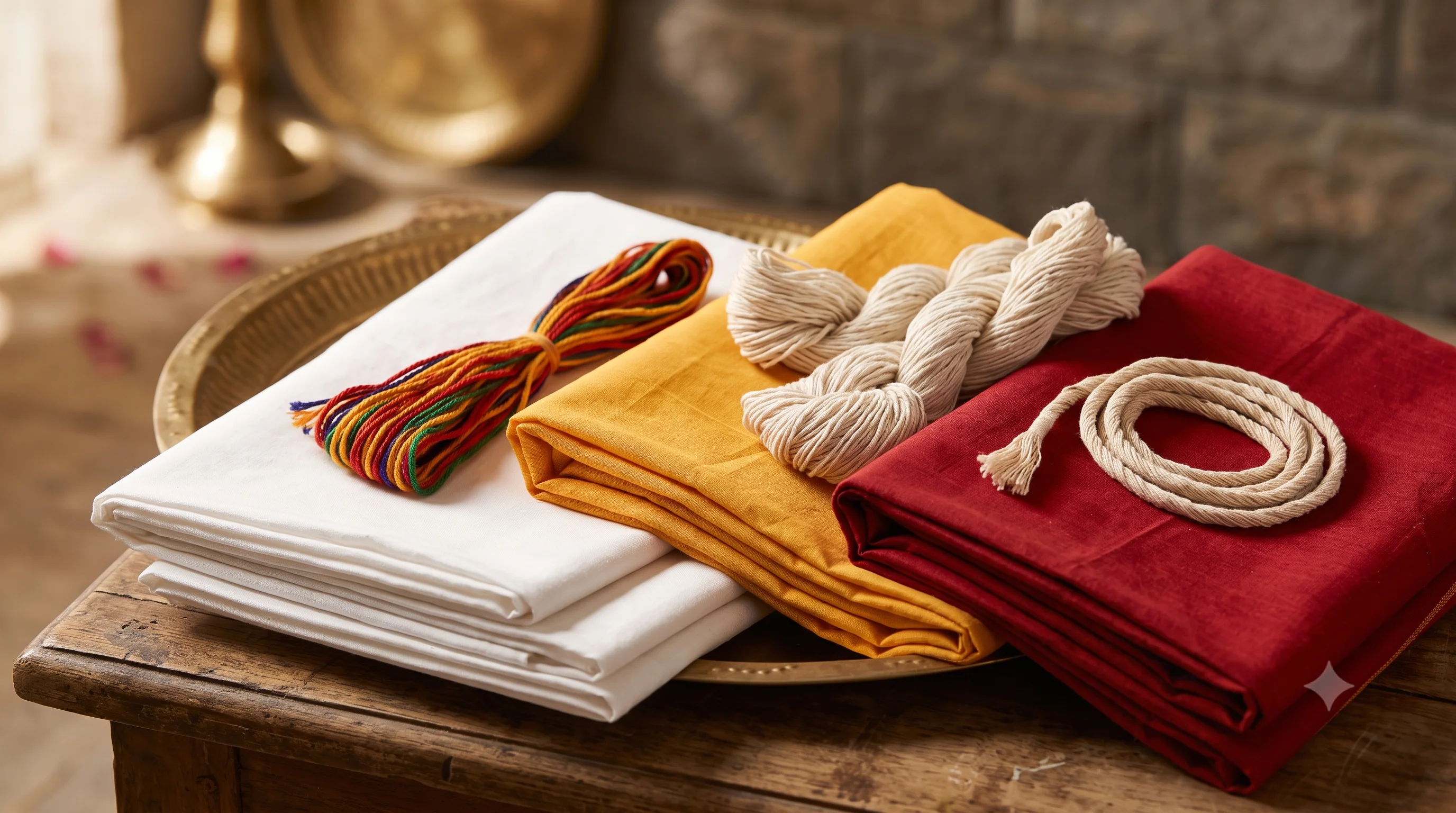
Cloth and thread carry meaning well beyond the material itself — a stole draped over Devi, a thread tied at the wrist to mark a vow or a blessing. This guide covers the eight cloth items and five sacred threads in Avyani's Master Samagri Catalogue.
Cloth clothes the deity and marks the occasion; thread ties a vow to a wrist and a lineage to a shoulder. Avyani's Master Samagri Catalogue records eight cloth items and five sacred threads.
Where this guide says scripture, it names a text you can check; where it says tradition or regional practice, the custom is real and widely followed but has no single locator, and families differ.
Cloth for the Deity
The kalash cover cloth (कलश वस्त्र) is tied around the pot described in our Kalash and Utensils guide. A new clothes pair (नवीन वस्त्र युग्म) — vastra yugal, an upper and a lower cloth — is the formal vastra offering in the worship described in our Daily Worship guide, and the deity vastra (देव वस्त्र), a silk robe, is its more elaborate form for larger occasions.
Vastra is one of the sixteen upacharas of the shodashopachara sequence, which is why an offering that looks decorative is in fact a required step in formal puja.
Colour and Occasion
Chunri or odhni (चुनरी), the stole draped over the Devi, and red cloth (लाल वस्त्र) belong above all to the worship in our Devi Rituals guide, and both reappear in the bridal rites of our Marriage Rituals guide.
Yellow cloth (पीला वस्त्र) goes with Vishnu worship in our Vishnu Rituals guide, and white cloth (सफेद वस्त्र) with the ancestral rites in our Shraddha and Pitru Karma guide. The navagraha nine-colour set (नवग्रह वस्त्र सेट) assigns a colour to each graha for the observances in our Navagraha and Dosha Nivaran guide.
Tradition. These colour associations are widely and consistently taught, and they also vary — the nine-colour assignments in particular differ between paddhati and between regions. Where a specific rite is concerned, the priest conducting it should say which set is wanted.
The Sacred Thread
The janeu or yajnopavita (जनेऊ/यज्ञोपवीत) is conferred at the Upanayana described in our Sixteen Samskaras guide, and worn thereafter over the left shoulder and across the body.
Scripture and tradition. Upanayana is a Grihya Sutra rite and among the oldest samskaras in continuous practice. The reading of the three strands, however, is where tradition takes over: they are variously explained as the three Vedas, the three gunas, the three debts owed to the gods, the ancestors and the sages, or the trinity itself. All are taught; no single reading is the scriptural one, and Avyani does not present one as such.
The thread is changed periodically, and the manner of changing it, the number of strands after marriage, and the days appointed for it all follow family and sampradaya practice.
Threads Tied and Worn
Mauli or kalawa (मौली/कलावा), the red-and-yellow thread, is tied at the wrist at the start of most rites — on the right wrist for men and for unmarried women, on the left for married women, in the most common convention. Kankan dhaga (कंकण धागा) is the paired wrist thread of vivah and mundan, and rakhi (राखी) is the protection thread of Raksha Bandhan, in the festival cycle of our Festival Rituals guide.
Pavitri (पवित्री) is different in kind: a ring twisted from kusha grass and worn on the right ring finger for shraddha and tarpana, described alongside the kusha in our Flowers and Leaves guide.
Tie wrist threads snugly, not tightly — especially on infants and small children. A thread tied tight on a growing wrist or ankle, or left on for months, can dig in and restrict circulation. Check it periodically, and remove or retie any thread that leaves a mark, reddens the skin or cannot be moved freely. Tradition asks that the thread be honoured, not that it be left untouched at any cost.
Choosing and Caring for Cloth
Practical guidance. Buy cotton or silk rather than synthetics. There are two reasons, and the second is the important one.
- Cheap dyed cloth bleeds, and red and yellow are the worst offenders. Rinse new cloth in cold water before it goes near a murti, and dry it fully; a wet stain on a stone or metal image is difficult to lift.
- Synthetic fabric melts and burns fast. Cloth on the altar sits close to lamps and camphor, so natural fibre is a genuine safety choice, not only a traditional one. Keep loose ends of chunri and dupatta well clear of the flame — see our Incense, Camphor, Oils and Ghee guide.
Wash puja cloth separately, fold it dry and store it away from damp. Cloth offered to a deity is not returned to household use; where it is retired, most traditions give it away or set it aside rather than binning it.
Cloth and Threads at a Glance
| Item | Hindi | What it is | Mandatory / Optional |
|---|---|---|---|
| Chunri / Odhni | चुनरी | Stole draped over the Devi | Mandatory |
| New Clothes Pair | नवीन वस्त्र युग्म | Vastra yugal; upper and lower cloth | Mandatory |
| Kalash Cover Cloth | कलश वस्त्र | Tied around the kalash | Mandatory |
| Red Cloth | लाल वस्त्र | Devi worship and bridal rites | Mandatory |
| Yellow Cloth | पीला वस्त्र | Vishnu worship | Mandatory |
| White Cloth | सफेद वस्त्र | Ancestral rites | Mandatory |
| Nava |
नवग्रह वस्त्र सेट | Nine colours, one per graha | Mandatory |
| Deity Vastra | देव वस्त्र | Silk robe for larger occasions | Optional |
| Janeu (Yajno |
जनेऊ/यज्ञोपवीत | Three-strand thread; Upana |
Mandatory |
| Mauli / Kalawa | मौली/कलावा | Red-yellow wrist thread | Mandatory |
| Kankan Dhaga | कंकण धागा | Wrist thread pair; vivah and mundan | Mandatory |
| Pavitri | पवित्री | Kusha grass ring; shraddha and tarpan | Mandatory |
| Rakhi | राखी | Protec |
Mandatory |
See our Understanding Samagri guide for how these fit the wider offering.
Sources
- Upanayana as a Grihya Sutra samskara — established Vedic domestic ritual literature; no single verse locator is asserted here.
- The three strands of the yajnopavita — multiple traditional readings are taught (three Vedas, three gunas, three debts, the trinity); none is presented as the scriptural interpretation.
- Vastra among the sixteen upacharas — standard shodashopachara sequence.
- Colour and graha associations — established tradition with documented variation between paddhati and region.
- Wrist-thread caution and synthetic-fabric flammability — general safety guidance, not a ritual rule.
- Item names, Hindi names and mandatory flags — Avyani Master Samagri Catalogue v1.
Where a scriptural locator could not be verified, the statement is given as tradition or regional practice rather than scripture. Nothing here is medical advice.