


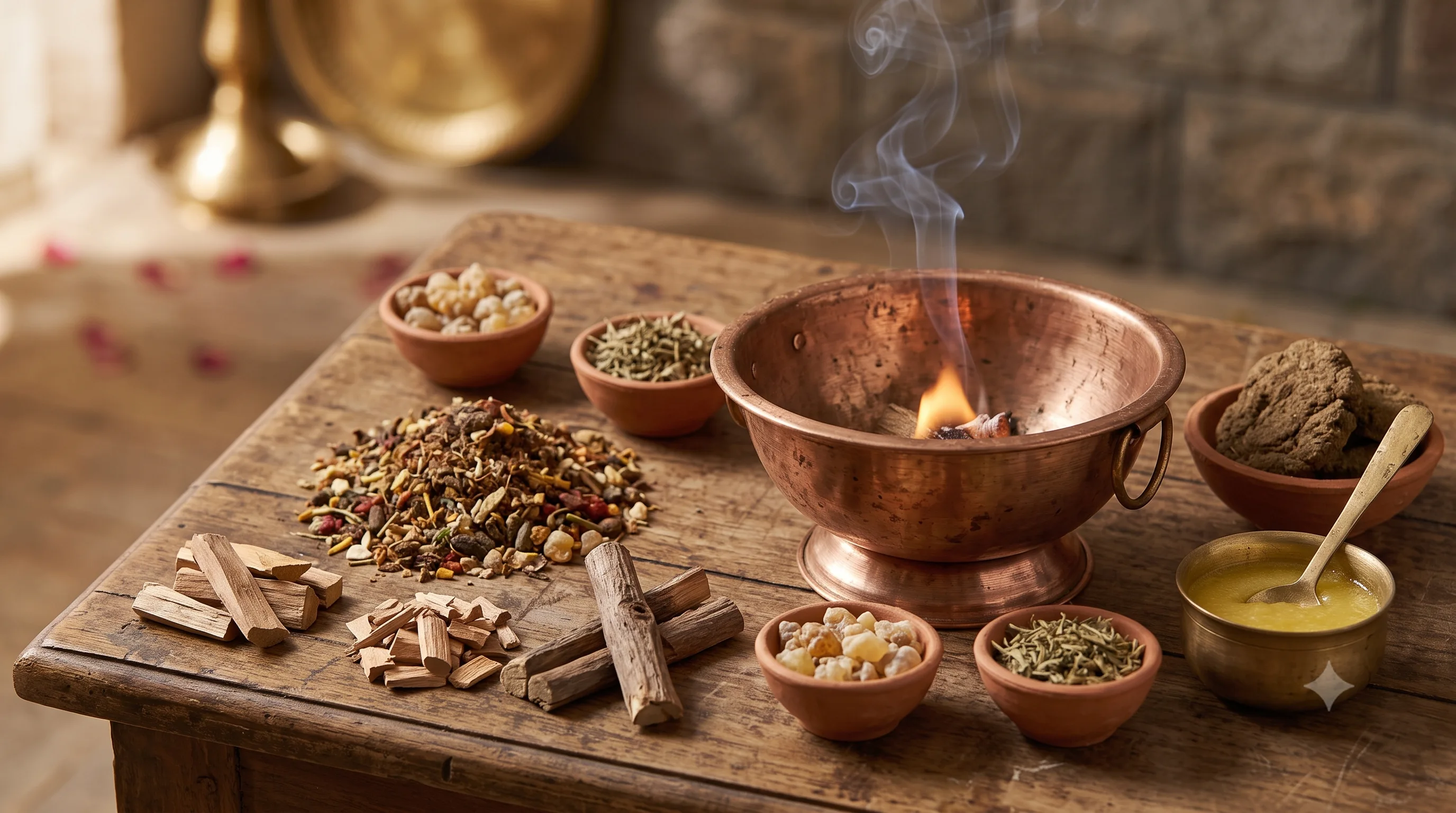
Fire itself officiates a havan — Agni, understood in tradition as the witness who carries each offering upward on its smoke. This guide covers the eleven havan, wood and fuel items in Avyani's Master Samagri Catalogue: what goes into the fire, and how to choose it.
This guide covers the materials that go into the fire. For the kund, the tools and the conduct of the rite itself, see our Havan Samagri: What You Need for a Fire Ritual guide and the rites described in Homam, Havan and Yajna.
Avyani's Master Samagri Catalogue records nine havan samagri items and two wood and fuel items. Where this guide says tradition, the practice is widely followed but has no single scriptural locator, and regional lists differ.
Samidha — the Sacred Wood
Samidha (समिधा) is the wood fed to the fire, and it is the one mandatory item in this category. The word comes from the root meaning to kindle, and samidha is not simply fuel: the sticks are themselves offered, with mantra, one at a time.
Tradition. Sticks are cut to a roughly uniform length — a span or so is the usual measure — and chosen straight, dry, barked and free of insect damage. Green or damp wood smoulders rather than burns, and the tradition's insistence on dry wood has an obvious practical face as well as a ritual one.
The catalogue lists a general samidha bundle of mango, peepal or shami, plus five tree-specific bundles:
- Palash (पलाश, Butea monosperma) — the classical samidha of Vedic practice, still the standard wood of the daily samidhadana in several traditions.
- Mango (आम) — the most widely used general havan wood, easily available and clean-burning.
- Peepal (पीपल) — used generally and in several graha observances.
- Shami (शमी) — associated with Shani and the Navagraha rites in our Navagraha and Dosha Nivaran guide.
- Bilva (बिल्व) — used in Shiva homa, alongside the bilva patra of our Shiva Rituals guide.
Tree-to-rite assignments of this kind are traditional and vary between paddhati and region, so where a particular homa is planned, ask the priest which wood they want rather than assuming a list.
The Havan Samagri Mix
Havan samagri (हवन सामग्री) is the prepared blend dropped into the fire with each svaha, and it is mandatory. A traditional mix is built from aromatic woods and barks, dried herbs and roots, resins, grains and sometimes dried fruit — sandalwood, agarwood, nagarmotha, jatamansi, giloy and camphor all appear in different recipes.
There is no single fixed formula. Composition varies by maker, tradition and price point, and a packet that lists nothing is telling you nothing. Where a mix is bought for a long homa, ask for the ingredient list, and prefer one without added synthetic fragrance — the point of the offering is the material, and perfume is not one of them.
Ghee, Jaggery and the Resins
Cow ghee is the principal liquid offering and is covered in our Incense, Camphor, Oils and Ghee guide. Jaggery (गुड़) is offered as ahuti for sweetness; buy unadulterated jaggery rather than the very pale, hard kind, which is often clarified with additives.
Guggal (गुग्गुल), the resin of Commiphora wightii, and loban (लोबान), benzoin resin, are added for their fragrant smoke. Both are true resins and should look and feel like resin — irregular, brittle, faintly sticky, releasing scent only when warmed. Uniform, strongly perfumed granules are usually a compounded product rather than the resin itself.
Guggal is worth a further note: Commiphora wightii is a slow-growing species under serious harvest pressure in India, so buy it from a supplier who can say where it came from, and buy no more than the rite needs.
Cow Dung Cakes
Kande (कंडे), dried cow dung cakes, are the traditional fuel that sustains a havan fire once it is established, particularly for longer rites. They should be thoroughly dry, light for their size, and free of mould; a damp cake produces far more smoke and much less heat.
Store them dry and off the floor. They absorb moisture readily and are unpleasant to handle once they have.
Buying and Storing
Practical guidance. Everything in this category is a dry good, and everything in it fails the same way — damp. Buy quantities matched to the rite rather than in bulk, keep wood and cakes off a concrete floor, and store resins and the samagri mix airtight, since both lose their aromatics to open air within months.
Check samidha bundles for insect holes and frass before use. Wood that has been treated, painted or varnished is not samidha and should never go into the fire.
Havan Samagri, Wood and Fuel at a Glance
| Item | Hindi | What it is | Mandatory / Optional |
|---|---|---|---|
| Samidha | समिधा | Sacred wood sticks; mango, peepal or shami | Mandatory |
| Havan Samagri Mix | हवन सामग्री | Blend of woods, herbs, resins and grains | Mandatory |
| Palash Samidha | पलाश की समिधा | Butea mono |
Optional |
| Mango Samidha | आम की समिधा | General-purpose havan wood | Optional |
| Peepal Samidha | पीपल की समिधा | General and graha obser |
Optional |
| Shami Samidha | शमी की समिधा | Shani and Nava |
Optional |
| Bilva Samidha | बिल्व की समिधा | Shiva homa | Optional |
| Guggal | गुग्गुल | Resin of Commi |
Optional |
| Loban | लोबान | Benzoin resin | Optional |
| Jaggery (Gud) | गुड़ | Offered as ahuti for sweetness | Optional |
| Cow Dung Cakes | कंडे | Dried kande; sustain |
Optional |
Sources
- Samidha specification — uniform length, dry, straight and undamaged wood; established paddhati practice, with tree-to-rite assignments varying by region and tradition.
- Butea monosperma (palash) as the classical samidha of Vedic practice, including daily samidhadana — documented ritual usage.
- Commiphora wightii — slow-growing and under harvest pressure in India; sourcing note rather than a ritual rule.
- Havan samagri mixes have no single fixed formula; composition varies by maker and tradition.
- Item names, Hindi names and mandatory flags — Avyani Master Samagri Catalogue v1.
Where a scriptural locator could not be verified, the statement is given as tradition or regional practice rather than scripture.