


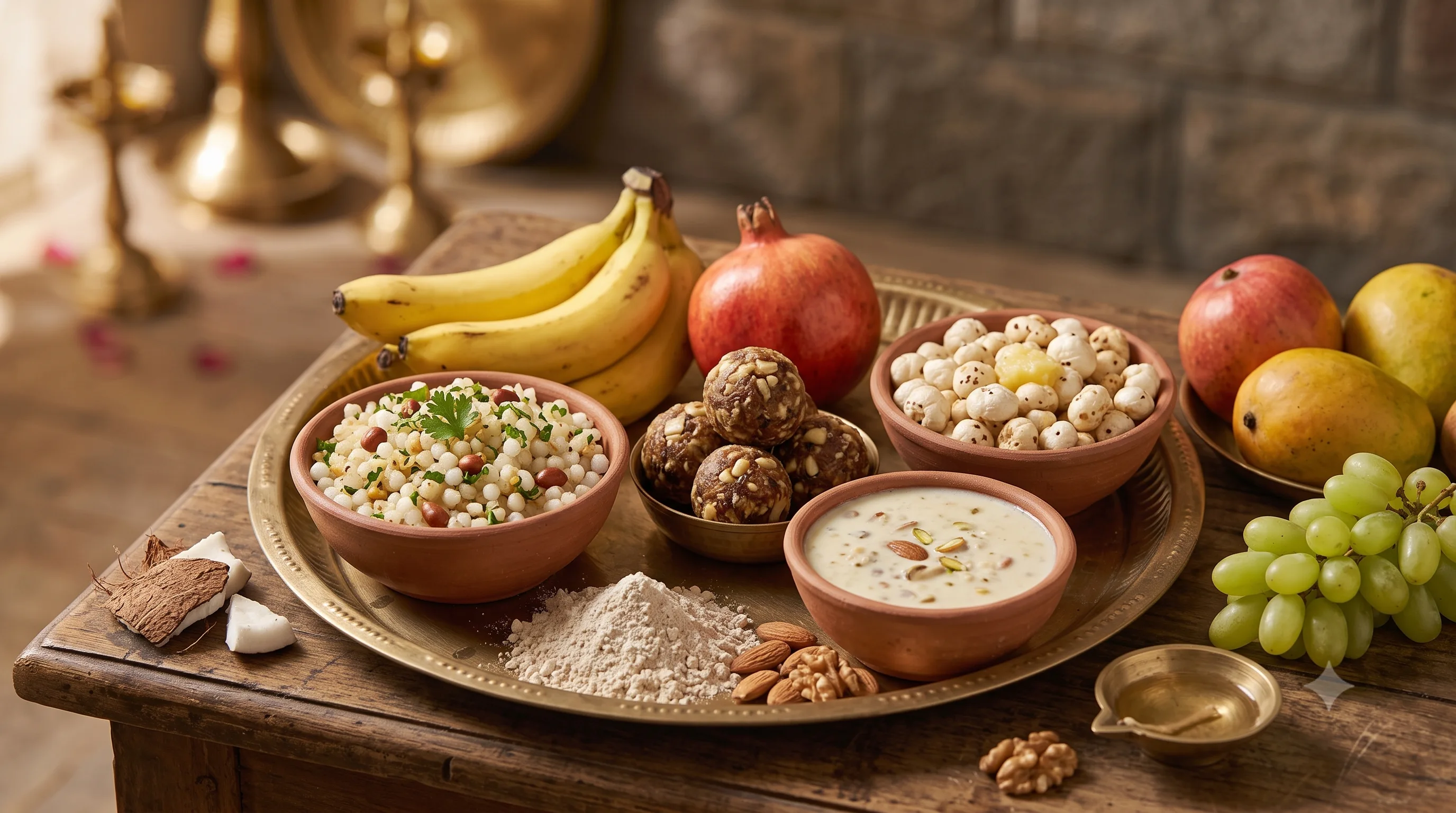
Fasting is one of the most personal forms of Hindu devotional discipline, and the food eaten during it follows its own careful rules — grain-free, simple, prepared with care. This guide covers the seven vrat falahaar items in Avyani's Master Samagri Catalogue, and how to buy and keep them safely.
Vrat falahaar is the food eaten on fasting days — days when the ordinary grains, pulses and common salt are set aside. Fasting is traditionally understood as a discipline of simplification, a quietening of the body so that attention rests more easily on the observance, whether an Ekadashi kept for Vishnu or a Karva Chauth kept for a husband's wellbeing. See our Vishnu Rituals and Devi Rituals guides.
What counts as falahaar is tradition, not a single rule. Which foods are permitted and which are set aside varies by region, by sampradaya, by family and by the particular vrat. Some households allow milk and fruit only; others eat a full cooked meal of the flours below. Avyani records the catalogue's seven items and does not adjudicate between traditions — follow your family's practice, and ask your priest where a specific vrat is concerned.
The Fasting Flours
Kuttu atta (कुट्टू का आटा) is buckwheat flour, ground from a seed rather than a cereal grain, which is why it is permitted where wheat is not. Singhare ka atta (सिंघाड़े का आटा) is water chestnut flour, milled from the dried nut. Both make the puris, pakoras and rotis that carry most fasting meals.
Buy kuttu atta with care. Illness after eating it during a fast is a recurring event in India.
- Around 200 people fell ill in north-west Delhi in September 2025 after eating food made with kuttu flour, and comparable incidents have been reported from Bijnor, Sonepat and other districts in earlier years.
- Reporting on these incidents points to spoilage, contamination and adulteration as possible causes. Investigators have often been unable to establish a single source, partly because the flour is bought from many different retailers, so no one explanation should be assumed.
- Ground buckwheat also has a short shelf life, and demand for it is concentrated into a few weeks a year — which makes stock age and storage worth attention.
- Buy sealed, traceable packs that name the manufacturer or packer and carry manufacture and expiry or best-before dates. Prefer small quantities from a shop with visible turnover.
- Store it airtight, cool and dry, and do not use flour left over from a previous year's fast.
- Discard flour that smells musty, sour or bitter, looks discoloured, or shows damp or insects. Note the limit of this check: normal smell and appearance mean only that nothing is obviously wrong, not that the flour is safe.
- If anyone feels unwell after a meal made with it, seek medical help. Keep the packet — it is what allows the cause to be traced.
Grain Substitutes
Sama rice (समा चावल) is barnyard millet, cooked much like rice and the closest thing to a staple on a fasting day. Rajgira or ramdana (राजगिरा/रामदाना) is amaranth, eaten popped as a sweet ladoo or ground into flour.
Sabudana (साबूदाना) is sago, made from tapioca starch and formed into pearls. It needs proper soaking — several hours in just enough water to cover, until a pearl crushes cleanly between the fingers with no hard white centre. Under-soaked sabudana is the usual reason a khichdi turns to paste, and it sits heavily.
Makhana and Sendha Namak
Makhana (मखाना), fox nut, is the seed of Euryale ferox, grown and hand-processed largely in the ponds of north Bihar. Dry-roast it before use; it turns crisp and keeps far better once roasted. Any bitterness means the batch is old.
Sendha namak (सेंधा नमक), rock salt, replaces ordinary table salt on fasting days across most traditions. One practical point worth knowing: rock salt is not iodised. That matters not at all for a day or a few days, but anyone who fasts very frequently should be sure they are getting iodised salt the rest of the time.
Fasting Sensibly
Practical guidance. Fasting food is starchy and often deep-fried, which is a quiet irony given that the point of the vrat is lightness. Keeping the meal simple — fruit, milk, a modest portion of one cooked dish — is closer to the intent than a spread of fried items.
Drink water unless the particular vrat prohibits it. Anyone who is pregnant, elderly, diabetic, taking regular medication, or recovering from illness should speak to a doctor before keeping a long or waterless fast; many traditions themselves make allowance in exactly these cases, and a priest can advise on the permitted substitutions.
These items appear above all during Navratri, Ekadashi, Karva Chauth and the observances in our Festival Rituals guide.
Vrat Falahaar at a Glance
| Item | Hindi | What it is | Mandatory / Optional |
|---|---|---|---|
| Kuttu Atta | कुट्टू का आटा | Buck |
Optional |
| Singhare Ka Atta | सिंघाड़े का आटा | Water chestnut flour | Optional |
| Sama Rice | समा चावल | Barnyard millet; cooked like rice | Optional |
| Rajgira (Ramdana) | राजगिरा/रामदाना | Amaranth; popped or ground | Optional |
| Sabudana | साबूदाना | Sago pearls; needs long soaking | Optional |
| Makhana | मखाना | Fox nut; dry-roast before use | Optional |
| Sendha Namak | सेंधा नमक | Rock salt; not iodised | Optional |
See our Fruits guide for what is eaten alongside these, and Understanding Samagri for how they fit the wider catalogue.
Sources
- Kuttu-flour illness — the September 2025 north-west Delhi incident affecting around 200 people, and comparable earlier incidents in Bijnor, Sonepat and elsewhere, reported and investigated by food-safety authorities.
- Possible causes — spoilage, contamination and adulteration all appear in reporting on these incidents; tracing a single source has repeatedly proved difficult, and this guide does not assert one.
- Short shelf life of ground buckwheat — noted in food-safety reporting on the recurring festival-season incidents.
- Rock salt is not iodised — standard composition; the note on frequent fasting is general dietary guidance, not medical advice.
- Permitted and prohibited fasting foods — regional and family tradition; no single scriptural list is asserted here.
- Item names, Hindi names and mandatory flags — Avyani Master Samagri Catalogue v1.
Where a scriptural locator could not be verified, the statement is given as tradition or regional practice rather than scripture. Nothing here is medical advice; a doctor is the right person to advise on fasting with any health condition.