


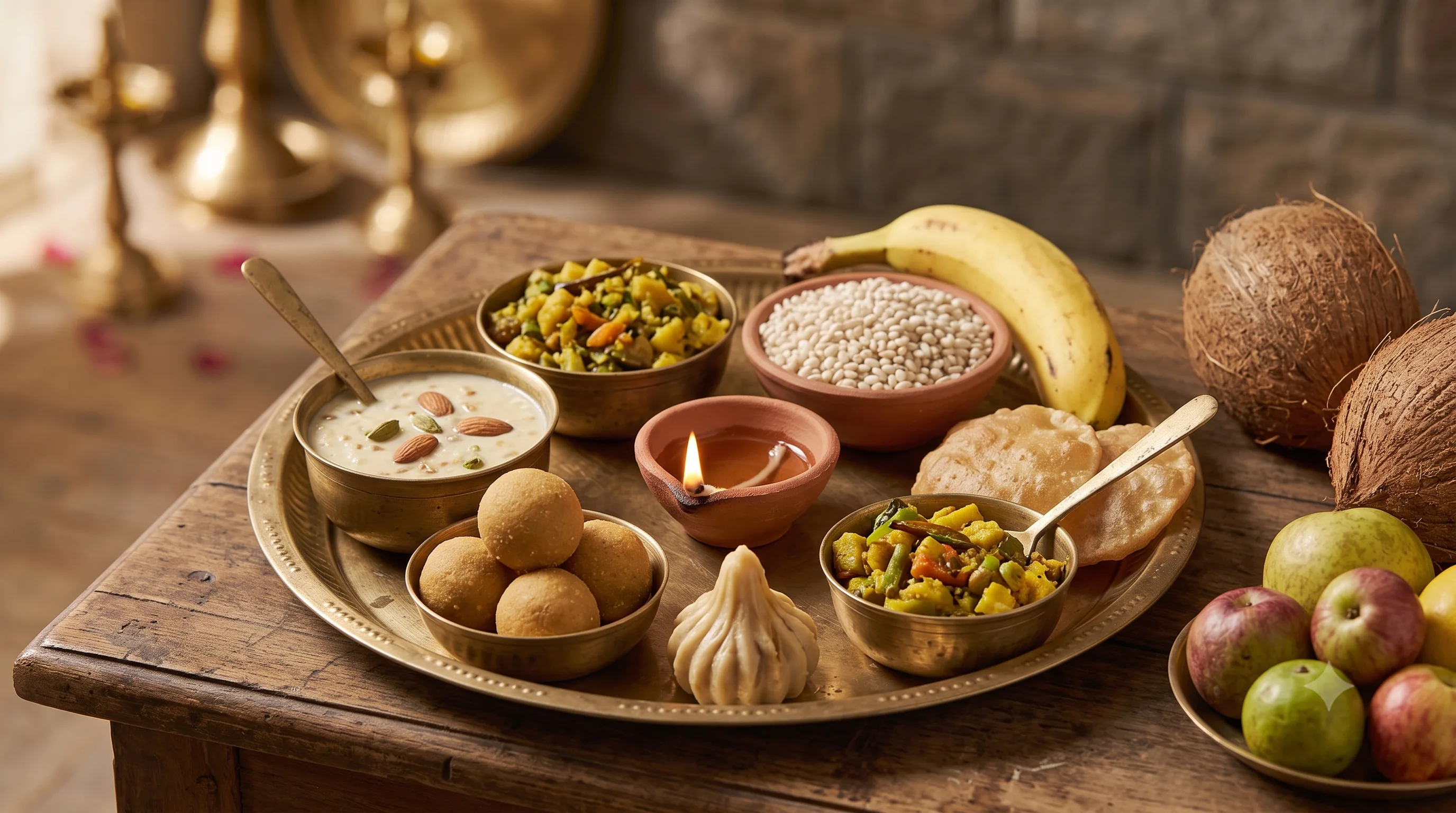
Naivedya is more than food set before the deity — once offered, it becomes prasad, grace returned and shared with everyone present. This guide covers the eight naivedya items in Avyani's Master Samagri Catalogue, from a single betel nut to the community meal.
Naivedya is food placed before the deity; prasad is that same food after it has been offered and returned. The change is not in the food but in what it now is, and that is why prasad is shared rather than kept.
The Bhagavad Gita sets the measure at 9.26: a leaf, a flower, a fruit or water, offered with devotion, is accepted. Everything below is elaboration on that, and none of it outranks it. Avyani's Master Samagri Catalogue records eight naivedya items.
Modak, Kheer and the Sweets
Modak (मोदक) belongs to Ganesha, and the association is old enough to have a textual footing: the Ganapati Atharvashirsha names it among the offerings and their fruits — one who worships with a thousand modakas obtains what is desired (v. 13). See our Ganapati Rituals guide. Steamed modak is made fresh on the day; the fried kind keeps a little longer.
Kheer or payasam (खीर), ladoo (लड्डू) and seasonal sweets (मिष्ठान्न) are the general offerings, given across the observances in our Festival Rituals guide. Most traditions prefer sweets made at home for the offering, and there is a practical reason as well as a devotional one: you know what went into them and when.
Thekua (ठेकुआ) is the wheat-and-jaggery sweet of Chhath, fried and long-keeping by design, since the observance requires food prepared in advance under strict purity — a Bihar and eastern Uttar Pradesh tradition, connected to our Surya Rituals guide.
Pinda and Anna Prasad
Pinda (पिंड) is the ancestral offering, shaped from cooked rice or barley flour with sesame, and central to Shraddha — see our Shraddha and Pitru Karma guide and the grain notes in our Grains guide. It is prepared under the direction of the priest conducting the rite, and its handling afterwards follows the same instruction.
Cooked rice as anna prasad (अन्न प्रसाद) is the community offering — annadanam, the feeding of whoever comes, described in our Temple Seva guide. It is the largest-scale item in the catalogue and the one where food handling stops being a private matter.
Betel Nut
Supari (सुपारी), the betel or areca nut (Areca catechu), is offered as a whole nut in almost every formal puja, often on a betel leaf as tambula, and given as a mark of respect to the priest.
Offering supari and chewing it are different things. The International Agency for Research on Cancer classifies areca nut, and betel quid without tobacco, as carcinogenic to humans — Group 1, independent of any tobacco content. The ritual offering of a whole nut carries no such exposure; habitual chewing does. Avyani records the item because worship uses it, and flags the distinction because both are common in the same households. This is not medical advice.
Offering Food Well
Tradition. Naivedya is not tasted before it is offered, so it is judged by look and smell rather than by sampling. Many households keep a separate set of vessels for it. In Vaishnava practice a tulsi leaf is placed on the offering — see our Flowers and Leaves guide — and most traditions keep the offering sattvic, which for many families means without onion or garlic. These conventions vary by sampradaya and by household, and none of them is a single scriptural rule.
Practical guidance. Because naivedya is eaten afterwards, treat it as food from the start.
- Cook fresh on the day, keep the offering covered, and distribute it soon after the rite rather than letting it stand through a long ceremony.
- Milk-based sweets, kheer and cooked rice are the items that spoil fastest in warm weather. These are the ones to watch, not the dry sweets.
- For annadanam and any large gathering, cook in batches timed to serving, keep hot food hot, and do not hold cooked rice at room temperature for hours.
- Where prasad is distributed to the public, name the common allergens — nuts, milk, wheat — if anyone asks. Someone always needs to know.
Naivedya at a Glance
| Item | Hindi | What it is | Mandatory / Optional |
|---|---|---|---|
| Betel Nut (Supari) | सुपारी | Whole areca nut; see note above | Mandatory |
| Modak | मोदक | Ganesha's offering; steamed or fried | Mandatory |
| Pinda | पिंड | Rice or barley-flour ball; shraddha | Mandatory |
| Kheer / Payasam | खीर | Milk and rice pudding | Optional |
| Ladoo | लड्डू | Sweet ball, many regional forms | Optional |
| Seasonal Sweets | मिष्ठान्न | Sweets of the festival or season | Optional |
| Thekua | ठेकुआ | Wheat and jaggery sweet; Chhath | Optional |
| Cooked Rice (Anna Prasad) | अन्न प्रसाद | Community meal; annadanam | Optional |
See our Fruits guide for the fruit offered alongside these, and Understanding Samagri for how they fit the wider offering.
Sources
- Bhagavad Gita 9.26 — Sanskrit text with translation.
- Ganapati Atharvashirsha v. 13, on modaka among the offerings — Sanskrit text with translation.
- Areca nut — IARC Monographs vol. 85 (2004), Betel-quid and Areca-nut Chewing and Some Areca-nut-derived Nitrosamines: areca nut and betel quid without tobacco classified Group 1, monograph.
- Sattvic conventions and the tulsi leaf on Vaishnava naivedya — established sampradaya practice with household variation.
- Item names, Hindi names and mandatory flags — Avyani Master Samagri Catalogue v1.
Where a scriptural locator could not be verified, the statement is given as tradition or regional practice rather than scripture. Nothing here is medical advice.