


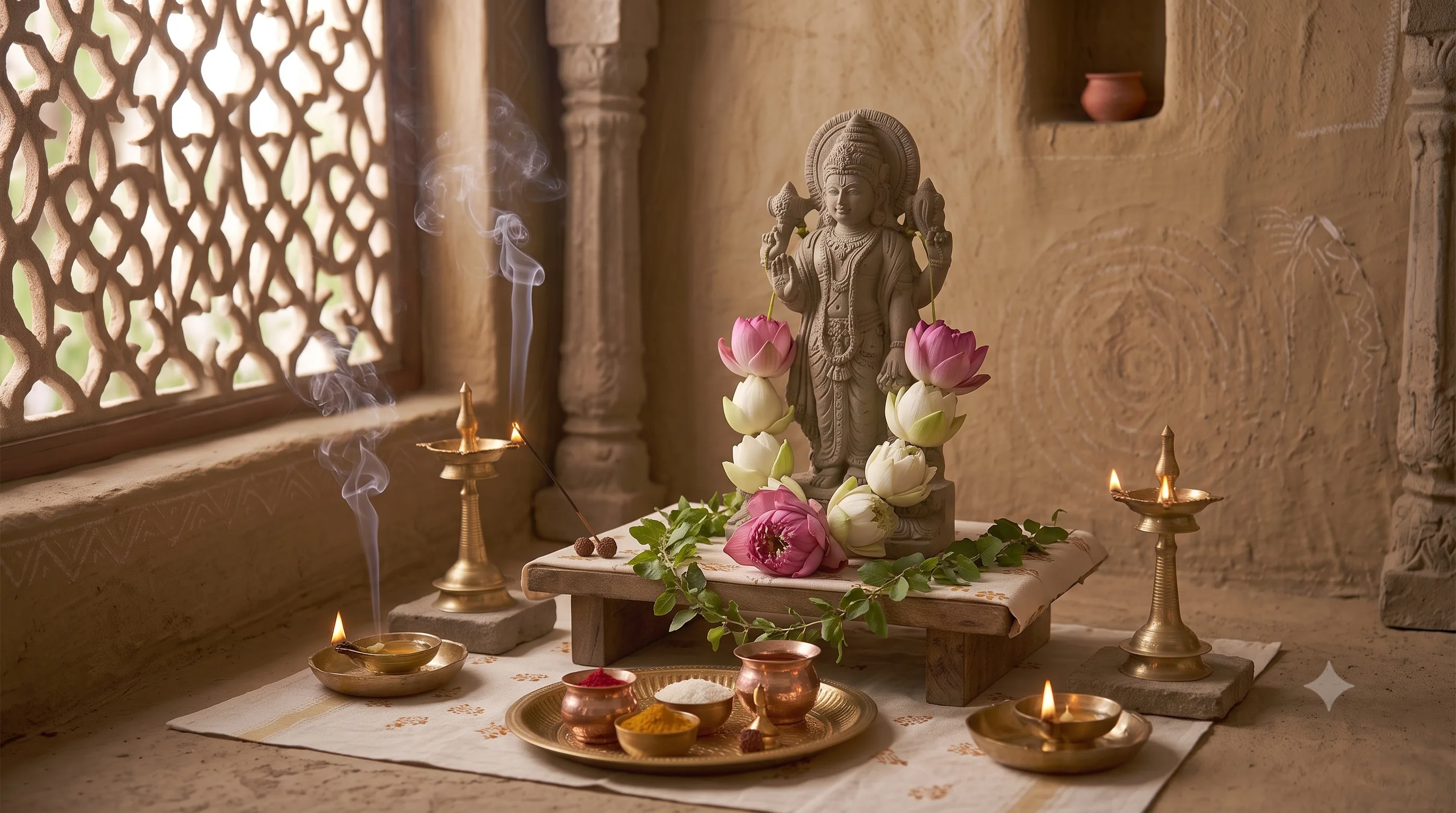
Thirty-three Vishnu rituals across the Vaishnava sampradayas — Satyanarayan Puja, the Dashavatara, and the Krishna and Jagannath traditions among them. This guide sets out the texts behind them and how the sampradayas differ, rather than how each is performed.
Worship of Vishnu spans his own form and each of his avataras, and is central to the Vaishnava sampradayas practised across India — Sri Vaishnava, Gaudiya, Madhva, Pushti Marg, Swaminarayan and others. Avyani's Master Puja & Ritual Catalogue documents thirty-three Vishnu rituals, from a short daily puja to the multi-day Jagannath Rath Yatra.
This is an overview of how those thirty-three relate to each other, not a manual for performing them. Where it says scripture, it names a text you can check; where it says tradition or regional practice, the custom is real and widely followed but has no single locator, and the sampradayas genuinely differ.
Everyday Worship
A standard Vishnu Puja, offered with tulsi and the sixteen-step shodashopachara sequence described in our Understanding Samagri guide, needs no priest and takes under an hour. It is commonly accompanied by the twelve-syllable mantra:
ॐ नमो भगवते वासुदेवाय
Om Namo Bhagavate Vasudevaya — "Om, salutations to the Blessed Lord Vasudeva" — is among the most widely recited Vaishnava mantras. Tulsi is effectively inseparable from this worship; our Flowers and Leaves guide covers its handling, and the household rules that vary by region.
The Sahasranama and the Sudarshana
Vishnu Sahasranama Archana offers the thousand names one at a time. The text is not a standalone stotra of uncertain origin: it sits in the Mahabharata, in the Anushasana Parva at chapter 149, spoken by Bhishma from the bed of arrows in answer to Yudhishthira. That is a checkable location, and it is part of why the text carries the weight it does.
Sudarshana Puja and Sudarshana Homam address Vishnu's discus as a distinct object of worship, chiefly in the Sri Vaishnava tradition of the south. Narasimha Kavacha Puja works similarly, invoking a protective hymn rather than a form.
Satyanarayan Puja
Satyanarayan Puja is among the most performed household rituals in northern and eastern India — kept on full-moon days, after a vow fulfilled, at a housewarming or before a wedding. It centres on the reading of the Satyanarayan Katha, a cycle of five stories about the consequences of keeping or breaking a vow, and closes with a sweet prasad of wheat flour, ghee and sugar.
Tradition. The Katha is generally attributed to the Skanda Purana, and Avyani has not been able to verify a specific chapter locator for it. It is recorded here as the widely accepted attribution rather than as a confirmed reference.
The Dashavatara
The catalogue records a puja for each of the ten avataras, and Dashavatara Puja for the sequence as a whole: Matsya, Kurma, Varaha, Narasimha, Vamana, Parashurama, Rama, Krishna, and in most lists the Buddha and Kalki.
The list itself is not uniform. Some traditions place Balarama where others place the Buddha; the Bhagavata reckons twenty-two avataras and calls the count innumerable. Where a family follows a particular list, that is the one to keep.
Rama Puja and Ram Navami, Krishna Puja, Bal Gopal Puja and Krishna Janmashtami are by far the most observed of these, and each has its own household form quite apart from the temple one.
Sampradaya and Temple Traditions
Regional practice. Several entries in the catalogue are not general rituals at all but the daily service of a particular tradition, and they are performed on that tradition's own terms rather than to a common pattern.
- Jagannath Puja and the Rath Yatra at Puri, with a daily seva cycle and an annual procession of three deities on chariots.
- Nathdwara Shrinathji Seva in the Pushti Marg of Vallabhacharya, built around eight daily darshans.
- Swaminarayan Thakorji Seva, and ISKCON deity aarti and kirtan seva in the Gaudiya line.
- Venkateswara Puja and Srinivasa Kalyanam at Tirumala; Ranganatha Puja at Srirangam; Panduranga Vitthal Puja of the Varkari tradition, whose pilgrimage on foot to Pandharpur is its central practice.
A householder cannot simply perform these; they are joined rather than arranged.
Ekadashi and Dhanvantari
Ekadashi Vrat falls twice a lunar month and is the most regular Vaishnava observance; Vaikunta Ekadashi in Margashirsha is its principal annual form, when the northern gate is opened at Srirangam and other temples. Our Vrat Falahaar guide covers what is eaten.
Dhanvantari Puja and Dhanvantari Homam address the physician of the gods, an avatara associated with Ayurveda, and are commonly performed on Dhanteras and by those in medical work.
On the healing rituals in this list. Dhanvantari worship is traditionally undertaken for health and recovery, and that is recorded here as the tradition's own intention. It is not a treatment, Avyani does not predict or guarantee any medical outcome, and no ritual should replace medical care. Families commonly arrange both, and there is no conflict in doing so.
Vishnu Rituals at a Glance
Durations are typical planning ranges. "Traditionally for" records the intention the tradition assigns — not an outcome Avyani predicts or guarantees.
| Ritual | Tradi |
Typical duration | Priest advised |
|---|---|---|---|
| Vishnu Puja | General worship; dharma | 30–45 mins | No |
| Vishnu Sahasra | Full devotion and merit | 1 hour | No |
| Satya | Vows kept; family welfare | 2–3 hours | Yes |
| Ekadashi Vrat Puja | Purity and merit | 1 hour | No |
| Vai | Moksha and merit | 2–3 hours | Yes |
| Lakshmi Narayan Puja | Wealth with dharma | 1 hour | Yes |
| Sudar | Shelter from ill will | 1 hour | Yes |
| Sudar | Shelter; clearing ill will | 2–3 hours | Yes |
| Dasha | The ten forms together | 1–2 hours | Yes |
| Matsya Puja | Shelter in calamity | 30 mins | No |
| Kurma Puja | Steadiness and support | 30 mins | No |
| Varaha Puja | The earth; plenty | 30 mins | No |
| Nara | Shelter from fear and harm | 1 hour | Yes |
| Nara | Protective hymn; shelter | 30 mins | No |
| Vamana Puja | Humility; dharma restored | 30 mins | No |
| Parashu | Strength; wrongs righted | 30 mins | No |
| Rama Puja | Dharma; family harmony | 30–45 mins | No |
| Ram Navami Puja | Birth festival of Rama | 2–3 hours | Yes |
| Krishna Puja | Love, shelter, plenty | 30–45 mins | No |
| Bal Gopal Puja | Devotion in the home | 30–60 mins | No |
| Krishna Janmash | Birth festival of Krishna | Full night | Yes |
| Hayagriva Puja | Learning and wisdom | 30–45 mins | No |
| Dhanvan | Health; see the note above | 1 hour | Yes |
| Dhanvan | Health; see the note above | 2 hours | Yes |
| Venkat | A wish; plenty | 1 hour | Yes |
| Srini | The divine marriage rite | 1–1.5 hours | Yes |
| Ranga | Shelter and plenty | 1 hour | Yes |
| Jagannath Puja | Daily seva at Puri | Daily seva cycle | Yes |
| Jagannath Rath Yatra | Public darshan; renewal | Multi-day | Yes |
| Nath | Pushti Marg daily seva | Daily seva cycle | Yes |
| Swami | Daily seva | Daily seva cycle | Yes |
| ISKCON Aarti and Kirtan Seva | Devotion and sankirtan | 30–60 mins | Yes |
| Pandu | Varkari bhakti | 1 hour | Yes |
For the samagri these rituals use, see the Samagri Catalogue.
Sources
- Vishnu Sahasranama — Mahabharata, Anushasana Parva, chapter 149, spoken by Bhishma to Yudhishthira.
- Bhagavad Gita 9.26, on what an offering requires — cited in full in our Naivedya guide.
- Satyanarayan Katha — widely attributed to the Skanda Purana; Avyani could not verify a chapter locator and records the attribution as traditional.
- The Dashavatara list — varies between traditions; the Bhagavata Purana gives a longer reckoning and treats the count as open.
- Sampradaya sevas — Jagannath at Puri, Pushti Marg at Nathdwara, Sri Vaishnava at Srirangam and Tirumala, Varkari at Pandharpur; established tradition, performed on each tradition's own terms.
- Ritual names, durations and priest-advised flags — Avyani Master Puja & Ritual Catalogue. Durations are planning ranges, not prescriptions.
Where a scriptural locator could not be verified, the statement is given as tradition rather than scripture. Stated purposes are the intentions the tradition assigns, not outcomes Avyani predicts. Nothing here is medical advice.