


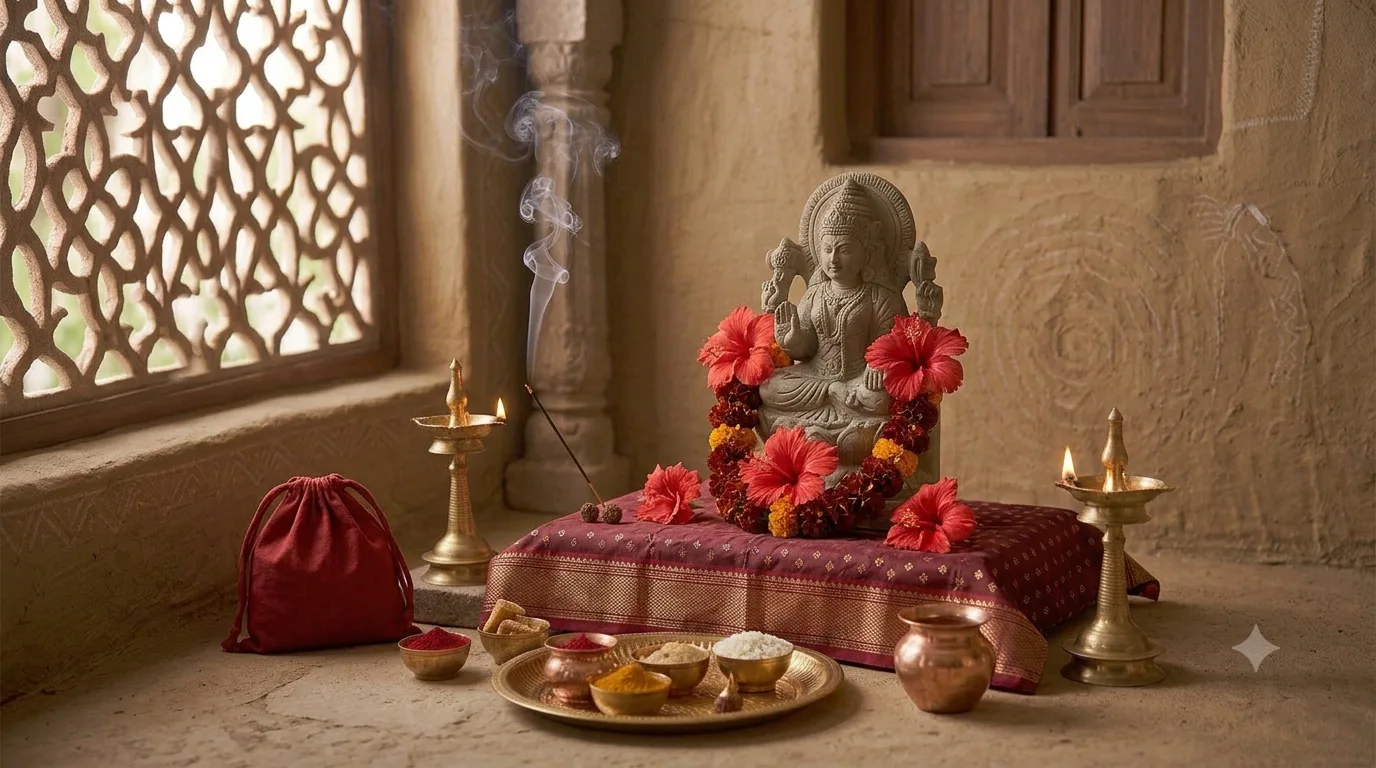
Forty-one Devi rituals, spanning Navratri, the Dasha Mahavidyas and goddess traditions rooted in every corner of India — the largest category in Avyani's Master Puja & Ritual Catalogue. This guide maps how they relate rather than how each is performed.
The Divine Mother is worshipped across India in an extraordinary range of forms — gentle and fierce, domestic and cosmic, pan-Indian and intensely local. With forty-one recorded rituals, this is the largest single category in Avyani's Master Puja & Ritual Catalogue, and the one where regional practice matters most.
This is an overview of how those forty-one relate to each other, not a manual for performing them. Where it says scripture, it names a text you can check; where it says tradition or regional practice, the custom is real and widely followed but has no single locator.
The Devi Mahatmya
One text stands behind a great deal of what follows. The Devi Mahatmya — also called the Durga Saptashati or Chandi Path — is not an independent book: it is chapters 81 to 93 of the Markandeya Purana, seven hundred verses in thirteen chapters, generally dated to around the fifth or sixth century CE.
Its importance is that it is the first text to present the Goddess as supreme in her own right rather than as a consort, and it supplies the narratives — Mahishasura, Shumbha and Nishumbha — that Durga Puja enacts. Durga Saptashati Path, Chandi Puja, Chandi Homam and Chandika Homam are all built on it, which is why they cluster together in the catalogue.
Its most repeated refrain runs through the recitation:
या देवी सर्वभूतेषु शक्तिरूपेण संस्थिता। नमस्तस्यै नमस्तस्यै नमस्तस्यै नमो नमः॥
"To that Goddess who abides in all beings in the form of power — salutations to her, salutations to her, salutations again and again."
Navratri and Durga Puja
The nine nights open with Ghatasthapana, the installation of the kalash described in our Kalash and Utensils guide, with navdhanya sown to sprout across the nine days — see our Grains guide. The Shailaputri to Siddhidatri sequence worships the nine Nava Durga forms, one each night.
Regional practice. What Navratri is varies enormously. In Bengal, Assam and Odisha it is Durga Puja, a public five-day festival with community pandals, Sandhi Puja at the junction of Ashtami and Navami, and Kumari Puja, the honouring of a young girl as the Goddess. In Gujarat it is nine nights of garba. In much of the south it is Golu, with dolls arranged in tiers. Ayudha Puja and Vijayadashami close the observance, when tools, instruments and vehicles are blessed.
The Dasha Mahavidyas
Ten of the catalogue's entries belong to a single Tantric grouping, the ten Mahavidyas: Kali, Tara, Tripurasundari (as Lalita), Bhuvaneshwari, Bhairavi, Chinnamasta, Dhumavati, Bagalamukhi, Matangi and Kamala.
Tradition. These are Tantric forms with their own initiatory lineages, and several are not household practices in any tradition. Avyani records them because the catalogue documents what is practised, and notes plainly that the fiercer forms — Chinnamasta, Dhumavati, Bagalamukhi among them — are undertaken within a lineage and under a qualified teacher, not assembled from a shop list. Lalita Sahasranama Archana, from the Brahmanda Purana, is the widely accessible exception and needs no priest.
Household and Vrat Observances
A second cluster is entirely domestic and mostly kept by women, without a priest. Gauri Puja and Mangala Gauri Puja, Hartalika Teej, and Karva Chauth — where the moon is viewed through the sieve described in our Miscellaneous guide — are observed for marriage and family. Santoshi Mata Puja, kept on Fridays, is a genuinely modern devotion that spread widely from the 1960s and 1970s.
Saraswati Puja and Annapurna Puja address learning and food, and both are simple household rites. Our Vrat Falahaar guide covers what is eaten on fasting days.
Regional and Local Goddesses
The remainder of the catalogue is regional, and deliberately so. Kamakhya Puja and the Ambubachi Mela in Assam; Vaishno Devi in Jammu; Meenakshi Puja and Thirukalyanam at Madurai; Attukal Pongala in Kerala, where women cook offerings in the open by the hundred thousand; Bathukamma and Bonalu in Telangana; Renuka Devi and Mariamman in the Deccan and the south.
Mariamman and Bonalu belong to the village-goddess traditions historically associated with epidemic disease, and both are traditionally observed for protection and in gratitude after illness has passed. That is the tradition's own framing, recorded as such; these observances are not treatments and do not replace medical care or vaccination.
Forty-one rituals is a working catalogue rather than a complete account. India has goddess traditions in villages that no catalogue reaches, and a family's own kuladevi may not appear here at all.
Devi Rituals at a Glance
Durations are typical planning ranges. "Traditionally for" records the intention the tradition assigns — not an outcome Avyani predicts or guarantees.
| Ritual | Tradi |
Typical duration | Priest advised |
|---|---|---|---|
| Ghatas | Opening the nine nights | 45–60 mins | No |
| Shaila | Nine nights, night by night | 9 days | Yes |
| Durga Puja | Victory over evil; shelter | Multi-day | Yes |
| Durga Sapta | Shelter; victory; merit | 9 days or one sitting | Yes |
| Durga Chalisa Path | Devotion and shelter | 15–20 mins | No |
| Vijaya | Good over evil | 1–2 hours | Yes |
| Ayudha Puja | Blessing tools and vehicles | 30–45 mins | No |
| Kumari Puja | The girl honoured as Devi | 1–1.5 hours | No |
| Kali Puja | Clearing ill will; shelter | Full night | Yes |
| Chandi Puja | Shelter; hardship cleared | 2–3 hours | Yes |
| Chandi Homam | Shelter; major blocks | 3–4 hours | Yes |
| Chandika Homam | Shelter; major blocks | 2–3 hours | Yes |
| Saraswati Puja | Learning, wisdom, the arts | 30–45 mins | No |
| Annapurna Puja | Food, plenty, hosting | 30–45 mins | No |
| Lalita Tripura | Beauty, wishes, shelter | 1–1.5 hours | Yes |
| Lalita Sahasra | Full devotion and merit | 1–1.5 hours | No |
| Raja Rajeshwari Puja | Rulership and plenty | 1 hour | Yes |
| Bhuvan | Inner and outer rulership | 1 hour | Yes |
| Tara Puja | Shelter; crossing hardship | 1 hour | Yes |
| Bagala | Victory over foes; disputes | 1–1.5 hours | Yes |
| Matangi Puja | Speech, learning, the arts | 1 hour | Yes |
| Kamala Devi Puja | Plenty of both kinds | 1 hour | Yes |
| Bhairavi Puja | Inner change; shelter | 1 hour | Yes |
| Dhumavati Puja | Release; hardship cleared | 1 hour | Yes |
| Chinna | Waking; facing fear | 1 hour | Yes |
| Kamakhya Puja | Shakti; fertility | 1 hour | Yes |
| Ambu | Fertility; yearly renewal | 4 days | Yes |
| Santoshi Mata Puja | Peace of mind; a wish | 45–60 mins | No |
| Vaishno Devi Puja | A wish; yatra merit | 1 hour | Yes |
| Renuka Devi Puja | Shelter; folk devotion | 1 hour | Yes |
| Mariamman Puja | Shelter; rain; welfare | 1–2 hours | Yes |
| Gauri Puja | Marriage; family welfare | 1 hour | No |
| Mangala Gauri Puja | Marriage; a husband's welfare | 1 hour | No |
| Harta | Marriage; a husband's welfare | 1–2 hours | No |
| Karva Chauth Puja | A husband's welfare | 1–2 hours | No |
| Bathu | Flowers, women, the season | Multi-day | No |
| Bonalu Rituals | Shelter; thanks given | 1 day | Yes |
| Attukal Pongala Rituals | A wish; shared devotion | 1 day | No |
| Meen | Marriage; shelter | 1 hour | Yes |
| Meen | The divine marriage rite | Multi-day | Yes |
| Vaish | Shelter; warding off harm | 1 hour | Yes |
For the samagri these rituals use — chunri, hibiscus, aparajita, kumkum and the rest — see the Samagri Catalogue and our Cloth and Sacred Threads guide.
Sources
- Devi Mahatmya / Durga Saptashati — Markandeya Purana, chapters 81–93; 700 verses in 13 chapters; generally dated to about the fifth or sixth century CE.
- Lalita Sahasranama — Brahmanda Purana; the attribution is the standard one.
- The ten Mahavidyas — Tantric tradition with initiatory lineages; lists and order vary between sources.
- Santoshi Mata as a modern devotion that spread widely from the mid-twentieth century — documented religious history.
- Village-goddess traditions and epidemic disease — established regional practice, recorded as tradition; no medical claim is made.
- Ritual names, durations and priest-advised flags — Avyani Master Puja & Ritual Catalogue. Durations are planning ranges, not prescriptions.
Where a scriptural locator could not be verified, the statement is given as tradition or regional practice rather than scripture. Stated purposes are the intentions the tradition assigns, not outcomes Avyani predicts. Nothing here is medical advice.