


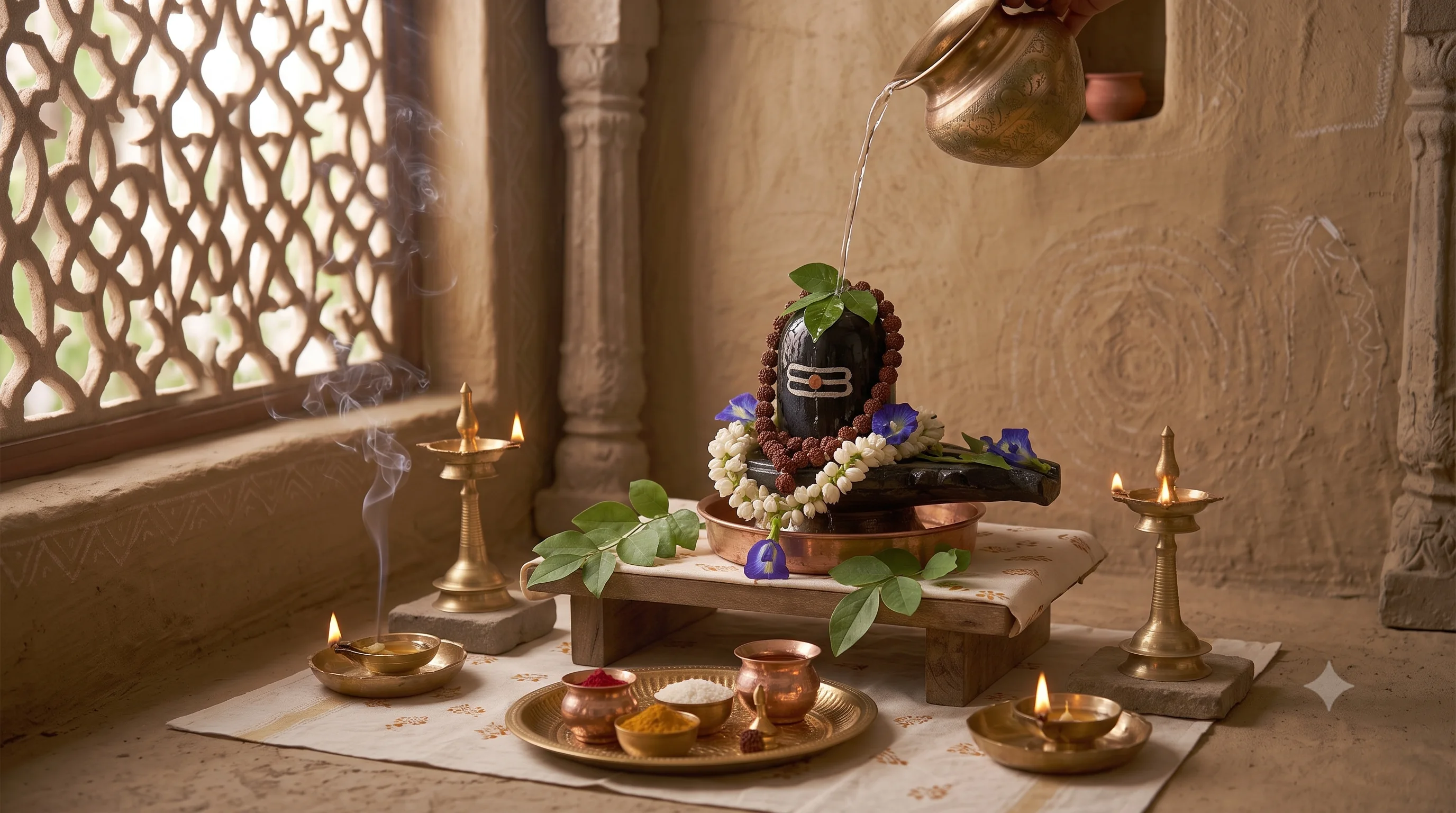
Thirty Shiva rituals, from a simple daily offering of water and bilva leaves to the eleven-day Rudra recitations of temple tradition. This guide sets out how they relate to one another — what the texts behind them actually are, why some scale so enormously, and when a qualified priest is genuinely needed.
Shiva is worshipped across India in forms ranging from the simplest offering of water and bilva leaves to multi-day recitations performed by teams of priests. Avyani's Master Puja & Ritual Catalogue documents thirty distinct Shiva rituals, spanning Vedic recitation, Agama temple practice and household devotion.
This is an overview of how those thirty relate to each other, not a manual for performing them. Where it says scripture, it names a text you can check; where it says tradition or regional practice, the custom is real and widely followed but has no single locator, and families and sampradayas differ.
The Text at the Centre
Most of the larger rituals here are, at bottom, one recitation performed at different scales. That recitation is the Sri Rudram, and it is Vedic rather than Puranic: it sits in the Krishna Yajurveda's Taittiriya Samhita, the Namakam at 4.5 and the Chamakam at 4.7.
The Namakam is a litany of salutations to Rudra, and it carries the Vedic wording namaḥ śivāya ca śivatarāya ca in its eighth section — "salutations to the auspicious one, and to the more auspicious one". The words of the Panchakshari are therefore present in the Veda itself.
What grew later is the practice: reciting Om Namah Shivaya on its own as a five-syllable mantra, with its own dhyana, count and place in daily discipline, is a devotional development of the Shaiva tradition rather than a Vedic prescription. Both things are true, and they are worth keeping apart.
ॐ नमः शिवाय
Om Namah Shivaya — "Om, salutations to Shiva" — takes its name from the five sounds na-mah-shi-va-ya. It needs no occasion, and many recite it simply as a steady point of return through the day.
Why the Rudra Rituals Scale
Rudrabhishek is the ritual bathing of the linga while the Rudram is recited, and it is the classical form of Shiva worship. What looks in the catalogue like six separate rituals is really one rite counted out at increasing multiples.
Tradition. The usual paddhati ladder multiplies by eleven at each step: a single Rudra, then Ekadash Rudra at eleven recitations, Laghu Rudra at eleven of those, Maha Rudra at eleven Laghu Rudras, and Ati Rudra at eleven Maha Rudras. That is why the durations in the table below run from ninety minutes to eleven days, and why the larger forms need teams of priests rather than one. Exact counts vary between traditions.
Two gentler variants sit alongside the ladder. Panchamrit Abhishekam bathes the linga in the five substances described in our Liquids and Panchamrit guide, and Rudrabhishekam with ghee substitutes ghee for the usual offerings. Both are widely performed and need no team.
Everyday Devotion
A simple Shiva Puja — water, bilva leaves and mantra offered to the linga — takes half an hour and needs no priest. Bilva Archana offers 108 or 1008 bael leaves one at a time; the Shiva Purana calls the bilva the symbol of Shiva, adored even by the gods (Vidyeshvara Samhita 22.22). Our Flowers and Leaves guide covers choosing the leaves, and Powders and Sacred Marks covers the bhasma and tripundra that go with Shaiva practice.
Somvar Vrat, the Monday fast, is among the most widely kept household observances in the country, and the sixteen-Monday Solah Somvar sequence is a common vow. Shiva Purana Paath is the week-long reading of the text itself.
Mahamrityunjaya
The Mahamrityunjaya or Tryambaka mantra is the second Vedic text in regular Shaiva use, and it is older still: it is a verse of the Rigveda (7.59.12), recurring in the Yajurveda at Taittiriya Samhita 1.8.6.i and Vajasaneyi Samhita 3.60. It asks to be released from death as a cucumber is released from its stem — and, in the same breath, not to be released from immortality.
It is recited personally as Mahamrityunjaya Jaap and offered into fire as Mahamrityunjaya Homam, the latter usually sought at times of illness, surgery or difficulty.
On what these rituals are for. The purposes given in the table below are the ones the tradition itself states — healing, longevity, protection, removal of afflictions. Avyani records them as traditional purpose, not as outcomes it predicts or promises. Nothing here is medical advice, and no ritual is a substitute for medical care. Families frequently arrange both, and there is no conflict in doing so.
The Shaiva Calendar
Pradosh Puja falls at twilight on the thirteenth lunar day, twice each month, and is among the most regular fixtures of Shaiva observance; Pradoshotsavam is its temple-scale form, when the Nandi is bathed and the utsava murti processed.
Maha Shivaratri is the year's principal observance — an all-night vigil with worship at each of the four watches of the night, each watch with its own abhishekam. Kedar Gauri Vrat and Lingodbhava Puja attach to particular days; Lingodbhava commemorates the column of fire in which Shiva manifested before Brahma and Vishnu, narrated in the Shiva Purana at Vidyeshvara Samhita 6–9.
Forms, Shrines and Regional Practice
Shiva is approached through many forms, and the catalogue records a puja for each: Nataraja, the cosmic dancer of Chidambaram, particularly revered by dancers and musicians; Dakshinamurti, the silent teacher facing south; Kalabhairava, the fierce guardian, in Kashi the keeper of the city; Ardhanarishwara, the joined form of Shiva and Parvati; and Vishwanath at Varanasi.
Jyotirlinga Puja refers to worship at, or invoking, the twelve jyotirlingas, whose list and origin story the Shiva Purana gives in its Koti Rudra Samhita. The Dvadasha Jyotirlinga Stotra, traditionally ascribed to Adi Shankaracharya, names all twelve in order and is recited by those who cannot travel to them. Vishwanath Puja, Sri Shailam Mallikarjuna Puja and Amarnath Yatra Puja are the shrine-specific forms the catalogue records.
Regional practice. Shaiva worship is not one tradition. Tamil Shaiva Siddhanta carries the Tevaram hymns of the Nayanars alongside Sanskrit liturgy; Lingayat practice centres on the ishtalinga worn on the body rather than on temple worship; Kashmir Shaivism developed its own philosophy and ritual. Thirty rituals is a working catalogue, not a complete account, and a family's own tradition may name forms that are not listed here.
When a Priest Is Needed
The table marks many rituals as priest-recommended, and the reason is specific rather than formal. The Rudram is Vedic, and Vedic recitation carries svara — pitch accents that are part of the text, not decoration. Reciting it correctly, at length, and in the right sequence with the abhishekam is a trained skill, and the longer Rudra forms additionally require enough reciters to hold the count.
The daily and devotional practices — Shiva Puja, bilva archana, panchakshari jaap, Somvar vrat — carry no such requirement and never have. A householder needs no intermediary for them.
Shiva Rituals at a Glance
Durations are typical planning ranges and vary with tradition, scale and the number of reciters. "Traditionally for" records the purpose the tradition assigns, as described in the note above.
| Ritual | Tradi |
Typical duration | Priest advised |
|---|---|---|---|
| Shiva Puja | General worship, inner peace | 30–45 mins | No |
| Pancha | Steady daily merit | 20–30 mins | No |
| Bilva Archana | Devotion and merit | 30–45 mins | No |
| Pancha | Purity and devotion | 30–45 mins | No |
| Somvar Vrat Puja | Wishes, marital harmony | 30–45 mins | No |
| Maha | Healing and long life | 30–60 mins | No |
| Kedar Gauri Vrat Puja | Marital harmony, wealth | 1 hour | No |
| Rudra | Peace, wealth, dosha removal | 1.5–2 hours | Yes |
| Rudra | Wealth and plenty | 1–1.5 hours | Yes |
| Ekadash Rudra | Eleven-fold Rudra worship | 4–6 hours | Yes |
| Laghu Rudra | Mid-scale Rudra worship | 1 day | Yes |
| Maha Rudra | Large-scale, shared merit | 2–3 days | Yes |
| Ati Rudra | Universal welfare; rare | 7–11 days | Yes |
| Rudram Chamakam Parayana | Full Rudram worship | 1 hour | Yes |
| Rudra Homam | Removal of dosha; purity | 1.5–2 hours | Yes |
| Maha | Long life and healing | 2–3 hours | Yes |
| Pradosh Puja | Removal of sins; wealth | 1–1.5 hours | Yes |
| Pradosh | Temple twilight worship | 2 hours | Yes |
| Shivaratri Puja | Moksha and awakening | Full night | Yes |
| Lingod | Shiva as the fire pillar | 1 hour | Yes |
| Shiva Sahasra | Full devotion and merit | 1–1.5 hours | Yes |
| Shiva Purana Paath | Knowledge of Shiva tattva | 7 days | Yes |
| Nataraja Puja | Cosmic rhythm, the arts | 1–2 hours | Yes |
| Dakshina | Knowledge, wisdom, guru grace | 1 hour | Yes |
| Kala | Safety, justice, fear removal | 1 hour | Yes |
| Ardha | Balance of male and female | 1 hour | Yes |
| Jyotir | Darshan merit, moksha | 1–2 hours | Yes |
| Vishwa | Moksha, spiritual merit | 1 hour | Yes |
| Sri Shailam Malli | Jyotir | 1 hour | Yes |
| Amarnath Yatra Puja | Yatra merit, darshan | 1–2 hours | Yes |
For the materials these rituals use — bilva, bhasma, panchamrit, samidha and the rest — see our Samagri Catalogue and the Understanding Samagri guide. A qualified priest can advise which form suits a particular occasion and family tradition.
Sources
- Sri Rudram — Krishna Yajurveda, Taittiriya Samhita: Namakam at 4.5, Chamakam at 4.7. The wording namaḥ śivāya ca śivatarāya ca occurs in the eighth anuvaka of the Namakam; the standalone Panchakshari practice is a later devotional development and is described as such.
- Mahamrityunjaya / Tryambaka mantra — Rigveda 7.59.12, recurring at Taittiriya Samhita 1.8.6.i and Vajasaneyi Samhita 3.60.
- Shiva Purana, Vidyeshvara Samhita 22.22 on the bilva, and 6–9 on the Lingodbhava — ch. 22, ch. 8.
- The twelve jyotirlingas — Shiva Purana, Koti Rudra Samhita. The Dvadasha Jyotirlinga Stotra is traditionally ascribed to Adi Shankaracharya.
- The eleven-fold Rudra ladder (Ekadash, Laghu, Maha, Ati) — paddhati convention; counts vary between traditions and no single scriptural locator is asserted.
- Ritual names, durations and priest-recommended flags — Avyani Master Puja & Ritual Catalogue. Durations are Avyani planning ranges, not prescriptions.
Where a scriptural locator could not be verified, the statement is given as tradition or regional practice rather than scripture. Stated purposes are those the tradition assigns; nothing here is medical advice.