


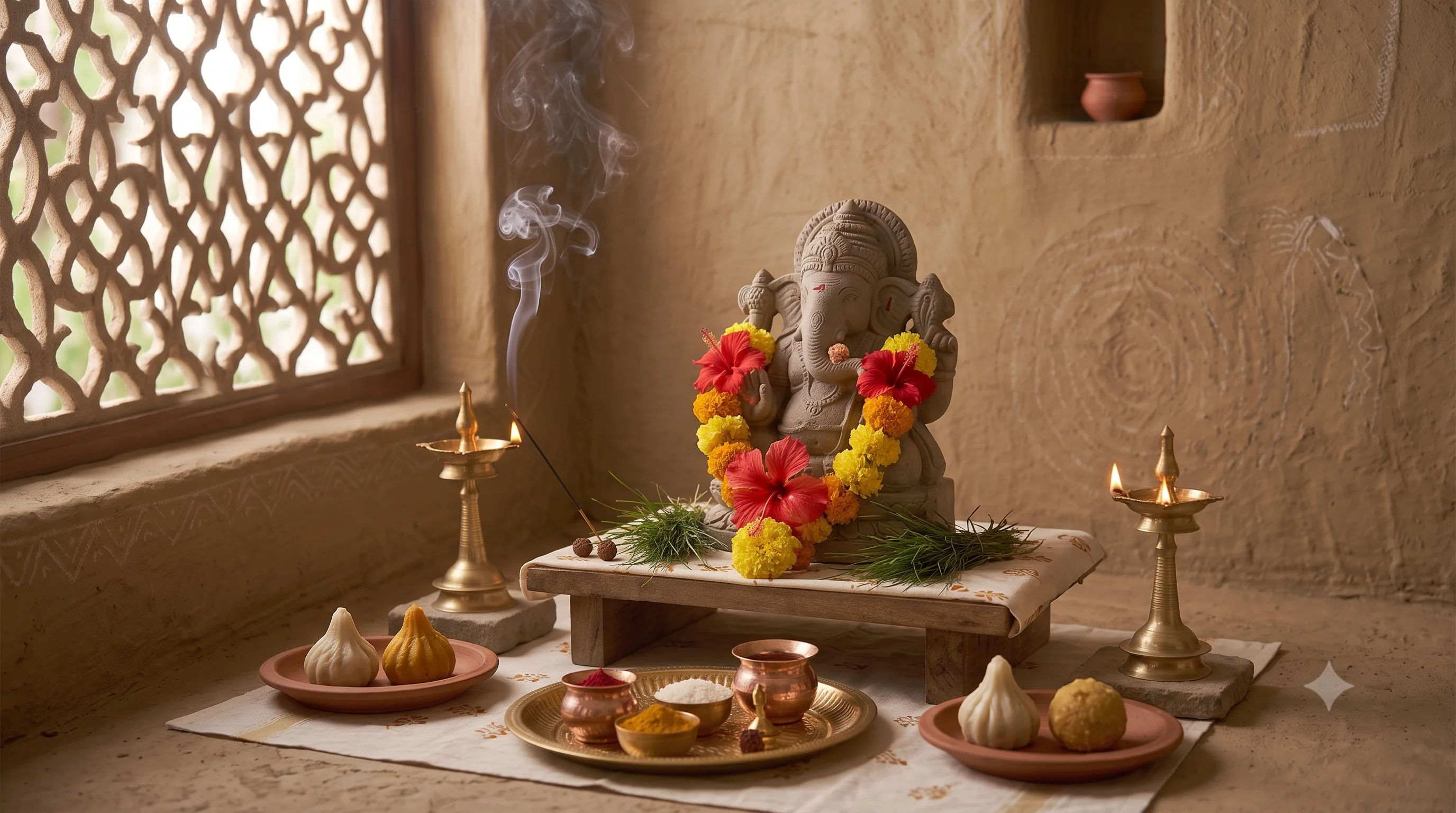
Eighteen Ganapati rituals, from a few quiet minutes of daily devotion to the ten-day celebration of Ganesh Chaturthi. This guide sets out what the texts behind them actually are, how the forms differ, and which are for the household and which for a temple.
Every undertaking in Hindu tradition — a new venture, a wedding, a festival, even the start of another puja — customarily opens with an invocation to Ganapati, the Remover of Obstacles and Lord of Beginnings. Avyani's Master Puja & Ritual Catalogue documents eighteen distinct Ganapati rituals.
This is an overview of how those eighteen relate to each other, not a manual for performing them. Where it says scripture, it names a text you can check; where it says tradition or regional practice, the custom is real and widely followed but has no single locator.
The Texts, and Their Actual Age
The Ganapati Atharvashirsha is the text most often recited in Ganapati worship, and it is the source of the durva offering: one who worships with durva sprouts becomes the equal of Kubera, and one who offers a thousand modakas obtains what is desired (v. 13). Our Flowers and Leaves and Naivedya guides cover both offerings.
It is worth being accurate about what that text is. It is counted among the Atharvaveda Upanishads and is often called Vedic, but scholars place its composition long after the Vedic period — estimates range from about the seventh century to as late as the seventeenth — and it belongs to the Ganapatya tradition that flourished especially in Maharashtra.
The word gaṇapati does occur in the Rigveda, at 2.23.1, where the hymn addresses Brahmanaspati by that epithet. What the hymn does not do is describe the elephant-headed deity worshipped later, and whether any line of continuity runs between the two is a question scholars continue to debate. Avyani notes the occurrence and leaves the identification open rather than settling it in either direction.
None of that diminishes the text or the worship. It simply means the Atharvashirsha is a devotional scripture of a living tradition rather than an ancient Vedic hymn, and Avyani would rather say so than imply otherwise. The fuller Puranic accounts of Ganesha sit in the Ganesha Purana and the Mudgala Purana, both also late.
Daily and Personal Worship
The simplest form is Ganesh Puja, offered before any auspicious beginning at home, temple or office. Sankashti Ganesh Puja falls on the fourth day of the waning moon each month and is kept as a fast broken after moonrise. Siddhivinayak Puja, popular in western India, is often performed on Tuesdays.
Many households keep a daily Ganesh Mantra Jaap using the mula mantra:
ॐ गं गणपतये नमः
Om Gam Ganapataye Namah combines Om with gam, the seed sound traditionally associated with Ganesha, and is invoked before a new beginning or whenever obstacles are sensed. Ganapati Atharvashirsha Path is the recitation of the text discussed above, and needs no priest.
Ganesh Chaturthi
The festival opens with Ganapati Sthapana, the installation and life-invocation of a murti, continues with daily worship and the offering of modaks, and closes with Ganesh Visarjan, the immersion, traditionally on Anant Chaturdashi. In Tamil Nadu the same festival is Pillayar Chaturthi.
History. The large public Ganeshotsav familiar from Maharashtra today is a comparatively recent development: Bal Gangadhar Tilak promoted the sarvajanik, or public, form of the festival from 1893 as a way of gathering people together. Household Ganesh Chaturthi is much older; the street pandal is not.
Practical guidance. Choose a natural clay murti. The Central Pollution Control Board's revised idol-immersion guidelines ban plaster of Paris and prohibit toxic dyes, and the reasoning is set out in our Miscellaneous guide.
Fire Rituals and Esoteric Forms
For significant undertakings, Ganapati Homam and the larger Maha Ganapati Homam invoke Ganesha through Agni — see our Havan Samagri, Wood and Fuel guide for what these require.
The catalogue also records Uchhishta Ganapati Sadhana, an esoteric Tantric form associated with the arts and traditionally practised only under the direct guidance of a qualified guru. Avyani documents it for completeness and does not present it as suitable for unsupervised home practice.
Prosperity and Wisdom Forms
Lakshmi Ganapati Puja joins Ganesha with Lakshmi and is common around Diwali and business openings — see our Lakshmi Rituals guide. Haridra Ganapati Puja uses a turmeric image of Ganesha, made fresh from haldi paste rather than bought. Ekadanta Ganapati Puja is favoured around educational milestones, and Ganesh Sahasranama Archana offers his thousand names one at a time with flowers or akshata.
Ganesh Modak Naivedya Seva is the simplest of all: the offering of modaks, which the Atharvashirsha itself singles out.
Ganapati Rituals at a Glance
Durations are typical planning ranges and vary with tradition and scale. "Traditionally for" records the intention the tradition assigns to a ritual — it is not an outcome Avyani predicts or guarantees.
| Ritual | Tradi |
Typical duration | Priest advised |
|---|---|---|---|
| Ganesh Puja | Removal of blocks; new starts | 30–60 mins | Yes |
| Ganesh Mantra Jaap | Removal of blocks | 20–30 mins | No |
| Ganapati Athar | Wisdom and shelter | 20–30 mins | No |
| Sankashti Ganesh Puja | Relief from hardship | 1–2 hours | No |
| Ganesh Modak Naivedya Seva | Devotion, simple offering | 30 mins | No |
| Ekadanta Ganapati Puja | Wisdom, study, exams | 30–45 mins | No |
| Siddhi | Success; a specific wish | 1 hour | Yes |
| Ganapati Sthapana | Install and invoke the murti | 1–2 hours | Yes |
| Vinayaka Chaturthi Puja | Birth festival of Ganesha | 2–3 hours | Yes |
| Pillayar Chaturthi Puja | Tamil form of the festival | 1–2 hours | Yes |
| Ganesh Visarjan | Immersion rite | 1–2 hours | Yes |
| Ganesh Visarjan Anant Chatur | Closing worship and farewell | 1–2 hours | Yes |
| Ganapati Homam | Removal of blocks; new starts | 1–2 hours | Yes |
| Maha Ganapati Homam | Larger obstacle removal | 2–4 hours | Yes |
| Ganesh Sahasra | Full devotion and merit | 1–1.5 hours | Yes |
| Haridra Ganapati Puja | Plenty and good fortune | 1 hour | Yes |
| Lakshmi Ganapati Puja | Wealth and good fortune | 1 hour | Yes |
| Uchhi | Tantric siddhi; the arts | 1 hour | Yes |
Our companion guide, Ganesh Chaturthi Puja Vidhi, walks through the festival sequence step by step, and our Havan Samagri: What You Need for a Fire Ritual guide covers the homam side. For the samagri these rituals use, see the Samagri Catalogue.
Sources
- Ganapati Atharvashirsha v. 13, on durva and modaka — Sanskrit text with translation.
- Dating of the Ganapati Atharvashirsha — scholarly estimates place it well after the Vedic period, with proposals ranging from roughly the seventh to the seventeenth century CE; it is a Ganapatya devotional text, listed in the Muktika canon of 108 Upanishads.
- gaṇapati at Rigveda 2.23.1 — the hymn addresses Brahmanaspati by this epithet. Whether it bears any relation to the later elephant-headed deity is debated among scholars, and no conclusion is asserted here.
- Public sarvajanik Ganeshotsav promoted by Bal Gangadhar Tilak from 1893 — documented modern history; household observance is far older.
- Central Pollution Control Board, Revised Guidelines for Idol Immersion (2020) — cited in full in the Miscellaneous guide.
- Ritual names, durations and priest-advised flags — Avyani Master Puja & Ritual Catalogue. Durations are planning ranges, not prescriptions.
Where a scriptural locator could not be verified, the statement is given as tradition or regional practice rather than scripture. Stated purposes are the intentions the tradition assigns, not outcomes Avyani predicts.