


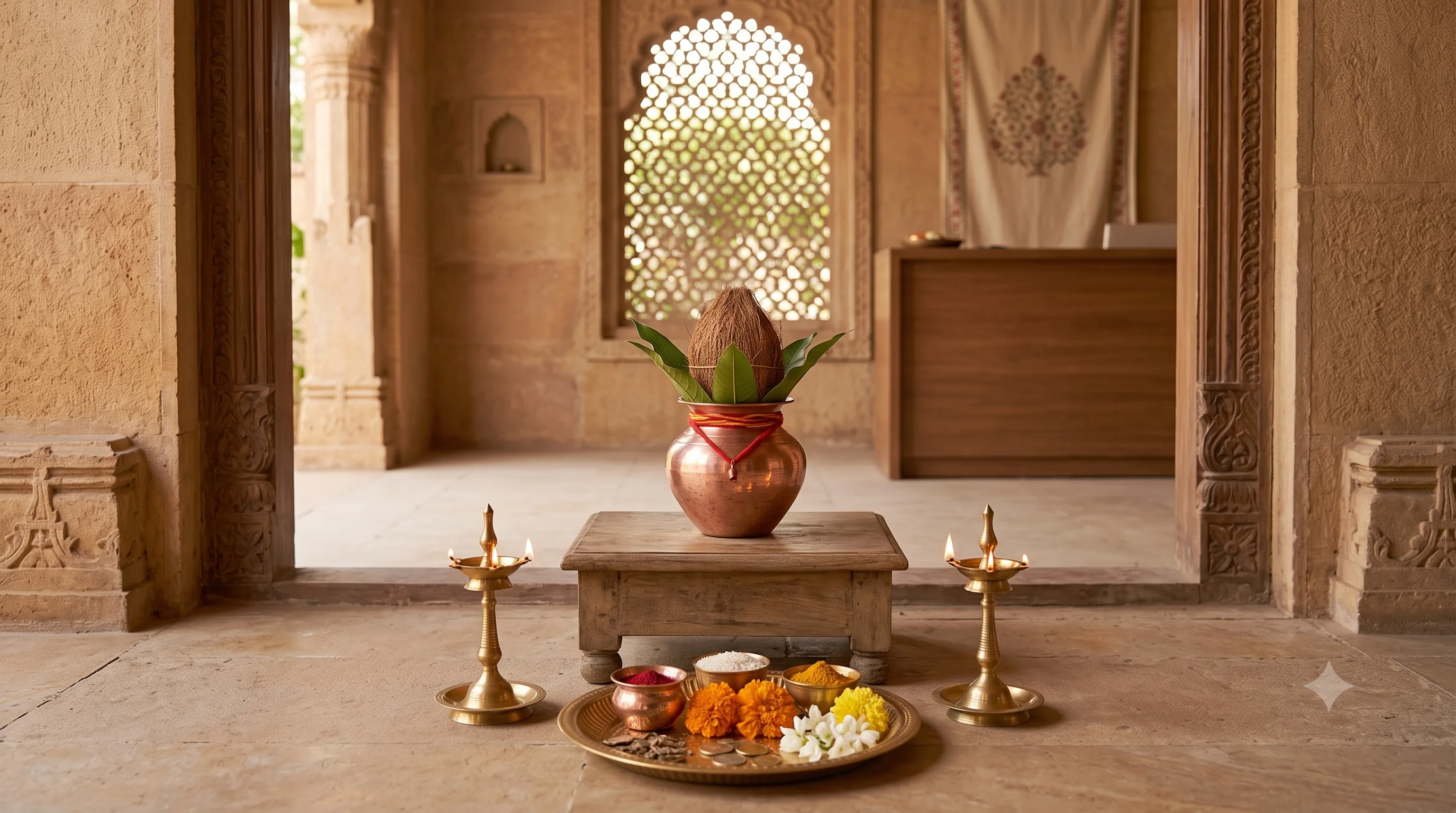
Fifteen Vastu rituals and twelve business observances — the worship performed when land is broken, a house entered, a shop opened or a vehicle bought. This guide describes them as the tradition holds them, and is clear about what Vastu Shastra is and is not.
Vastu Shastra (वास्तु शास्त्र) is the traditional Indian discipline of building — orientation, proportion, the placement of rooms and openings — expressed ritually in the worship of the Vastu Purusha, the presiding spirit of a site. Alongside it sits a second group of observances for the opening and running of a business. Avyani's Master Puja & Ritual Catalogue records fifteen and twelve of these respectively.
How this guide treats Vastu. Vastu Shastra is a real architectural tradition with its own classical literature, and much of its practical content — light, ventilation, orientation to the sun, the flow of a house — reads sensibly in any climate. Avyani presents it on its own terms.
What Avyani does not do is treat a building's orientation as the established cause of a family's illness, financial loss or discord, or promise that a ritual will change such an outcome. Where the concern is structural, a qualified engineer or architect is the person to consult; where it is financial or legal, an adviser. Nothing here is architectural, financial or legal advice.
Before and During Building
Bhoomi Pujan is the worship of the earth before ground is broken, and Shilanyas the laying of the foundation stone. Land Purchase Puja marks acquisition, and Well or Borewell Puja the opening of a water source.
Vastu Puja is the general worship of the Vastu Purusha, and Vastu Shanti Puja the remedial form performed where a vastu dosha is identified. Renovation Puja covers work on an existing building, and Real Estate Project Puja a development.
Tradition. The Vastu Purusha is described lying face-down across the site, pinned by the deities of the directions, with the vastu purusha mandala grid setting out which part of a plot belongs to which. It is a striking image, and it is the conceptual basis of the whole discipline.
Entering and Taking Possession
Griha Pravesh is the entry into a new home and the most widely performed ritual in this category by a wide margin. It is normally accompanied by the Griha Shanti Havan described in our Homam, Havan and Yajna guide, with milk boiled over on the new stove and the kalash carried in first.
Apartment Handover Puja is its modern form for a flat taken on possession, and Dwar Puja honours the main entrance — the toran described in our Miscellaneous guide belongs here.
Opening a Business
Shop Opening, New Shop, Office Inauguration, Factory Opening and Warehouse Puja mark the commencement of trade at a place. Office Vastu Puja applies the Vastu observance to a workplace, and Business Success Puja and Corporate Lakshmi Puja are the ongoing forms — see our Lakshmi Rituals guide, whose note on wealth language applies equally here.
Account Books Puja — the blessing of new ledgers, kept at Diwali as chopda pujan in Gujarat and Maharashtra — is among the oldest continuous business observances in India, and survives in spreadsheet form as readily as in a bound book.
Tools, Vehicles and Machines
Vishwakarma Puja honours the divine architect and is kept in workshops, factories and engineering offices, chiefly in eastern and northern India, with tools and machinery cleaned and garlanded. Its southern counterpart is Ayudha Puja at Navratri, described in our Devi Rituals guide.
Vehicle Puja, Machinery Puja and Agricultural Equipment Puja follow the same idea for a new purchase. Signboard or Naming Ceremony, Export/Import Consignment and IT or Software Launch Puja are the contemporary extensions of it — a tradition applied to whatever the work actually is, which is how it has always worked.
Practical guidance. A vehicle puja does not make a vehicle safe. Wear the seatbelt, service the car, and keep the lemon under the wheel if the family tradition asks for it; these are not in competition.
Vastu and Business Rituals at a Glance
Durations are typical planning ranges. "Traditionally for" records the intention the tradition assigns — not an outcome Avyani predicts or guarantees.
| Ritual | Tradi |
Typical duration | Priest advised |
|---|---|---|---|
| Bhoomi Pujan | Before breaking ground | 1–2 hours | Yes |
| Shilanyas | Laying the foundation stone | 1 hour | Yes |
| Land Purchase Puja | On acquiring land | 1 hour | Yes |
| Vastu Puja | Worship of the Vastu Purusha | 1–1.5 hours | Yes |
| Vastu Shanti Puja | Vastu shanti; see the note | 2–3 hours | Yes |
| Griha Pravesh Puja | Entering a new home | 2–3 hours | Yes |
| Apartment Handover Puja | Taking possession of a flat | 1.5–2 hours | Yes |
| Dwar Puja | The main entrance | 30–45 mins | No |
| Reno | Before or during works | 1 hour | Yes |
| Real Estate Project Puja | Starting a development | 1.5–2 hours | Yes |
| Well / Borewell Puja | Opening a water source | 45–60 mins | Yes |
| Office Vastu Puja | Vastu observance at work | 1–1.5 hours | Yes |
| Office Inaugu | Opening an office | 1–1.5 hours | Yes |
| Shop Opening Puja | Opening a shop | 1 hour | Yes |
| New Shop Puja | Beginning trade | 1 hour | Yes |
| Factory Opening Puja | Opening a factory | 1.5–2 hours | Yes |
| Warehouse Puja | Opening a store | 1 hour | Yes |
| Business Success Puja | An ongoing venture | 1–1.5 hours | Yes |
| Corporate Lakshmi Puja | Lakshmi in the firm | 1 hour | Yes |
| Account Books Puja | New ledgers; chopda pujan | 30–45 mins | No |
| Signboard / Naming Puja | Naming an enterprise | 30 mins | No |
| Vishwa | Tools and craftsmanship | 1 hour | No |
| Vehicle Puja | A new vehicle | 20–30 mins | No |
| Machinery Puja | New machines | 30–45 mins | No |
| Agri | New farm equipment | 20–30 mins | No |
| Export / Import Consign | Goods sent out | 20–30 mins | No |
| IT / Software Launch Puja | A launch | 30–45 mins | No |
Sources
- Vastu Purusha and the vastu purusha mandala — the conceptual basis of Vastu Shastra, described in its classical literature.
- Griha Pravesh with the Griha Shanti Havan, milk boiled over, and the kalash carried in first — established practice with regional variation.
- Chopda pujan at Diwali in Gujarat and Maharashtra — documented regional practice.
- Vishwakarma Puja in eastern and northern India, and Ayudha Puja as its southern counterpart — documented regional practice.
- Ritual names, durations and priest-advised flags — Avyani Master Puja & Ritual Catalogue. Durations are planning ranges, not prescriptions.
Where a scriptural locator could not be verified, the statement is given as tradition or regional practice rather than scripture. Stated purposes are the intentions the tradition assigns, not outcomes Avyani predicts. Nothing here is architectural, financial or legal advice.