


Sixteen rituals across three related concerns — health and healing, children and conception, and learning. These are the observances families turn to at difficult moments, and this guide is careful about what it does and does not claim for them.
Three related groups in Avyani's Master Puja & Ritual Catalogue address particular concerns: seven health rituals, three for children and conception, and six for learning — sixteen in all. They are among the observances people seek out at the hardest moments, which is why this guide states its limits before anything else.
These are observances of devotion, not treatment. The tradition undertakes them for healing, recovery and wellbeing, and that intention is recorded here as the tradition's own. Avyani does not predict or guarantee any medical outcome, and no ritual here is a substitute for medical care, medication, antenatal care or a doctor's advice.
Where someone is unwell, the right first step is a doctor. Families very commonly arrange both a rite and a course of treatment, and there is no conflict in doing so — the tradition itself has never asked anyone to choose. Nothing in this guide is medical advice.
Health and Healing
Mahamrityunjaya Puja and Mrityunjaya Rudrabhishek build worship around the Mahamrityunjaya mantra, which is Rigveda 7.59.12 and recurs in the Yajurveda — see our Shiva Rituals guide. The verse asks for release from death "as a cucumber from its stem", and in the same breath not to be released from immortality; it is a prayer about mortality rather than a claim about medicine.
Maha Sudarshana Puja invokes Vishnu's discus, and Chandi Homam for Protection the fierce form of the Goddess described in our Devi Rituals guide. Raksha Kavacha Puja is the consecration of a protective thread or amulet.
Ashwini Kumara Puja honours the twin physicians of the gods, who appear across the Rigveda as healers and rescuers and are among the oldest deities in the tradition associated with medicine. Navagraha Puja for Health applies the observances of our Navagraha and Dosha Nivaran guide to health concerns; that guide's scope note applies here too.
Children and Conception
Putra Kameshti Puja is the household form of the Vedic Putrakameshti Yajna — the rite performed by Dasharatha in the Ramayana before the birth of his sons, and described in its full historical form in our Homam, Havan and Yajna guide.
Balak Graha Shanti and Balarishta Shanti are performed for infants where a chart is read as showing early difficulty. As with everything in the Jyotish frame, Avyani describes these as the tradition describes them and does not treat a graha as the cause of a child's condition, read charts, or suggest that a rite substitutes for paediatric care.
Regional and household practice. Rites around conception and pregnancy overlap with the Godh Bharai and Garbha Raksha observances in our Marriage Rituals guide, and which are kept differs by family.
Learning
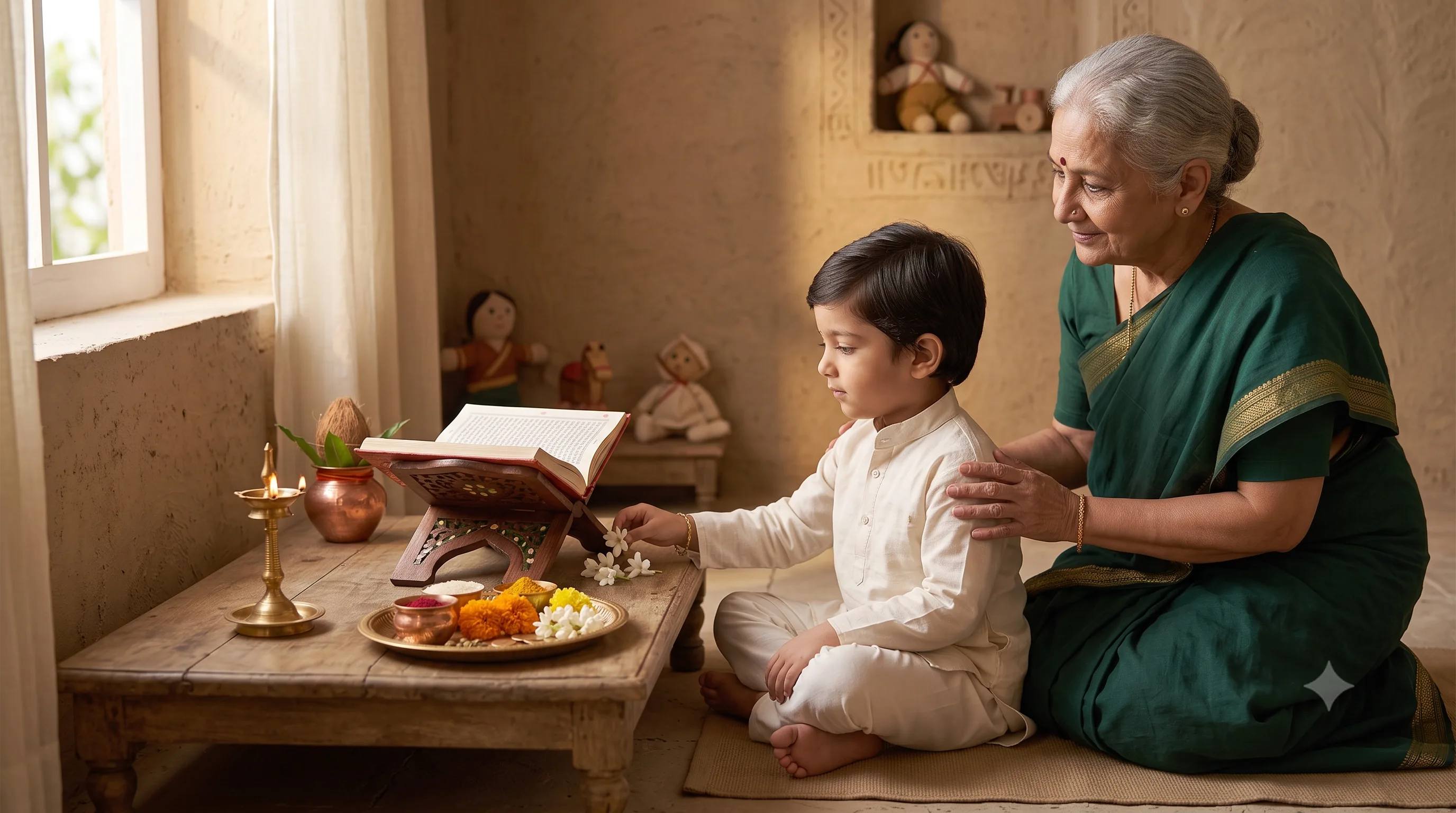
The education group is the least fraught and the most kept. Aksharabhyasam is the child's first writing of letters, traditionally traced in rice, and is the southern form of the Vidyarambha samskara in our Sixteen Samskaras guide — often performed at Vijayadashami or at a Saraswati temple.
Saraswati Puja for Education and Saraswati Homam for Students address the goddess of learning; Hayagriva Puja for Studies the horse-headed form of Vishnu associated with knowledge, particularly in Sri Vaishnava practice. Guru Puja honours teachers, most visibly on Guru Purnima, and Examination Success Puja is the short household observance kept before exams.
Practical guidance. These are worth keeping for what they are — a family marking that learning matters, and a child seeing it marked. They are not a study method, and no ritual substitutes for preparation.
Health, Children and Education Rituals at a Glance
Durations are typical planning ranges. "Traditionally for" records the intention the tradition assigns — not an outcome Avyani predicts or guarantees. See the note at the head of this guide.
| Ritual | Tradi |
Typical duration | Priest advised |
|---|---|---|---|
| Maha | Healing and long life | 2–3 hours | Yes |
| Mrityun | Healing; serious illness | 2 hours | Yes |
| Maha Sudar | Shelter and healing | 2 hours | Yes |
| Chandi Homam for Protection | Shelter in severe trouble | 3–4 hours | Yes |
| Ashwini Kumara Puja | Healing; the twin physicians | 30–45 mins | No |
| Raksha Kavacha Puja | A consecrated amulet | 1 hour | Yes |
| Nava | Graha shanti; see that guide | 1.5–2 hours | Yes |
| Putra Kameshti Puja | Tradi | 2–3 hours | Yes |
| Balak Graha Shanti Puja | Graha shanti for a child | 1–1.5 hours | Yes |
| Bala | Graha shanti for a child | 1.5–2 hours | Yes |
| Akshara | First letters written | 1 hour | Yes |
| Saraswati Puja for Education | Learning and wisdom | 30–45 mins | No |
| Saraswati Homam for Students | Learning; the fire form | 1.5–2 hours | Yes |
| Hayagriva Puja for Studies | Knowledge and memory | 30–45 mins | No |
| Guru Puja | Thanks to one's teachers | 30–45 mins | No |
| Examination Success Puja | Before an examination | 30 mins | No |
For the samagri these rituals use, see the Samagri Catalogue.
Sources
- Mahamrityunjaya / Tryambaka mantra — Rigveda 7.59.12, recurring in the Yajurveda.
- The Ashvins as healer deities across the Rigveda — established Vedic material.
- Putrakameshti in the Ramayana, performed by Dasharatha — the narrative source for the household form.
- Aksharabhyasam as the southern form of Vidyarambha, commonly at Vijayadashami — documented regional practice.
- Ritual names, durations and priest-advised flags — Avyani Master Puja & Ritual Catalogue. Durations are planning ranges, not prescriptions.
Where a scriptural locator could not be verified, the statement is given as tradition or regional practice rather than scripture. Stated purposes are the intentions the tradition assigns, not outcomes Avyani predicts. Nothing here is medical advice.