


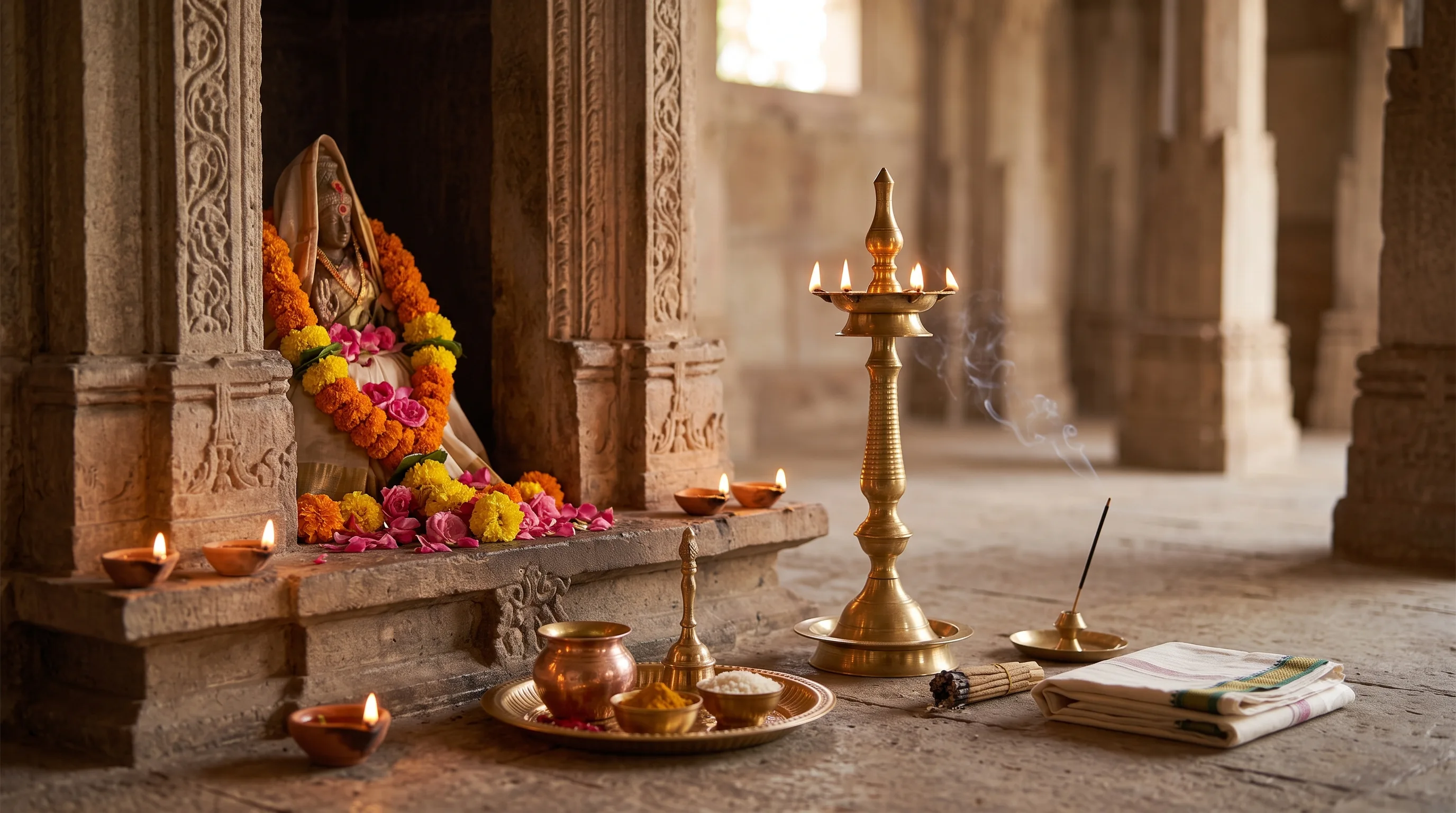
Eighteen temple sevas — the structured cycle of daily and periodic service offered to a presiding deity, and the sponsored offerings a devotee can arrange within it. This guide explains how a temple's day is ordered and what sponsoring a seva actually means.
Seva (सेवा) is service. In a temple it means the ordered cycle of attendance offered to the presiding deity according to the Agama calendar — the working practice of Hindu temples across India. Avyani's Master Puja & Ritual Catalogue records eighteen distinct sevas.
The organising idea is worth stating first: an Agama temple treats the deity as a resident sovereign in a household, and the day is arranged accordingly — waking, bathing, dressing, feeding, receiving visitors, resting. Almost everything below follows from that.
The Daily Cycle
A temple day opens with Suprabhata Seva, the ceremonial waking of the deity with a suprabhatam hymn — the Venkateswara Suprabhatam at Tirumala is the best known. Thomala Seva follows with fresh garlands, and Alankaram Seva with the ornament and dressing described in our Jewellery and Sacred Items guide.
Nitya Puja Seva is the full ongoing cycle performed by the temple's own priests, and each stage closes with Deeparadhana, the waving of lamps before the deity. The flowers and lamp oils involved are covered in our Flowers and Leaves and Incense, Camphor, Oils and Ghee guides.
Sponsored Sevas
Most of the rest are sevas a devotee sponsors, and it is worth being clear what that means. Sponsoring does not buy a private ritual; it means the temple performs its own service in your name, with your name and gotra recited at the appropriate point, and returns prasad.
Archana is the most accessible and takes ten minutes. Ashtottara Shatanamavali Archana extends it through the hundred and eight names, and Pushpanjali Seva is the flower offering made on a devotee's behalf. Panchamrita Abhishekam Seva is the sponsored form of the bathing described in our Abhishekam and Worship Methods guide.
Practical guidance. Sponsored sevas are usually booked in advance, in person or through the temple's own office, and the larger temples run their own systems with their own timings and rules. Ask the temple rather than an intermediary.
Processions and Occasions
The utsava murti — the festival image, generally bronze and portable, as distinct from the fixed mula murti in the sanctum — is what leaves the temple. Utsava Murti Procession Seva and Vahana Seva carry it out on a mount: Garuda, Hanuman, the elephant, the horse, each on its appointed night. Rathotsavam is the chariot procession, and Dolotsavam the swing service.
Kalyanotsavam is the deity's ceremonial wedding, sponsored by devotees and performed regularly at Tirumala and many Vaishnava temples — see our Vishnu Rituals guide. The larger annual festivals are covered in our Temple Festivals and Special Sevas guide.
Consecration
Kumbhabhishekam is the re-consecration of a temple, performed at its founding, after major renovation, and traditionally at intervals of about twelve years. Consecrated water from kalashas placed on the vimana is poured over the temple tower, and the rite runs across several days with many priests. Sahasra Kalasabhishekam is the thousand-pot form.
These are institutional undertakings rather than personal ones, though devotees participate and sponsor parts of them.
Food and Giving
Annadanam Seva sponsors the free community meal, and Prasada Seva the distribution of sanctified food. Both are continuous rather than scheduled, and both are among the most substantial things a temple does. Our Naivedya guide covers the food-handling that large-scale annadanam requires.
Temple Sevas at a Glance
Durations are typical planning ranges and vary greatly between temples. "Traditionally for" records the intention the tradition assigns — not an outcome Avyani predicts or guarantees.
| Seva | Tradi |
Typical duration | Priest advised |
|---|---|---|---|
| Supra | Waking the deity | 20–30 mins | Yes |
| Thomala Seva | Garlanding the deity | 30 mins | Yes |
| Alankaram Seva | Dressing and ornament | 30–60 mins | Yes |
| Nitya Puja Seva | The temple's daily cycle | Daily cycle | Yes |
| Deepa | Closing lamp offering | 10–15 mins | No |
| Archana | Worship in a devotee's name | 10–15 mins | Yes |
| Ashtot | The same, through 108 names | 30–45 mins | Yes |
| Pushpanjali Seva | Flowers offered on request | 15–20 mins | Yes |
| Pancha | Sponsored bathing | 30–45 mins | Yes |
| Kalyanot | The deity's wedding rite | 1–1.5 hours | Yes |
| Dolot | The swing service | 30–45 mins | Yes |
| Vahana Seva | Procession on a mount | 2–3 hours | Yes |
| Utsava Murti Procession Seva | Public darshan | 30–60 mins | Yes |
| Rathot | The chariot procession | 1 day | Yes |
| Sahasra Kalasa | The thousand-pot bathing | Full day | Yes |
| Kumbha | Re-consecrating the temple | Multi-day | Yes |
| Anna | The free community meal | Ongoing | No |
| Prasada Seva | Distribution of prasad | Ongoing | No |
Sources
- The Agama ordering of a temple day — waking, bathing, dressing, feeding, procession, rest; standard Agama liturgical practice, with substantial variation between temples and traditions.
- Utsava murti and mula murti as distinct images — standard usage in Agama temple practice.
- Kumbhabhishekam at founding, after renovation, and traditionally at roughly twelve-year intervals — established practice; intervals vary by temple.
- Seva names, durations and priest-advised flags — Avyani Master Puja & Ritual Catalogue. Durations are planning ranges and differ from temple to temple.
Where a scriptural locator could not be verified, the statement is given as tradition or regional practice rather than scripture. Stated purposes are the intentions the tradition assigns, not outcomes Avyani predicts. Booking, timings and rules are matters for the individual temple.