


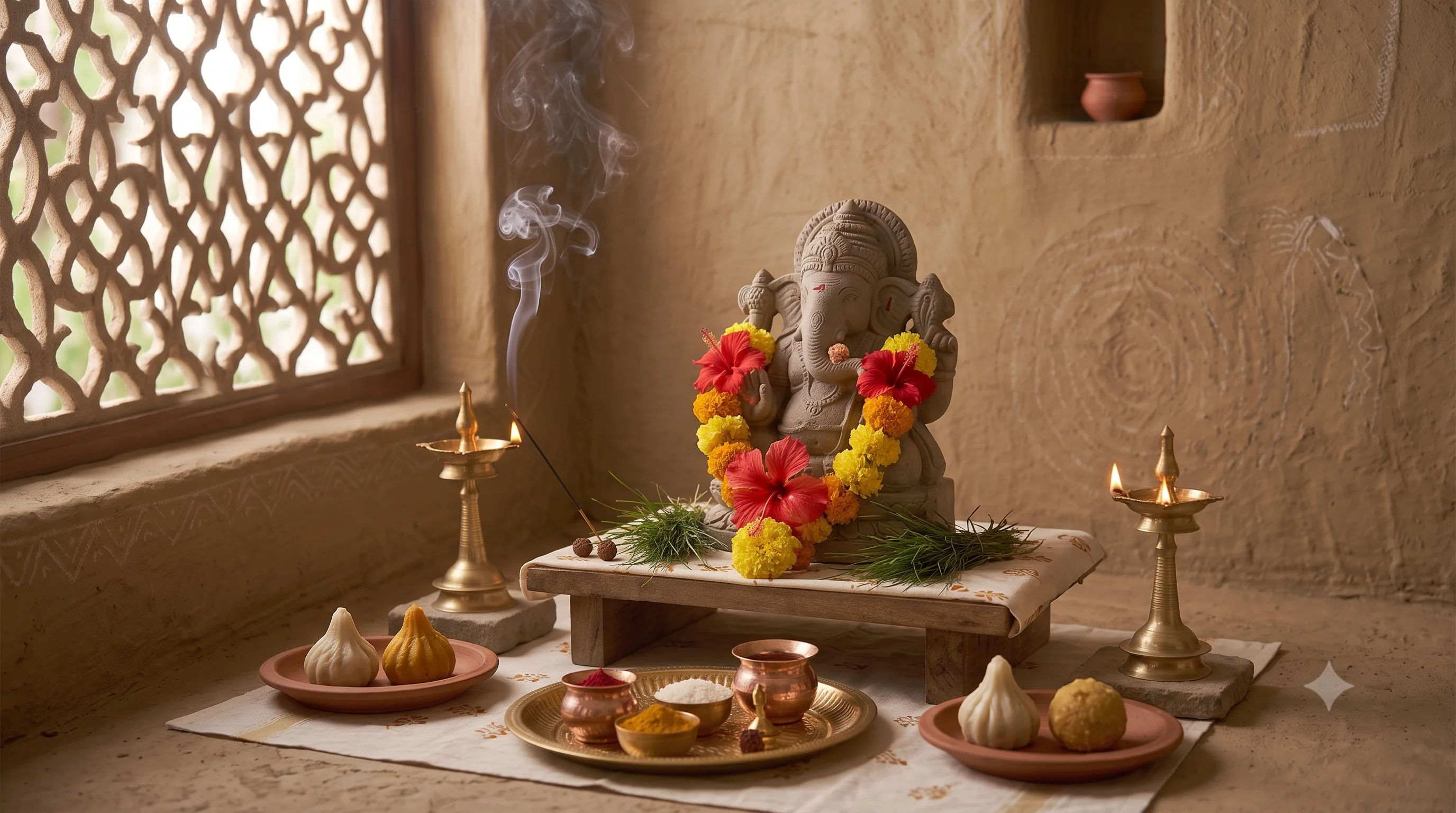
Ganesh Chaturthi unfolds over ten days, from installation to immersion. This guide walks through the household sequence step by step, with the practical decisions — which murti, how much samagri, how to immerse it — set out as you reach them.
Ganesh Chaturthi celebrates Ganesha's birth and, in most traditions, runs ten days from Bhadrapada Shukla Chaturthi to Anant Chaturdashi. Many households keep it for one and a half, three, five or seven days instead — all of these are usual, and the length is decided before the murti is installed rather than during.
The sequence below is the widely observed household form. Regional practice varies, and a family priest can advise on your own tradition; the Tamil observance is described as Pillayar Chaturthi in our Ganapati Rituals guide.
Before the Festival: Choosing the Murti
Practical guidance. Choose natural clay. The Central Pollution Control Board's revised idol-immersion guidelines ban plaster of Paris, do not permit single-use plastic or thermocol, and prohibit toxic dyes — the detail is in our Miscellaneous guide.
Clay is heavier and more fragile than PoP and holds less fine detail. Carry it from the base, keep it dry until visarjan, and size it to where it will sit and how you intend to immerse it — a smaller murti dissolves cleanly in a household vessel, which a large one will not.
1. Ganapati Sthapana — Installation
The festival opens with the installation and life-invocation — prana pratishtha — of the murti, at home or in a community pandal. This is the most elaborate stage, takes one to two hours, and is where a priest is most often engaged.
The murti is placed on a chowki with a clean cloth, facing east or north, with a kalash alongside — both described in our Kalash and Utensils guide.
2. Daily Worship
Once installed, the murti is worshipped each day with the sixteen-step shodashopachara sequence — flowers, incense, lamp and food — along with Ganesha mantras or the Ganapati Atharvashirsha. The main Vinayaka Chaturthi Puja on the first day is the fullest of these, at two to three hours.
The mula mantra is the simplest accompaniment:
ॐ गं गणपतये नमः
Twice daily, morning and evening, is the usual pattern. Aarti is performed at both.
3. Modak and Durva
Modak is offered each day, and the Ganapati Atharvashirsha itself singles it out: one who worships with a thousand modakas obtains what is desired, and one who worships with durva sprouts becomes the equal of Kubera (v. 13). Steamed modak is made fresh; the fried kind keeps.
Durva is offered as fresh young shoots, customarily in odd-numbered bunches, and red flowers — hibiscus above all — alongside. Our Flowers and Leaves guide covers choosing both, and notes that tulsi is the one leaf traditionally not offered to Ganesha.
4. Visarjan — the Immersion
On the final day the murti is taken for immersion, traditionally on Anant Chaturdashi, with an aarti and a farewell before it leaves the house.
Practical guidance. For a household immersion, a large vessel or drum of water dissolves a small clay murti cleanly over some hours; the remaining clay is then returned to earth, at the base of a plant or in a garden. Where a public immersion point is provided, use it. Strip off every non-clay decoration first — plastic thread, foil, thermocol, wire — because that is what actually pollutes.
The nirmalya from the ten days is set aside as described in our Flowers and Leaves guide.
What to Have Ready
For a ten-day household observance, plan for a clay murti and chowki; a kalash, lamp, bell and thali; durva and red flowers fresh every day or two; modak and other naivedya daily; incense, camphor, wicks and matches; and haldi, kumkum, akshat and a coconut. The Samagri Catalogue covers each of these, and our Understanding Samagri guide explains how they fit together.
Buy flowers and durva in small quantities through the festival rather than all at once. They will not last ten days.
Sources
- Ganapati Atharvashirsha v. 13, on modaka and durva — Sanskrit text with translation. The text's date and standing are discussed in our Ganapati Rituals guide.
- Central Pollution Control Board, Revised Guidelines for Idol Immersion (2020) — cited in full in our Miscellaneous guide.
- One-and-a-half, three, five, seven and ten-day observances are all usual — documented household practice, varying by family and region.
- Ritual names and durations — Avyani Master Puja & Ritual Catalogue. Durations are planning ranges, not prescriptions.
Regional and family practice varies; a family priest is the right person to ask about your own tradition's form.