


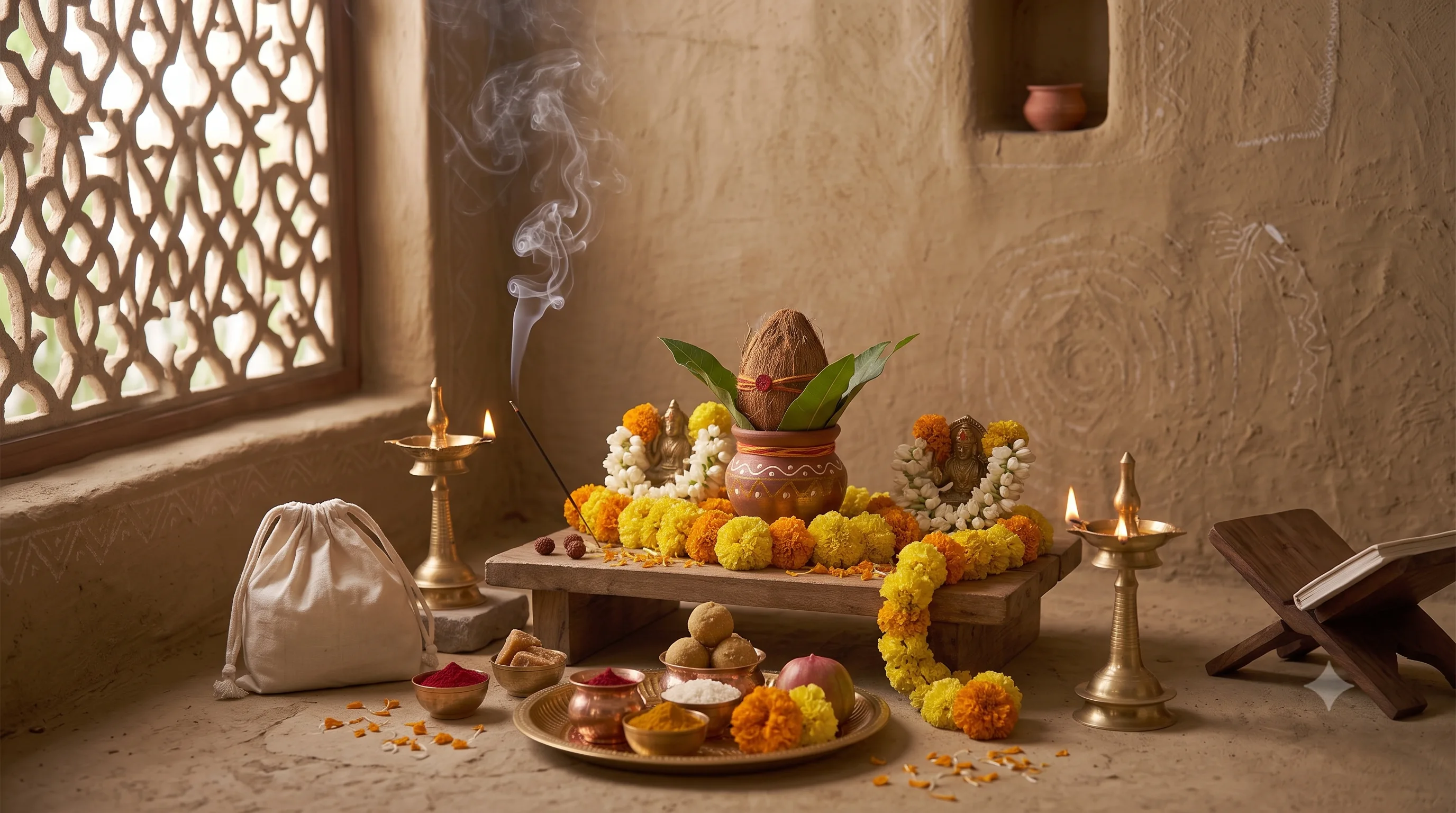
A first home puja needs no priest, no elaborate altar and very little samagri. This guide walks through the five-offering sequence step by step — what to have ready, what to do, and what genuinely does not matter.
What a home puja asks for is a clean space, a few unhurried minutes and sincerity. Everything else is elaboration — and the tradition says so itself. The Bhagavad Gita puts the requirement at its lowest: a leaf, a flower, a fruit or water, offered with devotion, is accepted (9.26).
Most households build a daily practice around Panchopachara, the five-offering method, which is the shortest of the sequences described in our Abhishekam and Worship Methods guide.
What You Will Need
Five things, one for each offering:
- Gandha — sandalwood paste, or a little haldi and kumkum for a tilak.
- Pushpa — a few fresh flowers or loose petals.
- Dhupa — an incense stick.
- Deepa — a small oil or ghee lamp with a cotton wick.
- Naivedya — a simple food offering: a fruit, a sweet, a spoon of sugar.
Alongside them, a small vessel of clean water and a spoon, and a plate or tray to work on. Our Understanding Samagri guide explains what each item means, and the Samagri Catalogue covers buying them well.
Setting Up
Bathe or wash your hands and face first, and wear clean clothes. Sit facing east or north where you can — and where you cannot, sit where you can be undisturbed, which matters more.
Place the image or murti of your ishta devata, your chosen deity, a little above the level at which you will sit. Light nothing yet.
The Five Steps
- Settle and invoke. Sit, steady your breath, and take a moment before beginning. Sprinkle a little water on yourself and around the seat, and invite the deity's presence — avahana. A simple mental invitation is enough.
- Offer gandha. Apply sandalwood paste, or haldi and kumkum, to the image, and a tilak to your own forehead.
- Offer pushpa. Place flowers or petals at the feet of the image, one at a time rather than in a handful, with the deity's name or a short mantra.
- Offer dhupa and deepa. Light the incense and the lamp, and move each in a small circle before the image — incense first, then the lamp.
- Offer naivedya and close. Present the food, sit quietly for a moment or a few rounds of mantra, and finish with a pranam.
That is the whole of it. Ten to fifteen minutes, and it is the same sequence, in essence, that a temple performs at far greater length.
What Does Not Matter as Much as People Think
Practical guidance. New practitioners worry about the wrong things, so it is worth saying plainly what is flexible.
- The exact words. If you do not know the Sanskrit, use the deity's name, or your own language. The tradition has never held that devotion requires Sanskrit.
- Getting the order slightly wrong. Correct it and carry on. A puja is not invalidated by a misstep.
- Missing an item. Offer water in its place. That is an accepted substitution, not a compromise.
- The size of the shrine. A shelf is sufficient. Regularity outranks elaboration in every account the tradition gives of itself.
What does matter: do not taste the naivedya before offering it, wash your hands before beginning, and keep the lamp somewhere it cannot catch cloth or paper.
Afterwards
Share the naivedya as prasad rather than storing it. Flowers and leaves are set aside respectfully once they wilt — composted or returned under a plant rather than binned, as described in our Flowers and Leaves guide. Put out the lamp rather than leaving it burning unattended.
Our Caring for Puja Samagri at Home guide covers cleaning and storing what you have used.
Where to Go From Here
This same sequence, kept daily, is Nitya Puja — the foundation of the fifteen observances in our Daily Worship guide. From there the tradition extends in every direction: the ten- and sixteen-offering sequences, deity-specific worship, jaap and paath, and the fire rites.
None of it replaces the five steps above. It elaborates them.
Sources
- Bhagavad Gita 9.26 — a leaf, a flower, a fruit or water, offered with devotion.
- Panchopachara as the five-offering sequence: gandha, pushpa, dhupa, dipa, naivedya — standard method; the fuller sequences vary between paddhati.
- Water as an accepted substitution for a missing upachara — established paddhati practice.
- Method names — Avyani Master Puja & Ritual Catalogue.
Household practice varies by family and sampradaya, and a family priest is the right person to ask about your own tradition's form.