


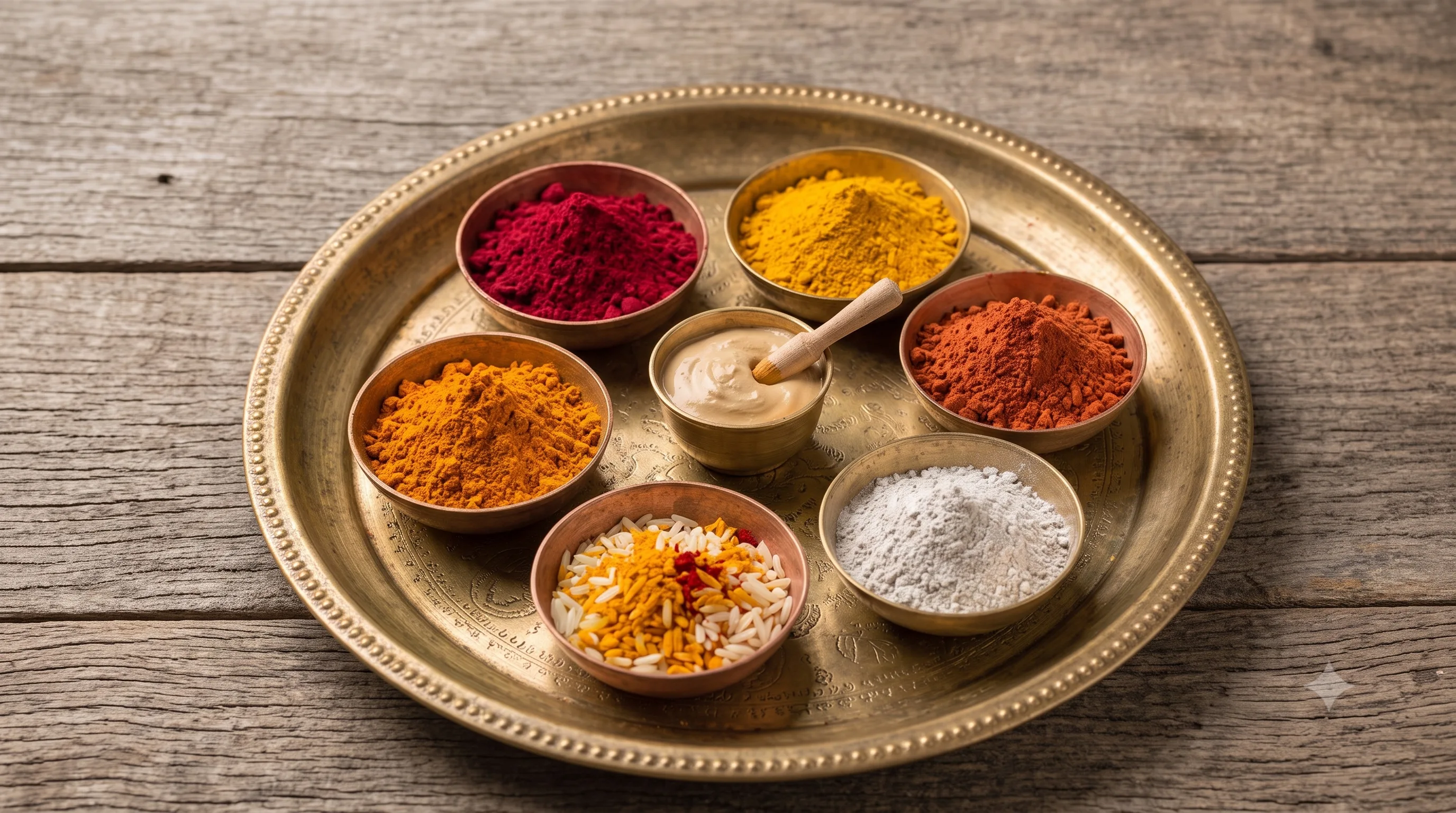
A mark on the forehead, a dusting of colour on the deity's image — sacred powders carry meaning well beyond decoration. This guide covers the seven powders in Avyani's Master Samagri Catalogue: what each one actually is, where the texts speak, and what to look for when buying.
Powders mark the deity and the devotee alike. They are among the least expensive items on any samagri list and among the easiest to buy badly, because a powder gives away very little about its own composition.
Where this guide says scripture, it names a text and verse you can check. Where it says tradition or regional practice, the custom is real and widely followed but has no single locator, and families differ.
Bhasma and the Tripundra
Bhasma or vibhuti (भस्म/विभूति), sacred ash, is the powder with the fullest scriptural treatment. The Shiva Purana gives it a whole chapter — Vidyeshvara Samhita 24, on the greatness of the holy ashes — which says that neither Brahma nor Vishnu nor Rudra nor the sages can adequately explain the greatness of applying it (v. 28), and that one who wears the ash wears as many lingas as there are particles in it (v. 39).
The same chapter distinguishes three kinds of ash by origin: shrauta from Vedic fire, smarta from ritual fire, and laukika from ordinary fire. It also defines the tripundra precisely: three lines on the forehead extending from the middle of the eyebrows to the tips of the brows (vv. 84–85), with further placements on thirty-two, sixteen, eight or five parts of the body (vv. 97–102). See our Shiva Rituals guide.
Ritual bhasma is traditionally made from cow dung cakes burnt in a controlled fire, or gathered from the homa fire itself. Ash sold loosely without any stated origin is worth a question.
Kumkum and Sindoor
Kumkum (कुमकुम) and sindoor (सिंदूर) are both red powders, applied to the deity and to devotees as tilak, and central to the worship in our Devi Rituals and Lakshmi Rituals guides. Sindoor carries a further meaning in marriage, and is offered to Hanuman in the practices described in our Hanuman Rituals and Marriage Rituals guides.
Traditionally both are made from turmeric turned red by slaked lime, or from red ochre — simple, plant-and-mineral preparations. Much of what is sold today is neither. The colour may come from synthetic dye, from mercury sulfide, or from red lead.
Some sindoor and kumkum contains lead. Buy it as carefully as you would buy food.
- A 2017 study in the American Journal of Public Health tested 118 sindoor samples from shops in New Jersey and India. Around four in five contained detectable lead; 43% of the Indian samples and 19% of the American ones exceeded the US Food and Drug Administration's 20 micrograms per gram limit for cosmetics.
- Lead accumulates in the body. It is most harmful to young children and in pregnancy, and no level of exposure is considered safe.
- Choose products that name their manufacturer and list their ingredients, and prefer turmeric-based preparations. Keep powders out of reach of children, and wash hands after applying.
Avyani records these items because worship uses them. This is not medical advice; a doctor is the right person to advise on any suspected exposure.
Haldi and Chandan
Haldi (हल्दी), turmeric, is the most straightforward powder here: culinary turmeric, mandatory across household and festival worship, and central to the pre-wedding Haldi ceremony described in our Marriage Rituals guide. Buy it as food, from a food supplier.
Chandan (चंदन), sandalwood, is the opposite — the powder most likely to be something else. True chandan is the heartwood of Santalum album, assessed as Vulnerable on the IUCN Red List, with harvest and export regulated in India. Its scarcity and price have made substitution routine: other woods, colouring, and synthetic fragrance standing in for the real thing.
A useful test is the smell. Genuine sandalwood is faint, warm and persistent; a powder that announces itself strongly across the room is almost certainly perfumed. Traditionally the wood is ground fresh on a stone with a little water rather than bought pre-powdered. The resulting paste corresponds to the Chandan Jal in our Liquids and Panchamrit guide.
Ashtagandha and Abir Gulal
Ashtagandha (अष्टगंध) is a blend of eight fragrant substances built around sandalwood, used where a more refined offering is wanted. There is no single fixed recipe: the eight vary by region, sampradaya and maker, and agarwood, saffron, camphor, musk-substitutes and various resins all appear in different lists. A supplier who states the eight is telling you something useful; one who does not is selling you a name.
Abir gulal (अबीर गुलाल) is the coloured powder of Holi and the spring festivals in our Festival Rituals guide. Composition varies enormously, from ground flower and starch preparations to industrial pigments. Since it ends up on skin, in eyes and in hair, buy colours that list what is in them.
Buying and Keeping Powders
Powders keep well but absorb damp readily. Store them in small airtight containers away from the stove and the window, and keep the ritual set separate from the kitchen tin of turmeric so the two are never confused.
Across all seven, one rule does most of the work: buy from a supplier who will tell you what is in the packet. Colour, price and fragrance are not evidence of purity, and no household test settles the question of lead.
Powders at a Glance
| Item | Hindi | What it is | Mandatory / Optional |
|---|---|---|---|
| Bhasma / Vibhuti | भस्म/विभूति | Sacred ash, tradi |
Mandatory |
| Kumkum | कुमकुम | Red powder, tradi |
Mandatory |
| Sindoor | सिंदूर | Red powder; check the label, see warning above | Mandatory |
| Haldi Powder | हल्दी पाउडर | Turmeric, Curcuma longa | Mandatory |
| Chandan Powder | चंदन पाउडर | Sandal |
Mandatory |
| Ashta |
अष्टगंध | Eight-fragrance sandal blend; recipe varies | Optional |
| Abir Gulal | अबीर गुलाल | Holi colour powder; compo |
Optional |
See our Understanding Samagri guide for how these fit the wider offering, and Caring for Puja Samagri at Home for storage.
Sources
- Shiva Purana, Vidyeshvara Samhita 24 — greatness of the holy ashes; vv. 28, 39, 84–85, 97–102 — English translation.
- Lead in sindoor: American Journal of Public Health 2017;107(10):1630, doi:10.2105/AJPH.2017.303931.
- US Food and Drug Administration guidance on lead in cosmetics; New York City Department of Health advisories on sindoor and kumkum.
- Santalum album — IUCN Red List assessment (Vulnerable); Indian regulation of sandalwood harvest and export.
- Item names, Hindi names and mandatory flags — Avyani Master Samagri Catalogue v1.
Scriptural references are cited to published translations. Where a locator could not be verified, the statement is given as tradition or regional practice rather than scripture. Nothing here is medical advice.