


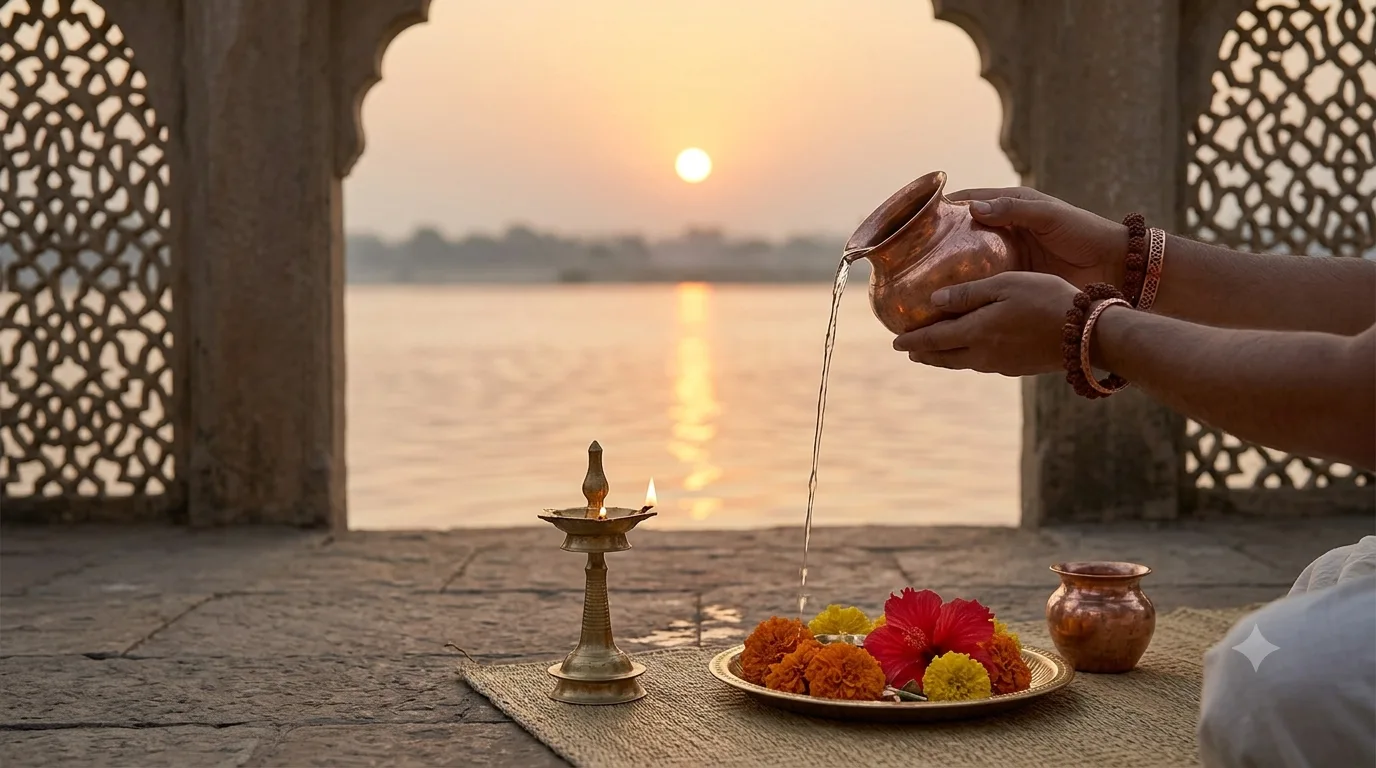
Eight Surya rituals, from a simple offering of water to the rising sun to the four-day fast of Chhath. This guide sets out which of them rest on Vedic text, which on later devotion, and which on a twentieth-century development that is often mistaken for both.
Surya (सूर्य) is worshipped daily in many households and honoured in some of the oldest continuously observed festivals in India. Avyani's Master Puja & Ritual Catalogue records eight distinct Surya rituals.
This is an overview, not a manual. Where it says scripture, it names a text you can check; where it says tradition or regional practice, the custom is real and widely followed but has no single locator.
Arghya and the Gayatri
Surya Arghya — water poured towards the rising sun from cupped hands or a small vessel — is the simplest devotional act in this catalogue, takes five minutes, and needs no priest. It sits inside the wider daily practice covered in our Daily Worship guide.
Scripture. The verse recited with it is usually the Gayatri, and its position is precise: Rigveda 3.62.10, attributed to the rishi Vishvamitra, addressed to Savitr — the sun as the impeller. It is among the oldest texts in continuous liturgical use anywhere in the world, and it is a solar verse before it is anything else.
The Aditya Hridayam
The Aditya Hridayam (आदित्य हृदयम्) is the hymn Agastya teaches Rama on the battlefield before the final encounter with Ravana. It sits in Valmiki's Ramayana, in the Yuddha Kanda — numbered sarga 107 in most editions, 105 in some recensions — and runs to about thirty verses.
Aditya Hridayam Path takes a quarter of an hour and needs no priest. Its subject is resolve rather than sunlight: Rama is exhausted, and the hymn is given to him as something to steady himself with.
Surya Namaskar — Two Different Things
The catalogue records Surya Namaskar Puja and Surya Namaskar Homam, and the name needs untangling, because it now refers to two quite separate practices.
Tradition. Surya namaskara as an act of devotional salutation to the sun, with mantra and prostration, is old and belongs squarely within Surya upasana.
History. The familiar twelve-posture flowing sequence is not. It was popularised and named in the 1920s and 1930s by Bhawanrao Pant Pratinidhi, the Raja of Aundh, who described it in a 1928 book and drew on Indian physical-training traditions and the exercise culture of the day; he himself said the practice was already current in Marathi custom. The sequence does not appear in any hatha yoga text before the nineteenth century, and at the time it was not classed as yoga at all.
Both are genuine. They are simply not the same thing, and a ritual catalogue is the wrong place to blur them.
The Solar Calendar
Makar Sankranti marks the sun's northward turn and is among the few Hindu festivals fixed to the solar rather than the lunar calendar, which is why it falls on nearly the same date each January. Pongal is its Tamil form, a four-day harvest festival where the first rice of the season is boiled until it spills over — the fresh turmeric plant tied to the pot is described in our Flowers and Leaves guide.
Ratha Saptami observes the sun's chariot turning north, and is kept with an early bath and arghya. The full calendar is covered in Hindu Festivals Through the Year.
Chhath
Chhath Puja is the most demanding observance in this category and one of the most demanding anywhere: four days, a waterless fast, and arghya offered standing in a river or pond at sunset and again at sunrise. It belongs to Bihar, Jharkhand, eastern Uttar Pradesh and Nepal, and it is unusual in Hindu practice for having no priest at any point — the vratis, mostly women, perform it themselves.
Thekua, the wheat-and-jaggery sweet prepared for it under strict purity, is described in our Naivedya guide, and the sugarcane and soop it uses in our Fruits and Miscellaneous guides.
Surya Rituals at a Glance
Durations are typical planning ranges. "Traditionally for" records the intention the tradition assigns — not an outcome Avyani predicts or guarantees.
| Ritual | Tradi |
Typical duration | Priest advised |
|---|---|---|---|
| Surya Puja | Health, vigour, standing | 20–30 mins | No |
| Aditya Hridayam Path | Strength and resolve | 15–20 mins | No |
| Surya Namaskar Puja | Salutation to the sun | 20–30 mins | No |
| Ratha Saptami Puja | The sun's turning north | 1–1.5 hours | Yes |
| Makar Sankranti Puja | The solar turn; harvest | 1 hour | No |
| Pongal Puja | Thanks for the harvest | 1 day | No |
| Chhath Puja | Family welfare; thanks | 4 days | No |
| Surya Namaskar Homam | Health, vigour, standing | 1.5–2 hours | Yes |
For the samagri these rituals use, see the Samagri Catalogue.
Sources
- Gayatri — Rigveda 3.62.10, attributed to Vishvamitra and addressed to Savitr.
- Aditya Hridayam — Valmiki Ramayana, Yuddha Kanda, sarga 107 in most editions; some recensions number it 105.
- The twelve-posture Surya Namaskar sequence — popularised and named by Bhawanrao Pant Pratinidhi of Aundh in the 1920s and 1930s, described in his 1928 book; it does not appear in hatha yoga texts before the nineteenth century, and Pant himself described it as already current in Marathi custom.
- Makar Sankranti as a solar-calendar festival; Chhath as a priestless observance of Bihar, Jharkhand, eastern Uttar Pradesh and Nepal — established regional practice.
- Ritual names, durations and priest-advised flags — Avyani Master Puja & Ritual Catalogue. Durations are planning ranges, not prescriptions.
Where a scriptural locator could not be verified, the statement is given as tradition or regional practice rather than scripture. Stated purposes are the intentions the tradition assigns, not outcomes Avyani predicts.