


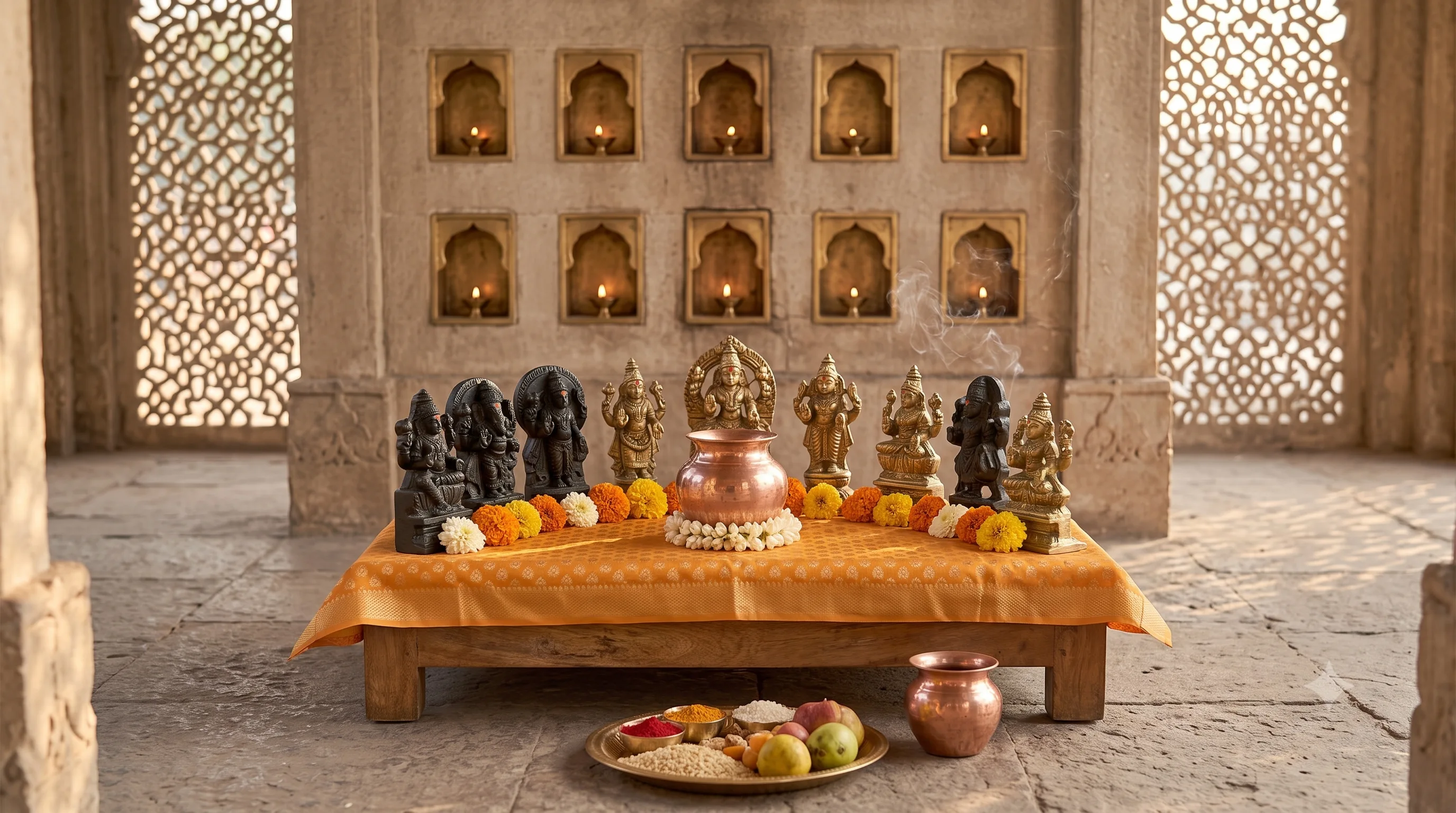
Worship of the Navagraha — the nine grahas of Jyotish — alongside the Graha Shanti and Dosha Nivaran rituals a family astrologer or priest may recommend. This guide explains what these observances are and where they sit in the tradition. It does not read charts or recommend remedies.
The Navagraha (नवग्रह) are the nine grahas of Jyotish: Surya, Chandra, Mangal, Budha, Brihaspati, Shukra and Shani, together with the lunar nodes Rahu and Ketu. They are worshipped both routinely, as part of general observance, and specifically, when a family's astrologer or priest identifies a particular dosha in a horoscope.
Avyani's Master Puja & Ritual Catalogue records twelve Navagraha rituals and twelve further Dosha Nivaran observances. This guide describes what they are. It is an overview of a tradition, not a manual, and not a consultation.
How this guide treats Jyotish.
- Within its own framework, Jyotish reads the grahas as karmic and cosmic indicators — signs of tendency, of timing, and of the conditions a life unfolds within. Avyani presents that framework on its own terms and with respect, because it is a serious discipline with its own literature and its own reasoning.
- What Avyani does not do is treat a graha as the simple, deterministic cause of a particular person's illness, loss, delay or difficulty. An indicator within a traditional framework is not the same claim as a cause established in a life, and this guide does not make the second claim.
- Nor does it read horoscopes, identify doshas, or tell any reader which ritual applies to them. That needs a birth chart and a qualified astrologer, and it is a personal consultation rather than something a catalogue can do.
- And it does not promise that performing a ritual will change an outcome. The tradition speaks of shanti — pacification, settling, easing — and Avyani records that intention without guaranteeing a result.
Nothing here is medical, legal, financial or astrological advice. For anything affecting health, money or a major decision, take advice from someone qualified to give it.
Where the Navagraha Sit in the Tradition
The nine are not a uniform set. Surya and Chandra are deities of long standing in their own right, with worship quite independent of Jyotish — see our Surya Rituals guide. Rahu and Ketu are not physical bodies at all but the two points where the Moon's path crosses the Sun's, and they enter the group later than the rest.
Tradition. The set of nine as a single object of worship, arranged together in a Navagraha shrine, is standard in temples across India, most visibly in the south, where the nine stand in a fixed geometric arrangement in their own enclosure. The Navagraha Stotra, traditionally ascribed to Vyasa, names them in order and is the text most often recited.
Jyotish itself is one of the six Vedangas, the auxiliary disciplines of Vedic learning, and its classical treatises — the Brihat Parashara Hora Shastra and the Brihat Jataka among them — are the sources a practitioner works from. Avyani names them as the tradition's own literature rather than endorsing conclusions drawn from them.
General Navagraha Worship
Navagraha Puja and Navagraha Homam address all nine together, without reference to any individual chart, and are commonly performed at a housewarming, before a wedding, at the start of a venture, or annually. In that general form they are closer to the daily observances in our Daily Worship guide than to a remedy.
Graha Shanti Puja is the broader observance of settling and honouring the grahas. The word shanti is worth dwelling on: it means peace or quieting, and the tradition's own framing is of pacification and right relationship rather than of cancelling an event.
Each graha also has its own worship — Surya, Chandra, Mangal, Budha, Brihaspati, Shukra, Shani, Rahu and Ketu Graha Shanti — performed on that graha's own weekday where one applies, with its own mantra, grain, cloth colour and samidha.
Our Grains, Cloth and Sacred Threads and Havan Samagri, Wood and Fuel guides cover the navdhanya, the nine-colour cloth set and the samidha these use — and note in each case that the correspondences vary between regions and paddhati.
The Dosha Nivaran Observances
The second half of the catalogue is remedial in intent, and each entry is named for a configuration that Jyotish recognises: Kaal Sarp, Manglik, Pitra, Guru Chandal, Naga, Kemadruma, Grahan, Vish, Angarak, Nadi and Putra dosha, along with Sarpa Samskara.
Tradition. These are recognised categories within Jyotish, and the observances attached to them are long-standing and widely performed — often at particular temples, as with Sarpa Samskara at Kukke Subramanya or Kaal Sarp observances at Trimbakeshwar.
Whether any of them applies to a given person is a question about that person's chart, and it is not one this guide can answer or should try to. Within Jyotish these configurations are read as indicators; Avyani does not restate them as established causes of the difficulties they are traditionally associated with. What we can say plainly is what each observance is called, roughly how long it takes, and that it needs a priest.
Pitra dosha is worth one further note, because it sits across two categories: the observances associated with it overlap substantially with the ancestral rites in our Shraddha and Pitru Karma guide, which many families perform as a matter of course rather than as a remedy.
Shani, Sade Sati and Proportion
Shani Shanti Puja is the most requested observance in this category, usually in connection with Sade Sati, the seven-and-a-half-year period when Saturn transits the signs around the natal Moon, or the shorter Dhaiya.
The devotional tradition around Shani is, in its own telling, less about averting misfortune than about accepting discipline, patience and consequence — Shani as the graha of slow, earned results. Sesame oil, black cloth and Saturday observance are its standard associations, and the Shani Mantra Jaap in our Jaap and Paath guide is its simplest form, needing no priest at all.
Practical guidance. If someone is anxious enough about a reading to be considering an expensive or repeated ritual, that anxiety deserves a second opinion — from another astrologer, and where the worry concerns health, money or a marriage, from a doctor, an adviser or a counsellor as well. A tradition that speaks of patience is not well served by urgency.
Navagraha and Dosha Nivaran at a Glance
Durations are typical planning ranges. "Traditionally for" records the intention the tradition assigns to a ritual — it is not a diagnosis, and not an outcome Avyani predicts or guarantees. Whether any of these applies to a particular person is a matter for a qualified astrologer.
| Ritual | Tradi |
Typical duration | Priest advised |
|---|---|---|---|
| Nava | General graha worship | 1.5–2 hours | Yes |
| Nava | Graha shanti; fire form | 2–4 hours | Yes |
| Graha Shanti Puja | Settling the grahas | 2–3 hours | Yes |
| Surya Graha Shanti | Surya; health, standing | 1 hour | Yes |
| Chandra Graha Shanti | Chandra; mind, feeling | 1 hour | Yes |
| Mangal Graha Shanti | Mangal; marriage matters | 1–1.5 hours | Yes |
| Budha Graha Shanti | Budha; speech, learning | 1 hour | Yes |
| Brihas | Guru; wisdom, fortune | 1 hour | Yes |
| Shukra Graha Shanti | Shukra; bonds, comfort | 1 hour | Yes |
| Shani Shanti Puja | Shani; Sade Sati, Dhaiya | 1.5–2 hours | Yes |
| Rahu Graha Shanti | Rahu; sudden change | 1–1.5 hours | Yes |
| Ketu Graha Shanti | Ketu; release, blocks | 1–1.5 hours | Yes |
| Kaal Sarp Dosh Puja | Kaal Sarp yoga | 3–4 hours | Yes |
| Manglik Dosh Nivaran Puja | Manglik, before marriage | 2–3 hours | Yes |
| Pitra Dosh Puja | Ancestral dosha | 2–3 hours | Yes |
| Guru Chandal Dosh Shanti | Guru with Rahu | 1–1.5 hours | Yes |
| Naga Dosha Puja | Serpent dosha | 2–3 hours | Yes |
| Sarpa Sams | Ancestral serpent rites | 1 day | Yes |
| Kema | Kema | 1–1.5 hours | Yes |
| Grahan Dosha Shanti | Birth during an eclipse | 1–1.5 hours | Yes |
| Vish Dosha Nivaran Puja | Vish yoga | 1–1.5 hours | Yes |
| Angarak Dosha Nivaran Puja | Sun with Mangal | 1–1.5 hours | Yes |
| Nadi Dosha Nivaran Puja | Nadi, in chart matching | 1–2 hours | Yes |
| Putra Dosha Nivaran Puja | Tradi | 1.5–2 hours | Yes |
For the samagri these rituals use, see the Samagri Catalogue. A qualified astrologer, and the priest who will conduct the rite, are the right people to advise on what a particular situation calls for.
Sources
- Jyotish as one of the six Vedangas; the Brihat Parashara Hora Shastra and Brihat Jataka as classical treatises — named as the tradition's own literature, without endorsement of conclusions drawn from them.
- Rahu and Ketu as the lunar nodes rather than physical bodies — standard within Jyotish and in astronomy alike.
- Navagraha Stotra — traditionally ascribed to Vyasa; the attribution is traditional and described as such.
- Graha-to-grain, colour and samidha correspondences — established tradition with documented regional variation; no single list is asserted, and the individual guides linked above say so.
- Sade Sati as Saturn's transit of the signs around the natal Moon — a definition within Jyotish, recorded as the tradition's own.
- Ritual names, durations and priest-advised flags — Avyani Master Puja & Ritual Catalogue. Durations are planning ranges, not prescriptions.
This guide describes a tradition on its own terms. It does not diagnose, prescribe from birth details, treat a graha as the deterministic cause of any event, or guarantee any outcome. Nothing here is medical, legal, financial or astrological advice.