


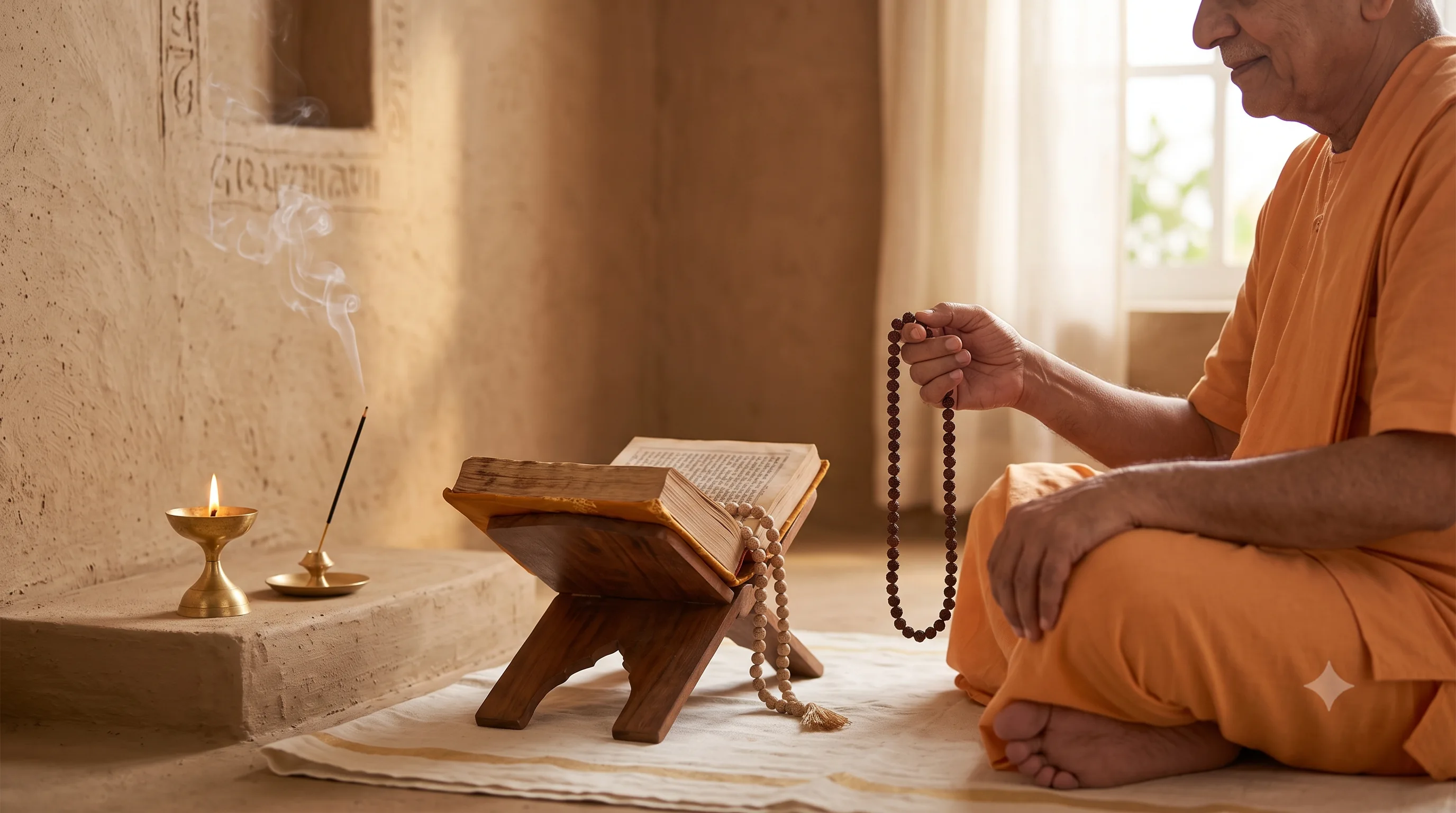
Two related practices sit alongside formal puja: Jaap, the repeated recitation of a mantra on a mala, and Paath, the reading of a scriptural text. This guide covers ten jaap and twelve paath observances — what distinguishes them, and what the tradition says about how they are done.
Two related but distinct practices sit alongside formal puja. Jaap (जाप) is the repeated recitation of a mantra, counted on a mala. Paath (पाठ) is the recitation or reading of a text. Avyani's Master Puja & Ritual Catalogue records ten jaap and twelve paath observances.
Almost all of them need no priest, which is what distinguishes this category from most of the Puja Catalogue. Where this guide says scripture, it names a text you can check; where it says tradition, the practice is widely followed but has no single locator.
The Three Kinds of Jaap
Scripture. The tradition classifies recitation by how audible it is, and grades it accordingly. The Manusmriti puts it directly: the offering that consists of repeating mantras excels the prescribed ritual offering tenfold; the inaudible repetition excels that a hundredfold; and mental repetition, a thousandfold (2.85).
That gives the three standard categories — vachika, spoken aloud; upamshu, murmured so only the reciter hears; and manasa, held entirely in the mind. It is a hierarchy of inwardness, not of volume, and it explains why experienced practitioners are so often silent.
Counting
Tradition. Jaap is counted on a mala of 108 beads plus the sumeru, the head bead, which is not crossed: on reaching it the mala is turned and counted back. Malas and their care are covered in our Jewellery and Sacred Items guide — rudraksha in Shaiva practice, tulsi in Vaishnava.
Larger undertakings are counted in multiples: a lakh of repetitions is a common vow, and an anushthana is a sustained count completed within a fixed period. The count is a container for the discipline rather than a total to be reached.
The Mantras
Gayatri Mantra Jaap is the most widely practised, and its text is Rigveda 3.62.10, attributed to Vishvamitra and addressed to Savitr. Om Namah Shivaya Jaap uses the Panchakshari, whose wording sits inside the Namakam of the Sri Rudram — the distinction between the Vedic phrase and the later standalone practice is set out in our Shiva Rituals guide.
Maha Mrityunjaya Mantra Jaap uses Rigveda 7.59.12, which recurs in the Yajurveda. Vishnu Sahasranama Jaap draws on the thousand names in the Mahabharata, Anushasana Parva 149. Durga, Lakshmi, Kali, Kuber, Navagraha and Shani mantra jaap are deity-specific recitations; the Navagraha and Shani forms belong with the observances in our Navagraha and Dosha Nivaran guide.
Paath — Reading a Text
Paath ranges from fifteen minutes to a week. The short forms are stotra recitations: Saraswati Stotra, Shiva Tandava Stotram, and the Hanuman Chalisa of our Hanuman Rituals guide.
Bhagavad Gita Paath reads the seven hundred verses of the Gita, which sit within the Mahabharata's Bhishma Parva — see Understanding the Bhagavad Gita. Sundarkand Path reads the fifth book of the Ramayana, Hanuman's own, and is among the most commonly undertaken single-sitting paaths.
Vishnu Purana Path, Bhagavata Purana Saptaha and the Bhagwat Katha are multi-day readings, the saptaha traditionally completed across seven days with a discourse. Guru Charitra Path is a seven-day reading kept chiefly in Maharashtra and Karnataka in the Dattatreya tradition.
Akhand Path and the Garuda Purana
Akhand Ramayan Path is an unbroken recitation completed in twenty-four hours, which requires relay reciters and is therefore the one paath in this list that genuinely needs organising rather than simply beginning.
Garuda Purana Path occupies a different place. It is read after a death, over the days between the cremation and the shraddha rites, and is not a general devotional reading — many households read it only in that context. Our Shraddha and Pitru Karma guide covers the surrounding rites.
Beginning a Practice
Practical guidance. The tradition is unanimous on one point: regularity outranks quantity. A fixed time, a fixed seat, and a count you can actually complete daily will carry a practice further than an ambitious vow abandoned in a fortnight.
Where a mantra requires initiation in a particular lineage, that is a matter for the guru of that lineage rather than for a catalogue. The mantras above are, with few exceptions, openly recited and need no such permission.
Jaap and Paath at a Glance
Durations are typical planning ranges. "Traditionally for" records the intention the tradition assigns — not an outcome Avyani predicts or guarantees.
| Practice | Tradi |
Typical duration | Priest advised |
|---|---|---|---|
| Gayatri Mantra Jaap | Light; inner purity | 20–30 mins | No |
| Om Namah Shivaya Jaap | Spiritual merit | 20–30 mins | No |
| Maha Mrityun | Healing and long life | 30–45 mins | No |
| Vishnu Sahasra | Full merit; shelter | 30–45 mins | No |
| Durga Mantra Jaap | Shelter, courage, victory | 20–30 mins | No |
| Lakshmi Mantra Jaap | Wealth and plenty | 20–30 mins | No |
| Kuber Mantra Jaap | Wealth kept and guarded | 20–30 mins | No |
| Nava | Graha shanti; see that guide | 20–30 mins | No |
| Shani Mantra Jaap | Shani shanti; steadiness | 20–30 mins | No |
| Kali Mantra Jaap | Shelter; ill will cleared | 20–30 mins | Yes |
| Saraswati Stotra Path | Learning and eloquence | 15–20 mins | No |
| Shiva Tandava Stotram Path | Devotion; inner force | 10–15 mins | No |
| Bhagavad Gita Paath | Wisdom; clarity of dharma | 30–60 mins | No |
| Sundar | Blocks cleared; shelter | 1.5–2 hours | No |
| Vishnu Sahasra | Full merit; shelter | 30–45 mins | No |
| Ramayana Paath | Dharma; family welfare | Daily portions | No |
| Akhand Ramayan Path | Unbroken merit; family | 24 hours | Yes |
| Bhagavata Purana Saptaha | Merit; moksha | 7 days | Yes |
| Bhagwat Katha | Discourse; shared merit | 3–7 days | Yes |
| Vishnu Purana Path | Knowledge; dharma | Multi-day | Yes |
| Guru Charitra Path | Devotion and guidance | 7 days | No |
| Garuda Purana Path | Read after a death | 3–13 days | Yes |
Sources
- Manusmriti 2.85 — japa-yajna excels the prescribed offering tenfold, inaudible repetition a hundredfold, mental repetition a thousandfold; the basis of the vachika, upamshu and manasa classification.
- Gayatri — Rigveda 3.62.10. Mahamrityunjaya — Rigveda 7.59.12. Vishnu Sahasranama — Mahabharata, Anushasana Parva 149.
- Bhagavad Gita — Mahabharata, Bhishma Parva; 700 verses.
- Mala of 108 beads with an uncrossed sumeru, and counting in lakhs or anushthana — established practice across traditions.
- Ritual names, durations and priest-advised flags — Avyani Master Puja & Ritual Catalogue. Durations are planning ranges, not prescriptions.
Where a scriptural locator could not be verified, the statement is given as tradition rather than scripture. Stated purposes are the intentions the tradition assigns, not outcomes Avyani predicts.